
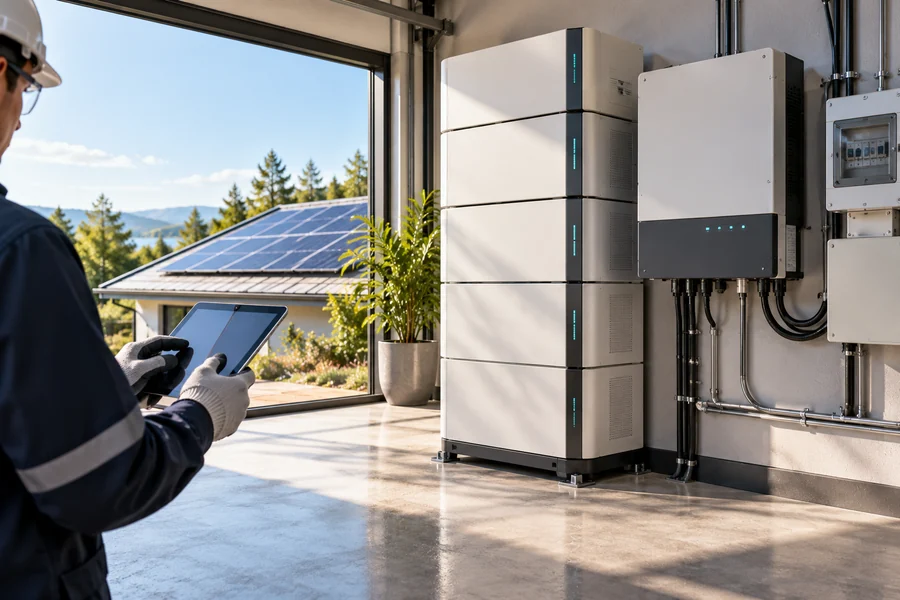
](https://voltcrave-battery.com/wp-content/uploads/2026/10/High-Voltage-LiFePO4-Battery-The-Perfect-Balance-Between-Energy-Density-and-Safety.webp)
Energy storage buyers need high power, long service life, and dependable safety. Choosing the wrong battery architecture can increase electrical losses, installation complexity, and operating risks.
A high-voltage LiFePO4 battery combines lithium iron phosphate chemistry with a higher-voltage battery configuration. It offers good thermal stability, long-cycle-life potential, and efficient high-power system integration. However, higher voltage does not directly increase cell energy density. Its main advantages come from reduced current, improved electrical architecture, and compatible inverter design.
I believe high-voltage LiFePO4 technology provides a practical balance between performance and safety for residential energy storage, commercial battery systems, and renewable power applications.
What Is a High-Voltage LiFePO4 Battery and How Does It Work?
High-voltage battery systems are often described as more advanced than conventional 48V batteries. However, the main difference is the electrical configuration, not a new battery chemistry.
A high-voltage LiFePO4 battery uses lithium iron phosphate cells connected in series to create a higher DC operating voltage. The system normally includes battery modules, a Battery Management System (BMS), electrical protection, monitoring, and compatible power conversion equipment. Higher voltage allows the same power to be delivered with lower current, but it also requires suitable electrical insulation and safety controls.
How Does LiFePO4 Battery Chemistry Work?
LiFePO4 stands for lithium iron phosphate.
It is a lithium-ion battery chemistry that uses lithium iron phosphate as the positive electrode material.
During charging and discharging, lithium ions move between the battery electrodes through the electrolyte.
Electrons travel through the external circuit to supply electrical power.
A typical LiFePO4 cell has a nominal voltage of approximately 3.2V.
Multiple cells can be connected to create the battery voltage and capacity required for an energy storage application.
I consider LiFePO4 especially useful for stationary energy storage because its chemistry provides favorable thermal stability and cycling characteristics.
However, battery chemistry alone does not determine the complete system's safety or service life.
Cell quality, battery management, temperature, electrical protection, and operating conditions are also important.
What Makes a LiFePO4 Battery High Voltage?
Battery voltage increases when cells or modules are connected in series.
For example, consider a simplified battery pack containing 100 LiFePO4 cells connected in series.
Each cell has a nominal voltage of approximately 3.2V.
The nominal pack voltage is:
100 × 3.2V = 320V
The series connection increases voltage.
However, it does not increase the ampere-hour capacity of the string.
I consider this distinction important because buyers sometimes confuse voltage with stored energy.
A high-voltage battery can provide substantial power without requiring the high DC current associated with a lower-voltage configuration.
The term "high voltage" can also have different formal meanings under different electrical standards.
In energy storage marketing, it commonly refers to battery systems operating at hundreds of volts rather than traditional 48V battery banks.
Main Components of a High-Voltage Battery System
A complete high-voltage LiFePO4 battery system commonly includes several components.
| Component | Main Function |
|---|---|
| LiFePO4 Cells | Store electrical energy |
| Battery Modules | Organize cells into manageable assemblies |
| BMS | Monitors cell voltage, current, and temperature |
| Battery Control Unit | Coordinates battery operation |
| Contactors | Provide controlled electrical isolation |
| Current Protection | Protects against specified fault conditions |
| Insulation Monitoring | Helps detect insulation faults where required |
| Thermal Management | Maintains suitable operating temperatures |
| Communication Interface | Supports inverter and EMS coordination |
| Battery Enclosure | Provides mechanical and environmental protection |
I believe system-level engineering is essential.
A high-voltage battery should not be viewed simply as several low-voltage batteries connected together.
Its protection systems must be designed and validated for the complete electrical configuration.
High-Voltage vs. Low-Voltage LiFePO4 Batteries
| Specification | High-Voltage LFP | Low-Voltage LFP |
|---|---|---|
| Common architecture | Hundreds of volts | 48V/51.2V |
| Power delivery current | Lower at equal power | Higher at equal power |
| Battery arrangement | Often series-connected modules | Often parallel expansion |
| Electrical protection | High-voltage-rated components | Suitable low-voltage, high-current components |
| Inverter requirement | Compatible HV inverter | Compatible LV inverter |
| Typical applications | Residential and larger ESS | Smaller solar and backup systems |
| Installation complexity | Requires HV safety design | Requires high-current design |
I do not consider one architecture automatically superior.
The correct choice depends on electrical demand, existing equipment, cost, and system requirements.
Does High Voltage Improve LiFePO4 Battery Energy Density and Efficiency?
Energy density and electrical efficiency are frequently confused. Higher battery voltage can improve some system-level electrical characteristics, but it does not automatically change the chemical energy stored inside each battery cell.
High voltage does not directly increase the gravimetric or volumetric energy density of LiFePO4 cells. Energy density depends mainly on cell chemistry and construction. However, high-voltage architecture reduces current at the same power level, which can lower resistive losses and support efficient system integration when combined with a suitable inverter and electrical design.
What Is Battery Energy Density?
Battery energy density describes how much electricity can be stored relative to the battery's weight or volume.
Two common measurements are:
Gravimetric Energy Density (Wh/kg)
This measures electrical energy per kilogram of battery mass.
Volumetric Energy Density (Wh/L)
This measures electrical energy per liter of battery volume.
I distinguish these from battery capacity.
A 20kWh battery stores more total energy than a 10kWh battery.
However, this does not necessarily mean the 20kWh system has a higher energy density.
It may simply contain more cells.
How Does LiFePO4 Compare With NMC Batteries?
Lithium iron phosphate and nickel manganese cobalt batteries have different characteristics.
NMC batteries generally provide higher cell-level energy density.
LiFePO4 batteries generally offer better thermal stability and strong cycling performance.
| Characteristic | LiFePO4 | NMC |
|---|---|---|
| Cell energy density | Generally lower | Generally higher |
| Thermal stability | Generally favorable | More dependent on composition |
| Cycle-life potential | Often longer | Depends on cell design |
| Cobalt content | No cobalt in LFP cathode | Typically contains cobalt |
| Stationary ESS suitability | Strong | Also used |
| Thermal runaway risk | Still possible | Still possible |
| High-voltage configuration | Possible | Possible |
I believe LFP's value for stationary storage comes from its overall performance balance.
For a home battery or industrial storage cabinet, the highest possible cell energy density may be less important than safety, durability, and lifetime cost.
However, I would not describe LFP as having the highest energy density among mainstream lithium-ion chemistries.
Why Does Higher Voltage Reduce Current?
Electrical power is calculated using:
Power (W) = Voltage (V) × Current (A)
Therefore:
Current (A) = Power (W) ÷ Voltage (V)
Consider two hypothetical battery configurations delivering 10kW of DC power.
System A operates at 51.2V.
System B operates at 400V.
For System A:
10,000W ÷ 51.2V = 195.3A
For System B:
10,000W ÷ 400V = 25A
The higher-voltage system delivers the same electrical power with substantially lower current.
I consider this one of the main benefits of a high-voltage battery architecture.
Lower current can reduce conductor heating and some transmission losses.
However, voltage rating, insulation, switching equipment, and installation safety become more demanding.
How Does Lower Current Affect Electrical Losses?
Resistive electrical losses are related to current.
The basic relationship is:
Power Loss = Current² × Resistance
This means electrical losses in a conductor can increase rapidly as current rises.
For otherwise identical conductor resistance and power transfer conditions, reducing current can significantly lower resistive heating.
However, I would not assume that a 400V battery automatically provides a fixed percentage improvement in total system efficiency.
The actual result depends on:
- Cable length and cross-section
- Electrical contact resistance
- Inverter efficiency
- DC/DC conversion stages
- Battery internal resistance
- Switching equipment
- Operating load
- Thermal management consumption
I recommend comparing complete system efficiency rather than battery voltage alone.
Does High Voltage Increase Battery Capacity?
Not necessarily.
Battery capacity depends on voltage and ampere-hour capacity.
The simplified formula is:
Battery Energy (Wh) = Nominal Voltage (V) × Capacity (Ah)
For example:
A 51.2V battery rated at 100Ah provides:
51.2V × 100Ah = 5,120Wh
A 400V battery rated at 100Ah provides:
400V × 100Ah = 40,000Wh
The second battery stores more energy because its electrical configuration represents substantially more total cell energy, not because voltage alone has improved the chemistry.
I would compare battery weight, volume, usable energy, and complete configuration before evaluating energy density.
Can High-Voltage Systems Be More Compact?
They can be, depending on system design.
Higher voltage may allow more practical high-power connections, lower current, and different power conversion arrangements.
Modular battery stacks can also provide efficient use of installation space.
However, the energy density of the complete cabinet depends on cell packing, cooling, enclosure construction, insulation, and protective equipment.
I believe the real advantage of high-voltage architecture is often better system-level electrical design rather than an automatic increase in cell energy density.
Why Are High-Voltage LiFePO4 Batteries Considered Safer and More Reliable?
Battery safety is a critical concern for residential and commercial energy storage. High-voltage systems contain substantial stored electrical energy, so both battery chemistry and engineering protection must be considered.
LiFePO4 batteries offer favorable thermal stability compared with several other lithium-ion chemistries. Their phosphate-based cathode structure can reduce certain thermal runaway risks, but it cannot eliminate fire, toxic gas, electric shock, or arc-flash hazards. High-voltage battery safety depends on cell quality, BMS protection, electrical isolation, thermal management, and complete-system testing.
Why Is LiFePO4 Chemically Stable?
LiFePO4 uses a phosphate-based positive electrode material.
Its crystal structure provides comparatively strong thermal stability.
This can help reduce the likelihood or severity of certain failure processes compared with some other lithium-ion cell chemistries.
I consider this important for stationary energy storage systems that may operate for many years.
However, LFP cells still contain electrolyte and stored electrical energy.
They can experience thermal runaway under severe electrical, thermal, or mechanical abuse.
The U.S. Department of Energy has specifically cautioned that LFP is not immune to hazardous battery incidents.
I therefore avoid describing any lithium-ion chemistry as completely fireproof.
How Does the Battery Management System Improve Safety?
A high-voltage battery system generally requires coordinated monitoring and protection.
The BMS monitors operating conditions such as:
- Individual cell voltage
- Module voltage
- Battery current
- Battery temperature
- State of charge
- Cell balancing requirements
- Fault conditions
The control system can restrict charging or discharging when operating limits are exceeded.
It may also open contactors to isolate the battery under specified fault conditions.
I believe the quality of the BMS is one of the most important factors in system reliability.
However, a BMS cannot prevent every possible failure.
The battery must also have appropriate physical protection, wiring, thermal design, and emergency safety provisions.
What Additional Risks Does High Voltage Create?
Higher voltage introduces electrical hazards that must be managed carefully.
Potential hazards include electric shock, DC arcing, insulation breakdown, and high-energy short circuits.
I consider these risks especially important because DC arcs can be difficult to interrupt without suitable protection equipment.
High-voltage systems may require:
- High-voltage-rated cables and connectors
- Appropriate fuses and contactors
- Insulation monitoring
- Protective enclosures
- Controlled precharge arrangements
- Electrical isolation procedures
- Suitable grounding and bonding design
- Clearly marked electrical hazards
I recommend using the manufacturer's complete installation and service documentation.
High-voltage battery packs should be installed and serviced by qualified personnel.
I would not recommend connecting incompatible battery modules in series to create a high-voltage system.
What Safety Standards Should Buyers Check?
For North American and international energy storage projects, several standards are important.
| Standard | Main Purpose |
|---|---|
| UL 1973 | Stationary and certain other battery safety |
| UL 9540 | Complete energy storage system safety |
| UL 9540A | Thermal runaway fire-propagation testing |
| UL 1741 | Inverters and related distributed energy equipment |
| IEC 62619 | Industrial lithium battery safety |
| IEC 63056 | Batteries used in electrical energy storage systems |
| NFPA 855 | Energy storage installation safety |
I distinguish battery-level certification from system-level certification.
For example, UL 1973 addresses battery equipment, while UL 9540 evaluates the complete energy storage system.
UL 9540A is a test method, not a replacement for complete UL 9540 certification.
The 2026 edition of NFPA 855 also addresses important installation and fire safety requirements.
I recommend checking the exact certificate, product model, and approved system configuration rather than relying on a manufacturer's general compliance statement.
Does High Voltage Reduce Battery Fire Risk?
I would not make that claim.
A high-voltage system does not become chemically safer simply because its cells are connected in series.
The chemistry remains LiFePO4, while the voltage-related electrical hazards increase.
The safety advantages commonly associated with high-voltage LFP storage come from combining thermally stable chemistry with well-engineered system protection.
I therefore evaluate complete battery safety rather than assuming that high voltage itself reduces fire risk.
Where Are High-Voltage LiFePO4 Batteries Used, and How Do You Choose the Right System?
High-voltage lithium iron phosphate batteries are increasingly used in renewable energy and backup applications. However, choosing a suitable system requires more than comparing storage capacity.
High-voltage LiFePO4 batteries are widely used in residential solar storage, commercial and industrial energy storage, hybrid inverter systems, and higher-power backup applications. Buyers should evaluate operating voltage, usable capacity, continuous power, inverter compatibility, battery management, safety certification, scalability, and long-term technical support before selecting a system.
Residential Solar Battery Storage
High-voltage LFP batteries are used with compatible residential hybrid inverters.
They can store excess solar electricity and supply household loads when needed.
For example, the BYD Battery-Box Premium HVS uses modular battery units connected in series.
Its published configurations offer approximately 5.1–12.8kWh of usable storage per tower.
The larger HVM family offers approximately 8.1–21.7kWh in its currently described configurations.
I consider these examples useful because they demonstrate how modular high-voltage battery platforms can scale according to household energy requirements.
However, the available configurations and compatible inverter models must be verified for the target market.
Commercial and Industrial Energy Storage
Commercial facilities may use batteries for peak demand management, backup power, and solar energy self-consumption.
Industrial loads can require substantial electrical power.
High-voltage battery architectures can be appropriate when integrated with suitably rated power conversion systems.
For example, commercial battery cabinets may operate at several hundred volts DC or higher.
I consider lower operating current valuable when systems must transfer substantial electrical power.
However, industrial energy storage also requires appropriate thermal management, monitoring, electrical isolation, and emergency planning.
The system must be designed for the actual facility loads.
High-Voltage Battery Integration With Hybrid Inverters
I believe inverter compatibility is one of the most important selection factors.
A high-voltage battery cannot automatically operate with every hybrid inverter.
The equipment must support compatible:
- DC operating voltage
- Maximum charging and discharging current
- Battery communication protocol
- BMS software and firmware
- Battery capacity configuration
- Backup operating modes
- Electrical protection requirements
Some manufacturers publish lists of approved battery and inverter combinations.
I recommend reviewing those documents before purchasing.
A battery may have suitable nominal voltage but still be incompatible because of communication or software requirements.
High-Voltage vs. 48V Battery Selection
I generally evaluate high-voltage systems when the installation requires substantial output power or the selected inverter platform is designed for high-voltage batteries.
I consider 48V systems practical for many smaller off-grid applications, telecommunications equipment, and modular battery installations.
The better choice depends on the complete electrical architecture.
| Application | Suitable Starting Point |
|---|---|
| Small off-grid cabin | 48V LiFePO4 |
| Telecom backup | 48V LiFePO4 |
| Smaller residential backup | Either, depending on inverter |
| High-power residential solar ESS | High-voltage LFP worth evaluating |
| Commercial solar storage | Engineered high-voltage system |
| Industrial peak management | Engineered high-voltage BESS |
| Large containerized storage | Project-specific high-voltage BESS |
I would not choose voltage solely because one product is marketed as more advanced.
The system must meet electrical, economic, and installation requirements.
How Much Battery Capacity Do You Need?
I begin with the required energy and operating duration.
The simplified formula is:
Required AC Energy (kWh) = Average Load (kW) × Runtime (hours)
Suppose a commercial facility requires an average of 5kW for four hours.
The electrical energy requirement is:
5kW × 4 hours = 20kWh
Assume:
- Usable battery discharge fraction: 90%
- AC delivery efficiency: 90%
The nominal battery capacity requirement becomes:
20kWh ÷ (0.90 × 0.90) = 24.7kWh
I would therefore evaluate a system with approximately 25kWh or more of nominal storage, plus appropriate operating reserves.
The inverter must also support the facility's continuous and peak power requirements.
What Should B2B Buyers Verify?
For distributors, solar installers, and energy storage system integrators, I consider the following technical information essential.
| Procurement Factor | What I Check |
|---|---|
| Battery Chemistry | Verified LiFePO4 cell specifications |
| Nominal Voltage | Complete operating voltage range |
| Battery Capacity | Nominal and usable kWh |
| Power Capability | Continuous charge/discharge limits |
| Battery Management | Cell monitoring and fault protection |
| Inverter Compatibility | Approved models and firmware |
| Communication | CAN, RS485, or supported protocols |
| Thermal Management | Cooling, heating, and temperature limits |
| Safety Certification | Applicable battery and system approvals |
| Expansion | Approved series and parallel configurations |
| Warranty | Years, throughput, and retained capacity |
| Technical Support | Manuals, commissioning, and service |
I recommend requesting complete datasheets, wiring diagrams, operating manuals, and relevant test reports before placing substantial orders.
For international projects, I also verify regional electrical standards and installation requirements.
A well-documented high-voltage battery system can reduce integration uncertainty and improve long-term project reliability.
My Insights: High-Voltage LiFePO4 Battery—The Perfect Balance Between Energy Density and Safety
High-voltage LiFePO4 batteries are often promoted as having superior energy density and safety. However, these benefits come from different aspects of battery design, and they should not be treated as interchangeable advantages.
I believe high-voltage LiFePO4 batteries provide an attractive balance for stationary energy storage because they combine the thermal stability and cycling potential of LFP chemistry with the lower-current advantages of high-voltage architecture. However, high voltage does not directly improve cell energy density, and complete-system safety depends on engineering quality, protection equipment, and verified certification.
I Separate Battery Chemistry From Electrical Architecture
I believe this is the most important technical distinction.
LiFePO4 chemistry determines many of the battery's electrochemical characteristics.
These include thermal stability, voltage behavior, energy density, and cycling performance.
High-voltage architecture determines how cells and modules are electrically connected.
It influences current levels, inverter integration, wiring requirements, and electrical safety design.
I do not consider high voltage an improvement to the chemistry itself.
A 400V LFP system still uses LFP cells.
Its potential advantages come from the overall electrical configuration.
I Evaluate System-Level Efficiency Instead of Voltage Alone
I also believe buyers should avoid assuming that high voltage guarantees a fixed efficiency improvement.
Lower current can reduce resistive losses.
However, actual system performance depends on power conversion, thermal management, cable design, and operating conditions.
A high-voltage battery with poorly matched conversion equipment may not outperform a well-designed low-voltage system in every application.
I prefer comparing complete system data.
This includes AC-to-AC round-trip efficiency, inverter efficiency, auxiliary power consumption, and usable battery capacity under specified operating conditions.
Safety Requires More Than Stable Chemistry
I consider LFP's thermal stability a meaningful advantage.
However, I do not believe any lithium-ion battery should be described as completely safe from thermal runaway.
High-voltage battery systems also introduce additional electrical hazards.
A properly engineered battery should combine cell-level safety with suitable BMS controls, insulation, fault protection, and thermal management.
I also evaluate the complete product's certification status.
For North American stationary ESS projects, UL 9540 system-level certification can be especially important.
For international battery projects, IEC 62619 and IEC 63056 may also be relevant.
Energy Density Should Be Evaluated at the Correct Level
I believe energy density comparisons must distinguish between cells, modules, and complete battery systems.
A battery cell may have one Wh/kg specification.
A finished battery cabinet includes enclosures, wiring, cooling, contactors, and control equipment.
These components affect the system's overall energy density.
High-voltage architecture may help optimize some parts of the installation, but it does not automatically increase the energy stored per kilogram of cells.
I therefore compare usable system energy against complete installed weight and volume when evaluating battery cabinets.
Long-Term Value Depends on Compatibility and Reliability
I also consider inverter compatibility and future serviceability important.
A high-voltage battery may offer strong performance but require a specific inverter family or communication protocol.
This can influence installation flexibility.
I recommend checking approved inverter lists and expansion requirements before purchasing.
I also evaluate whether the manufacturer provides reliable technical support, firmware updates, and replacement components.
For B2B projects, these factors can reduce integration problems and long-term service costs.
My Final Recommendation
I evaluate high-voltage LiFePO4 battery systems using five connected factors:
Cell Chemistry → Electrical Architecture → System Efficiency → Safety Protection → Lifetime Value
For high-power residential storage and commercial battery applications, I would consider high-voltage LFP technology a strong option.
For smaller 48V backup installations, a low-voltage LiFePO4 system may remain practical and economical.
I would not select either architecture until I had verified power requirements, battery capacity, inverter compatibility, and safety documentation.
Ultimately, I believe high-voltage LiFePO4 batteries achieve their most valuable balance through stable chemistry, efficient electrical design, and verified system safety—not through higher voltage alone.
Conclusion
High-voltage LiFePO4 batteries combine stable chemistry with efficient power delivery. Choose systems based on energy capacity, inverter compatibility, safety certification, and long-term reliability.
](https://voltcrave-battery.com/wp-content/uploads/2026/06/What-Is-a-Commercial-Energy-Storage-System-768x512.jpg)
](https://voltcrave-battery.com/wp-content/uploads/2026/08/Is-a-240V-Portable-Power-Station-Necessary-for-Home-Backup-768x512.webp)
](https://voltcrave-battery.com/wp-content/uploads/2026/08/What-Are-the-Two-Types-of-Energy-Storage-Systems-768x512.webp)







































