

](https://voltcrave-battery.com/wp-content/uploads/2026/08/What-Is-an-All-in-One-Energy-Storage-System.webp)
Separate batteries, inverters, controllers, and protection devices can make energy storage installation complex, expensive, and difficult to maintain.
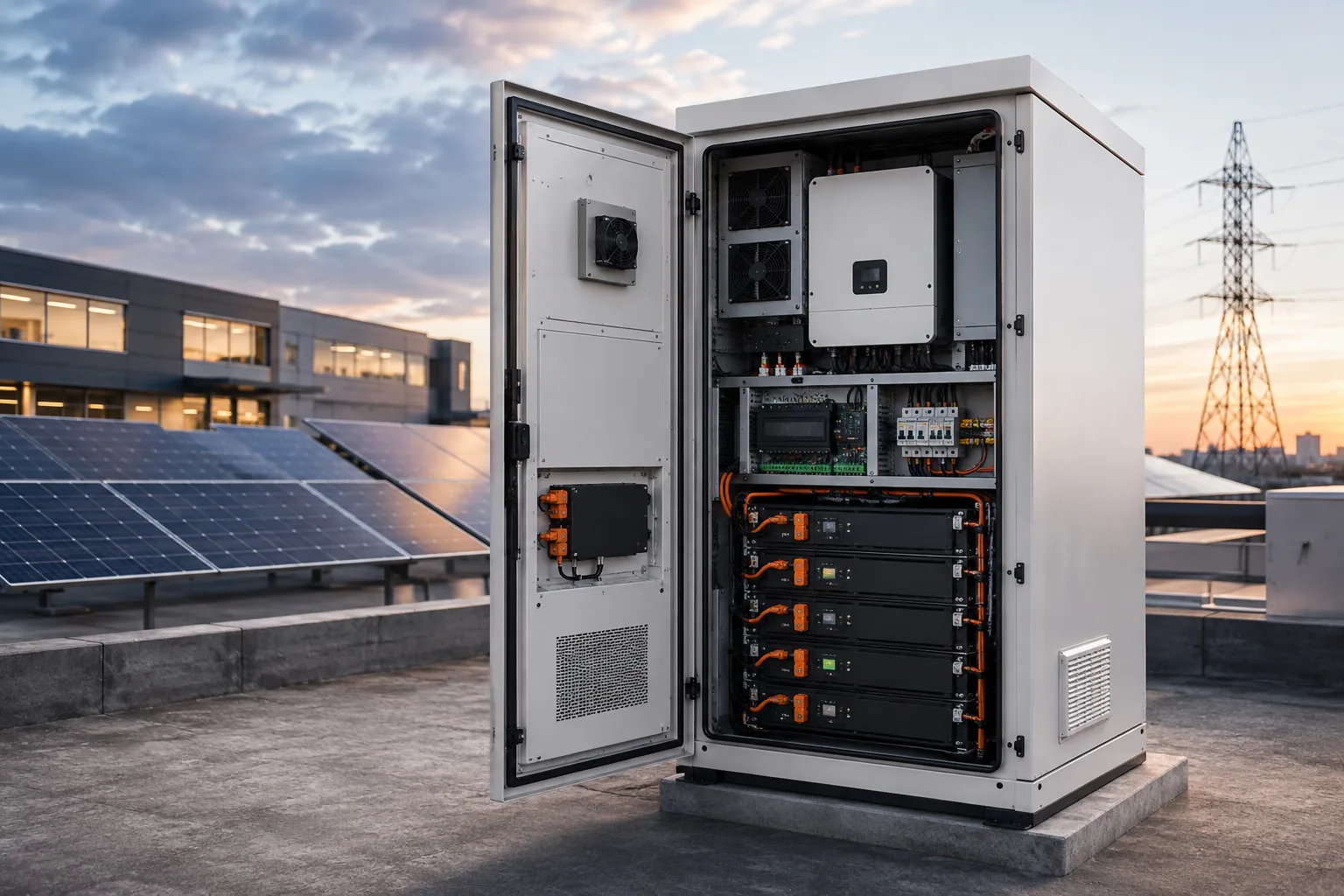
An all-in-one energy storage system is an integrated solution that combines battery storage, a bidirectional or hybrid inverter, BMS, energy controls, protection, and monitoring within one coordinated system. It can store solar or grid electricity, power loads, provide backup during outages, and simplify installation compared with separately designed battery and inverter systems.
I see an all-in-one ESS as a pre-integrated energy platform rather than simply a battery cabinet. The exact components differ between residential, commercial, and industrial products, but the main idea is the same: the manufacturer integrates most of the major storage and power-conversion components before the equipment reaches the installation site.
What Components Are Included in an All-in-One Energy Storage System?
The word “all-in-one” does not mean that every electrical component in an entire building is physically inside one box. It means the main battery-storage subsystems are integrated into one coordinated product or cabinet.
A typical all-in-one ESS includes a lithium battery, battery management system, hybrid or bidirectional inverter, energy-management controls, electrical protection, communications, and monitoring. Larger commercial systems may also integrate thermal management, fire detection, switchgear, and other balance-of-system equipment. The exact system boundary should always be confirmed from the manufacturer's technical documentation.
Battery Storage
The battery is the energy-storage section.
In most modern residential and small commercial systems, I commonly see lithium-ion batteries, especially lithium iron phosphate or LFP.
The battery stores electricity as DC energy.
It may charge from:
- Solar PV
- Utility grid
- Generator
- Other compatible power sources
It later releases that stored energy when electricity is needed.
Battery capacity is normally expressed in:
kWh for residential and small commercial systems
or
MWh for larger commercial and utility systems
The battery itself is only one part of an all-in-one ESS.
Battery Management System
The BMS protects and monitors the battery.
It typically watches:
- Cell voltage
- Pack voltage
- Current
- Temperature
- State of charge
- State of health
- Cell balance
- Fault conditions
The BMS communicates operating limits to the inverter or system controller.
For example, if the battery becomes too hot, the BMS may reduce the permitted charge or discharge current.
I therefore treat the BMS as the local battery protection layer rather than the overall energy-management brain.
Hybrid or Bidirectional Inverter
The inverter is another major component.
Batteries store DC electricity.
Homes, commercial buildings, and utility grids primarily use AC electricity.
The inverter converts between the two.
During discharge:
Battery DC → inverter → AC loads/grid
During AC charging:
Grid AC → inverter → battery DC
DOE explains that solar-plus-storage systems use bidirectional inverters to connect battery storage with PV and the electrical system. In a DC-coupled configuration, battery and solar can share a bidirectional inverter architecture.
Many all-in-one products use a hybrid inverter because it can coordinate:
- Solar
- Battery
- Utility grid
- Backup loads
This reduces the number of separate power-conversion devices required.
Energy Management and Monitoring
The system also needs control logic.
I use the EMS or integrated controller to determine when the battery should:
- Charge
- Discharge
- Maintain backup reserve
- Export electricity
- Limit grid purchases
- Use solar directly
- Respond to electricity tariffs
Monitoring software can provide:
- Battery SOC
- Solar production
- Household consumption
- Grid imports
- Grid exports
- System alarms
- Historical energy data
This control layer is what turns a group of electrical components into a coordinated energy system.
How Does an All-in-One Energy Storage System Work?
An all-in-one ESS continuously manages energy flowing between generation, storage, loads, and the utility grid.
During normal operation, an all-in-one ESS can use solar electricity to power loads and charge its battery. When solar production falls, the battery can discharge to reduce grid consumption. During an outage, a backup-capable system can isolate from the utility grid and continue supplying protected loads if the inverter and system controls support islanded operation.
Daytime Solar Operation
Consider a home with rooftop solar.
At midday, the solar array produces:
8 kW
The house consumes:
3 kW
The remaining:
5 kW
can potentially charge the battery if the system has available storage capacity.
The flow becomes:
Solar → home loads
and
Excess solar → battery
If the battery becomes full, additional solar may be exported to the grid or curtailed depending on the system configuration and local rules.
Evening Battery Operation
After sunset, solar production drops.
The house may still consume:
2 kW
Instead of immediately buying all of that electricity from the grid, the ESS can discharge:
Battery → inverter → home
This increases solar self-consumption.
It can also reduce electricity purchases during expensive time-of-use periods.
Outage Operation
A backup-capable all-in-one ESS can operate differently when the utility grid fails.
DOE notes that advanced solar-plus-storage inverters can operate without grid support when systems are designed for outage operation.
A simplified sequence is:
- Grid outage occurs.
- Backup controls detect the failure.
- The system isolates the protected electrical network from the utility.
- The battery inverter establishes local AC voltage and frequency.
- The battery supplies the protected loads.
- Compatible solar can continue producing electricity.
- Excess solar can recharge the battery.
- The system reconnects safely when grid service returns.
This is why I distinguish an all-in-one energy storage system from an ordinary battery.
The battery stores energy.
The complete system controls how that energy enters and leaves the building.
What Is the Difference Between an All-in-One ESS and a Separate Battery and Inverter?
The main difference is the level of factory integration.
An all-in-one ESS combines the battery, inverter, control system, and related equipment into a pre-integrated package. A modular system uses separately selected batteries, inverters, controllers, and protection equipment. All-in-one systems usually simplify installation and compatibility, while modular designs can provide more component choice, service flexibility, and customization.
Architecture Comparison
| Feature | All-in-One ESS | Separate Components |
|---|---|---|
| Battery | Integrated or factory-matched | Selected separately |
| Inverter | Integrated | Separate |
| BMS communication | Pre-engineered | Must be verified |
| EMS/control | Usually integrated | May require separate controller |
| Installation | Generally simpler | More engineering required |
| Wiring | Reduced | More field wiring |
| Compatibility | Factory validated | Installer must confirm |
| Customization | More limited | Usually greater |
| Expansion | Product-dependent | Often more flexible |
| Service | System-level | Component-level possible |
I would not say that one architecture is universally better.
They solve different problems.
All-in-One Prioritizes Simplicity
An integrated system reduces the number of equipment interfaces that an installer must design in the field.
Instead of selecting:
- Battery brand A
- Inverter brand B
- Controller brand C
- Monitoring platform D
the installer receives a coordinated system.
That can reduce:
- Compatibility problems
- Communication configuration
- Installation labor
- Commissioning time
- Troubleshooting complexity
Current all-in-one products are specifically marketed around pre-integration and reduced installation complexity.
Modular Systems Prioritize Flexibility
A separate-component system can be better when I need unusual requirements.
For example, I may want:
- A particular inverter manufacturer
- A specific battery chemistry
- Much larger battery capacity
- Different batteries in the future
- Easier component-level replacement
The all-in-one approach is strongest when the project fits a standardized architecture.
Modular systems can be stronger when the design must be highly customized.
Is an All-in-One ESS the Same as a Hybrid Inverter?
No. A hybrid inverter is an important component, but it is not automatically a complete energy storage system.
A hybrid inverter manages power between solar panels, batteries, the grid, and electrical loads. An all-in-one ESS includes the energy-storage battery as well as the inverter and supporting management systems. A hybrid inverter may still require an external battery cabinet, while an all-in-one system is designed as a complete or closely integrated storage package.
Hybrid Inverter Means Power Conversion
The hybrid inverter performs electrical conversion and energy routing.
It may contain:
- Solar MPPT inputs
- Battery DC interface
- Grid AC interface
- Backup AC output
- Grid synchronization
- Charging controls
However, it may not physically contain the battery.
A homeowner could therefore purchase a hybrid inverter today and add compatible battery modules later.
All-in-One Means System Integration
An all-in-one ESS goes further.
A typical architecture may be:
PV → integrated hybrid inverter
Battery ↔ integrated inverter
Grid ↔ integrated inverter
Integrated inverter → household loads
all coordinated by one control and monitoring platform.
This is why I think of “hybrid inverter” as a component category and “all-in-one ESS” as a product architecture.
What Are the Advantages of an All-in-One Energy Storage System?
The strongest advantage is reduced integration complexity.
All-in-one energy storage systems can simplify installation, reduce field wiring, minimize compatibility problems, consolidate monitoring, save equipment space, and make procurement easier. Factory-matched batteries and inverters can also simplify commissioning because communication protocols, power limits, and operating modes are already designed to work together.
Faster Installation
Traditional systems may require installation teams to mount and connect several independent components.
An all-in-one cabinet can reduce the amount of:
- DC cabling
- Communication wiring
- Wall equipment
- External control hardware
This does not mean installation becomes completely plug-and-play.
Electrical codes, permits, grid interconnection, backup isolation, and professional commissioning are still required.
However, pre-integration can remove a large amount of project-specific engineering.
Smaller Footprint
Integration can also reduce physical space.
Separate battery and inverter systems may require:
- Battery cabinet
- Inverter cabinet
- Controller
- External disconnects
- Multiple cable routes
An integrated system can place several of these functions inside one enclosure.
This can be valuable for:
- Homes
- Garages
- Small businesses
- Retail buildings
- Telecom sites
- Space-constrained commercial projects
One Monitoring Platform
Another advantage is data integration.
If the inverter, battery, BMS, and energy controller come from the same ecosystem, the monitoring system can display the complete energy flow.
I can often see:
Solar generation → load consumption → battery SOC → grid import/export
from one application or web portal.
This simplifies both owner operation and technician troubleshooting.
What Are the Disadvantages of an All-in-One Energy Storage System?
Integration creates convenience, but it can also reduce flexibility.
The main disadvantages of an all-in-one ESS are vendor dependence, less freedom to mix components, possible difficulty replacing individual subsystems, fixed inverter-to-battery sizing, and product-specific expansion limits. If one integrated component becomes obsolete or fails, the owner may depend heavily on the original manufacturer for compatible replacement parts and software support.
Vendor Lock-In Can Matter
Suppose I purchase an integrated battery and inverter system.
Five years later, I want to add battery capacity.
I may discover that only the manufacturer's own expansion battery is supported.
A modular system could potentially offer more choices.
I therefore check:
- Maximum battery expansion
- Compatible future modules
- Firmware support
- Replacement inverter availability
- Communication protocols
- Warranty transfer
- Manufacturer service network
before buying.
Component Replacement Can Be More Complicated
Integration reduces wiring, but it can increase dependency between components.
If the battery, inverter, and controller are tightly packaged together, replacing only one subsystem may be more complicated than in a modular installation.
This does not automatically make an integrated system unreliable.
It means I pay more attention to:
- Warranty length
- Manufacturer stability
- Local service support
- Spare parts
- Remote diagnostics
Fixed Ratios May Not Suit Every Project
Consider an all-in-one system with:
10 kW inverter + 20 kWh battery
That gives a nominal power-to-energy relationship of:
20 kWh ÷ 10 kW = 2 hours
A particular project might instead need:
5 kW inverter + 30 kWh battery
for longer backup.
If the manufacturer does not support that configuration, a modular system may fit better.
Where Are All-in-One Energy Storage Systems Used?
All-in-one systems are most attractive where standardized deployment and simple integration are important.
All-in-one ESS products are used in homes, small businesses, commercial buildings, telecom sites, off-grid properties, solar-plus-storage projects, EV charging locations, and some industrial applications. Residential products emphasize compact backup and solar integration, while commercial all-in-one BESS products may integrate larger battery blocks with control and energy-management systems.
Residential Energy Storage
A home all-in-one ESS may provide:
- Solar self-consumption
- Time-of-use optimization
- Backup power
- Whole-home or essential-load backup
- Grid export
- Energy monitoring
Typical residential systems may range from roughly:
5–30+ kWh
depending on the product and expansion architecture.
Small Commercial Applications
Small businesses may use integrated storage for:
- Peak shaving
- Solar shifting
- Backup
- EV charging support
- Demand management
Honeywell, for example, introduced an all-in-one modular battery storage platform for commercial and industrial applications in 2025, combining flexible battery storage with integrated control capabilities.
This shows that the all-in-one concept is moving beyond residential products.
Off-Grid and Weak-Grid Applications
All-in-one ESS designs are also useful where grid supply is unreliable.
A system can coordinate:
Solar + battery + grid + generator
The battery can supply short outages silently.
Solar can recharge it during the day.
A generator can become the final backup source during extended periods of poor weather or low battery SOC.
This integrated control strategy can be simpler than operating several independent systems.
How Do I Size an All-in-One Energy Storage System?
I size the battery and inverter separately even when they are physically integrated.
To size an all-in-one ESS, I calculate required battery energy in kWh and required power in kW. Battery capacity determines how long loads can operate, while inverter power determines which appliances can operate simultaneously. Solar capacity, outage duration, electricity tariffs, and expected future loads should also be included in the design.
Energy Determines Runtime
Suppose my protected loads consume:
1.5 kW average
and I need:
8 hours of backup
The basic energy requirement is:
1.5 kW × 8 h = 12 kWh
I would then add margin for:
- Conversion losses
- Minimum battery reserve
- Battery aging
- Uncertain consumption
I might therefore evaluate a system around:
15 kWh
rather than exactly 12 kWh.
Power Determines What Can Run
Now suppose the house contains:
- Refrigerator
- Well pump
- Microwave
- Air conditioner
These loads may briefly require much more than the average 1.5 kW.
If peak simultaneous demand reaches 8 kW, a 15 kWh battery with only a 5 kW inverter may not provide acceptable whole-home backup.
I therefore need:
kWh for duration
and
kW for instantaneous demand
DOE also distinguishes battery energy capacity from inverter power in its solar-plus-storage explanations.
What Should I Check Before Buying an All-in-One ESS?
A clean cabinet does not guarantee a good storage system.
I check usable battery capacity, continuous and surge power, chemistry, solar-input capability, backup operation, efficiency, expansion, BMS design, thermal management, certification, warranty, installation requirements, software, and local service. I also confirm exactly which components are truly integrated because manufacturers can use “all-in-one” differently.
My All-in-One ESS Checklist
| Feature | What I check |
|---|---|
| Battery capacity | Nominal and usable kWh |
| Inverter power | Continuous and surge kW |
| Chemistry | LFP or other chemistry |
| Solar input | PV voltage, current, and MPPT limits |
| Grid charging | Supported charging power |
| Backup | Whole-home or essential loads |
| Output voltage | Compatible with local electrical system |
| BMS | Cell monitoring and protection |
| EMS | Tariff and energy optimization |
| Expansion | Maximum future kWh |
| Cooling | Passive, fan, or liquid cooling |
| Monitoring | Local and remote access |
| Certification | Applicable local system standards |
| Warranty | Years, throughput, capacity retention |
| Service | Installer and spare-part availability |
Certification Matters at System Level
An integrated product combines multiple electrical and battery subsystems, so I look at the complete system's certifications rather than only checking individual cells.
In the United States, solar and battery equipment can involve standards covering inverters, interconnection, battery systems, and complete energy storage systems.
The exact requirements depend on:
- System type
- Installation location
- Jurisdiction
- Grid connection
- Indoor/outdoor placement
I would confirm these requirements with the installer and local authority before procurement.
My Insights: What Is an All-in-One Energy Storage System
I believe the real value of an all-in-one ESS is not simply putting several components inside the same enclosure. Its value comes from making those components operate as one validated energy platform.
An all-in-one energy storage system combines battery storage, bidirectional power conversion, BMS, controls, protection, and monitoring into one coordinated solution. I see its main advantage as reduced integration complexity: the battery, inverter, communications, and software are designed together, which can simplify installation, commissioning, backup operation, solar integration, and long-term energy management.
Integration Is More Important Than Appearance
Two products can both look like single cabinets.
One may contain:
- Battery
- Inverter
- BMS
- EMS
- Solar MPPT
- Backup controls
Another may contain only:
- Battery
- Basic inverter
Both could be marketed as “all-in-one.”
I therefore ask for a block diagram.
That diagram tells me where:
- Solar connects
- Grid connects
- Battery connects
- Backup loads connect
- Protection occurs
- Communications occur
I find this much more useful than the marketing name.
All-in-One Systems Reduce Integration Risk
In a modular design, the installer takes greater responsibility for making several products communicate correctly.
The installer must check:
- Battery voltage compatibility
- CAN or RS485 communications
- Charge limits
- Discharge limits
- Firmware compatibility
- Inverter settings
An integrated ESS transfers more of that validation to the manufacturer.
That can reduce field problems.
For standardized residential and commercial deployments, I consider this one of the strongest reasons to choose an all-in-one architecture.
Modular Systems Still Have an Important Advantage
I would not assume greater integration always means better engineering.
A large industrial project may need:
- Special inverter sizing
- Independent battery replacement
- Multiple battery suppliers
- Custom transformers
- Unusual operating strategies
A modular system gives the engineering team more freedom.
My decision therefore depends on the project.
If I value:
fast deployment + predictable configuration + simple installation
I lean toward all-in-one.
If I value:
maximum customization + component independence + flexible future replacement
I consider modular architecture more seriously.
The Future Is Moving Toward More Integration
I expect energy-storage systems to become increasingly integrated because batteries are becoming active parts of complete energy platforms.
Modern systems already combine:
- Storage
- Solar conversion
- Backup
- Smart load control
- Energy optimization
- Grid interaction
DOE notes that modern inverters increasingly perform monitoring and grid-support functions in addition to basic power conversion.
Commercial suppliers are also introducing more integrated BESS platforms. Honeywell's 2025 Ionic Modular All-in-One product is one example of this shift toward factory-integrated storage and control for C&I applications.
For me, this points to a broader change.
The energy storage system is evolving from:
Battery + separate electrical equipment
into:
A coordinated energy-management appliance
That is the real meaning of an all-in-one ESS.
Conclusion
An all-in-one ESS integrates batteries, inverter functions, BMS, controls, protection, and monitoring into one coordinated platform, simplifying solar storage, backup power, installation, and energy management.
](https://voltcrave-battery.com/wp-content/uploads/2026/08/How-Is-a-Solar-Panel-Made-768x512.webp)
](https://voltcrave-battery.com/wp-content/uploads/2026/08/Are-Solar-Batteries-Worth-It-in-2026-768x512.webp)
](https://voltcrave-battery.com/wp-content/uploads/2026/09/What-Can-You-Run-Off-a-2000W-Pure-Sine-Wave-Inverter-768x512.webp)