
](https://voltcrave-battery.com/wp-content/uploads/2026/10/What-Is-a-Mobile-BESS-EV-Charging-Station-Complete-Guide-2026.webp)
Installing conventional EV charging stations can be expensive and time-consuming. Limited grid capacity, delayed utility connections, and high power demand often make temporary charging difficult.
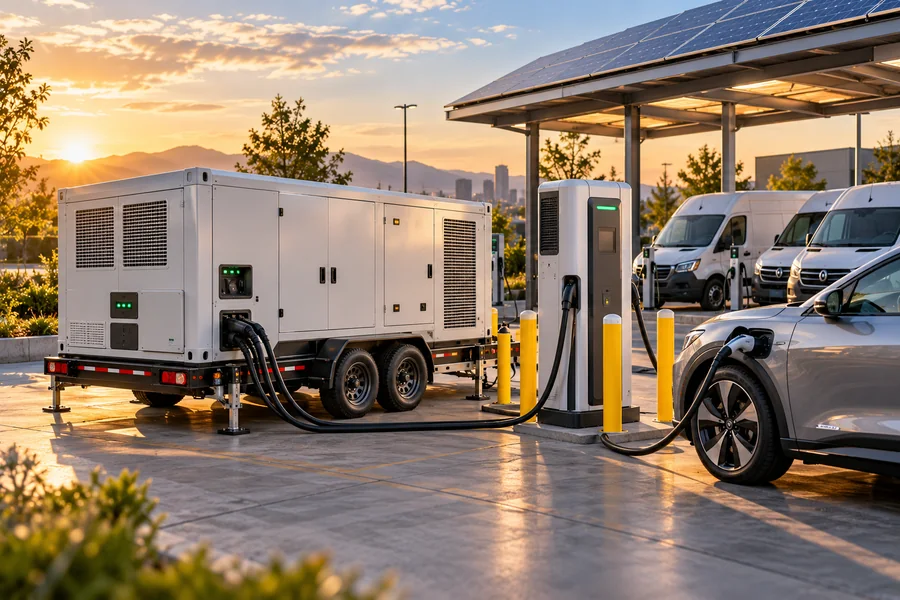
A Mobile BESS EV Charging Station is a transportable electric vehicle charging system that combines battery energy storage with compatible EV charging equipment. It stores electricity from the grid, solar panels, or generators and delivers it to electric vehicles when needed. This makes temporary and high-power charging possible where permanent charging infrastructure is unavailable or insufficient.
Mobile BESS supports flexible EV charging through stored energy, power conversion, and intelligent management, enabling temporary off-grid operation while requiring periodic recharging from available sources.
What Is a Mobile BESS EV Charging Station and What Are Its Main Components?
Permanent EV charging infrastructure requires suitable electrical connections, charging equipment, installation space, and sometimes utility upgrades. These requirements can delay charging projects when vehicles need electricity immediately.
A mobile BESS EV charging station integrates a battery storage system, electrical protection, power conversion equipment, and EV charging functionality into a transportable solution. The equipment may be mounted on a trailer, skid, vehicle, or relocatable platform. It can operate independently using stored energy or work with available grid and generation sources.
Main Components of a Mobile BESS EV Charging Station
A complete mobile charging system generally contains several interconnected components.
| Component | Main Function |
|---|---|
| Battery Energy Storage System | Stores electrical energy |
| Battery Management System (BMS) | Monitors battery voltage, current, and temperature |
| Power Conversion Equipment | Converts and regulates electrical power |
| DC Fast Charger | Delivers controlled DC charging power to EV batteries |
| Energy Management System (EMS) | Coordinates energy storage and charging operations |
| Thermal Management | Maintains suitable operating temperatures |
| Protection Equipment | Provides electrical isolation and fault protection |
| Mobile Enclosure | Supports transportation and site deployment |
I consider the complete system architecture more important than battery capacity alone.
A battery may store substantial electrical energy but still require suitable charging equipment before it can charge an electric vehicle.
Battery Energy Storage System
The battery is the main energy storage component.
Many modern mobile BESS designs use lithium iron phosphate (LiFePO4) cells because of their cycle-life potential and thermal stability.
The BMS monitors battery conditions and helps protect the system from operating outside its specified limits.
Battery storage capacity is measured in kilowatt-hours (kWh).
For example, a 300 kWh battery system has a nominal energy capacity of 300 kilowatt-hours.
However, the amount of electricity ultimately delivered to electric vehicles depends on usable capacity, conversion losses, and operating reserves.
EV Charging and Power Conversion Equipment
The charging equipment controls electricity delivery to connected vehicles.
A DC fast charging system regulates output voltage and current according to the vehicle's charging requirements and the charger's capabilities.
The system may use DC-to-DC conversion or a combination of AC and DC power conversion stages, depending on its design.
I always check the electrical architecture rather than assuming every mobile BESS includes the same charging hardware.
For example, a standalone battery trailer without integrated EV charging equipment is not automatically a complete EV charging station.
Energy Management and Mobility
The EMS coordinates how stored energy is used.
It may monitor battery state of charge, charging sessions, output power, and available recharging sources.
The mobile enclosure allows operators to transport equipment between charging locations.
This is particularly valuable for commercial EV fleets, temporary depots, and locations awaiting permanent electrical infrastructure.
However, mobility does not eliminate the need for suitable site preparation, electrical protection, and applicable approvals.
How Does a Mobile BESS EV Charging Station Work?
Electric vehicles require controlled electrical power to recharge their batteries. Conventional fast chargers usually draw electricity directly from the utility grid, but that connection may be unavailable or insufficient.
A mobile BESS EV charging station works by storing electricity in rechargeable batteries and supplying it through compatible charging equipment. The system charges its batteries from an available energy source, monitors stored energy through the BMS and EMS, and delivers regulated electricity to connected vehicles. This allows EV charging even when grid power is temporarily unavailable.
Step 1: Charge the Mobile Battery System
The mobile BESS must receive electricity before it can supply energy to electric vehicles.
Possible charging sources include:
- Utility grid connections
- Compatible solar photovoltaic systems
- Diesel or other generators
- Suitable fixed charging infrastructure
- Other approved electrical generation systems
The available charging methods depend on the manufacturer's design.
For example, a mobile charging trailer may recharge at a depot overnight and travel to a fleet location the following day.
A grid-connected system may also charge during periods when electricity demand or energy prices are lower.
I consider the battery recharging plan essential because energy storage does not generate electricity independently.
Step 2: Store and Manage Electrical Energy
During charging, the battery stores electrical energy through reversible electrochemical reactions.
The BMS monitors battery operating conditions and helps maintain operation within specified limits.
The EMS may track battery state of charge, expected charging demand, and available charging power.
For a fleet depot, the EMS can also help operators decide when to charge vehicles and when to recharge the battery system itself.
Step 3: Deliver DC Charging Power to Electric Vehicles
When an electric vehicle connects to the charging equipment, the vehicle and charger communicate to establish compatible charging conditions.
The charging system then delivers DC electricity within the limits of the charger, battery storage system, connector, and vehicle.
In North America, supported DC charging interfaces may include CCS1 and SAE J3400/NACS, depending on the equipment and vehicle.
I do not assume that every mobile station supports every vehicle.
Charging compatibility must be verified for the actual charging connector and communication protocol.
Step 4: Recharge the Mobile BESS
Once the battery reaches its operating reserve, the station needs additional energy.
The operator may recharge the system on-site, transport it to a charging facility, or exchange it with a charged unit if the service provider supports that method.
For continuous fleet operation, this logistics plan can be as important as the equipment's rated charging power.
How Much Energy Can a Mobile BESS Deliver?
Consider a hypothetical system with the following specifications:
| Parameter | Example Value |
|---|---|
| Nominal battery capacity | 300 kWh |
| Usable discharge fraction | 85% |
| Assumed energy delivery efficiency | 90% |
| Energy available to EVs | 229.5 kWh |
| Energy supplied per charging session | 40 kWh |
| Theoretical number of sessions | 5 complete sessions |
The available energy is calculated as:
300 kWh × 0.85 × 0.90 = 229.5 kWh
If each vehicle receives 40 kWh:
229.5 kWh ÷ 40 kWh = 5.74 sessions
This means the battery could theoretically support five complete 40 kWh charging sessions under the stated assumptions, with some energy remaining.
Real-world results depend on temperature, charging losses, battery condition, vehicle demand, and reserve settings.
I would not interpret this example as a guaranteed number of vehicles for every 300 kWh mobile charging system.
What Are the Main Applications and Benefits of Mobile BESS EV Charging Stations?
EV charging demand is expanding beyond permanent public charging facilities. Fleets, construction projects, temporary parking areas, and commercial facilities may need charging before fixed infrastructure becomes available.
Mobile BESS EV charging stations can serve fleet depots, logistics centers, temporary events, emergency charging operations, construction sites, and commercial vehicle testing facilities. Their main advantages include flexible deployment, reduced dependence on continuous grid power, support for charging during grid constraints, and the ability to move charging capacity between locations.
Application 1: Electric Vehicle Fleet Depots
Commercial fleets may operate electric delivery vans, service vehicles, or company cars.
These vehicles often need to recharge according to specific working schedules.
However, fleet operators may not have enough electrical capacity to install conventional DC fast chargers immediately.
I consider mobile BESS useful as a temporary charging solution while grid upgrades are being planned or completed.
For example, a logistics depot may use a battery-supported charging system to serve electric delivery vehicles during scheduled breaks.
The system can then recharge when suitable electricity is available.
Application 2: Temporary EV Charging at Events
Automotive exhibitions, sporting events, conferences, and festivals may create temporary charging demand.
A mobile battery charging station can be transported to the event location and provide charging services for participating vehicles.
This reduces the need to install permanent charging infrastructure for a short-duration event.
However, the total number of charging sessions depends on available battery capacity and recharging arrangements.
I would evaluate expected vehicle arrivals and energy consumption before selecting equipment.
Application 3: Emergency Roadside and Recovery Charging
Some mobile charging services support electric vehicles that cannot reach a fixed charging station.
A properly equipped service vehicle or battery trailer can deliver enough energy to help an EV continue to a suitable charging location.
This application is different from operating a permanent charging hub.
The objective is usually to restore enough driving range rather than fully recharge the vehicle.
I consider response time, equipment compatibility, safe parking conditions, and available energy important for this application.
Application 4: Construction and Industrial Sites
Electric construction machinery, commercial vehicles, and temporary fleets may need charging at locations without sufficient grid capacity.
Mobile BESS provides a way to bring stored electricity to the site.
This can be valuable during the early phases of construction or when charging demand changes between projects.
The system can also relocate when a project ends, provided transportation and site requirements are satisfied.
Application 5: Temporary EV Fleet Testing
Vehicle manufacturers, fleet operators, and testing organizations may need flexible charging infrastructure.
Mobile charging can support testing programs, temporary demonstration sites, and trial fleet deployments.
I consider mobility particularly useful when the charging location or vehicle requirements change frequently.
Mobile BESS vs. Conventional Grid Charging
| Feature | Mobile BESS EV Charging | Conventional Grid Charging |
|---|---|---|
| Energy supply | Stored electricity and optional external sources | Primarily grid electricity |
| Mobility | Transportable or relocatable | Usually fixed |
| Grid connection during charging | Not always required | Usually required |
| Energy availability | Limited by storage and recharging | Depends on grid supply |
| Deployment flexibility | High | Site-dependent |
| Long-term frequent charging | Requires sufficient replenishment | Often better suited to established high-use sites |
| Main advantage | Flexible temporary charging | Continuous fixed infrastructure |
Can Mobile BESS Reduce Grid Demand Charges?
Battery-buffered EV charging can help limit the amount of power drawn from the grid during high-demand charging periods.
For example, a site with a limited grid connection may store energy gradually and use the battery to supplement the grid during a fast charging session.
This can reduce peak grid demand under suitable conditions.
However, I would not assume that every mobile BESS automatically reduces electricity bills.
The actual economics depend on charging schedules, battery losses, electricity tariffs, demand charges, equipment costs, and utilization.
How Do You Choose the Right Mobile BESS EV Charging Station in 2026?
Selecting the wrong mobile charging system can result in insufficient energy capacity, slow charging, or unnecessary equipment costs. A high-capacity battery also cannot guarantee high charging power.
To choose a mobile BESS EV charging station, I evaluate battery capacity in kWh, charging output in kW, daily vehicle demand, charging connector compatibility, battery recharging time, mobility requirements, and safety certification. The system must provide enough stored energy and charging power while remaining suitable for the intended installation and operating schedule.
Understand kW and kWh
Battery capacity and charging power are different measurements.
Kilowatt-hours (kWh) describe the amount of stored energy.
Kilowatts (kW) describe the rate at which electricity is delivered.
For example, an 80 kW DC charger operating at a constant 80 kW for 30 minutes would theoretically deliver:
80 kW × 0.5 hours = 40 kWh
Actual EV charging sessions may deliver less because charging power depends on vehicle state of charge, battery temperature, and the vehicle's charging curve.
A charger capable of 150 kW does not mean every electric vehicle will accept 150 kW throughout the session.
Estimate Daily EV Charging Demand
Suppose a commercial fleet needs to charge six electric vans each day.
Each vehicle requires approximately 35 kWh of delivered energy.
The total daily energy requirement is:
6 vehicles × 35 kWh = 210 kWh
Assume the mobile BESS has:
- 85% usable discharge fraction
- 90% overall energy delivery efficiency
The nominal battery requirement would be:
210 kWh ÷ (0.85 × 0.90) = 274.5 kWh
A 300 kWh system might satisfy this simplified energy requirement.
However, I would also evaluate charging power, vehicle scheduling, unexpected demand, and the time required to recharge the storage battery.
The final system could need additional reserve capacity or a higher continuous power rating.
Compare Important Technical Specifications
| Selection Factor | What I Check |
|---|---|
| Battery energy capacity | Total and usable kWh |
| DC charging output | Continuous charging power in kW |
| Number of charging ports | Simultaneous charging capability |
| Charging connectors | Vehicle and regional compatibility |
| Battery chemistry | Cycle life and thermal characteristics |
| Recharging input | Grid, solar, generator, or approved alternatives |
| Charging efficiency | Losses between stored energy and EV delivery |
| BMS and EMS | Battery protection and energy management |
| Thermal management | Suitability for ambient conditions |
| Mobile configuration | Trailer, skid, or vehicle-mounted design |
| Certifications | Applicable battery, charger, and integrated-system safety standards |
Understand Mobile EV Charging Safety Standards
Safety is particularly important because mobile BESS EV charging stations combine high-energy batteries with high-power electrical equipment.
UL 3202 is especially relevant in North America.
The standard, published in June 2025, covers mobile EV charging systems integrated with energy storage. It addresses the safety and compatibility of the combined system.
Other relevant standards may include:
| Standard | Main Application |
|---|---|
| UL 3202 | Integrated mobile EV charging and energy storage systems |
| UL 2202 | DC charging equipment for electric vehicles |
| UL 9540 | Energy storage systems and equipment |
| UL 9540A | Testing thermal runaway fire propagation |
| UL 1973 | Batteries for stationary and certain other applications |
| IEC 61851-23 | DC EV charging stations |
I would not assume that meeting one component standard automatically establishes compliance for the complete mobile charging system.
UL 9540A is a test method, not a substitute for whole-system certification.
Operators must also consider applicable electrical and fire codes, equipment transportation, parking protection, emergency access, and local approval requirements.
Evaluate Total Charging Costs
I believe equipment price alone is insufficient for comparing mobile charging solutions.
The complete cost can include:
- Battery system purchase or rental
- DC charging equipment
- Transportation and deployment
- Battery charging electricity
- Electrical installation and site preparation
- Maintenance and monitoring
- Battery degradation
- Personnel and operating costs
Some providers offer charging-as-a-service arrangements rather than equipment purchases.
For example, SparkCharge markets mobile battery-supported EV charging systems with purchase, rental, and managed-service options.
I consider this flexibility useful because a temporary fleet deployment may not justify the capital expenditure required for permanent infrastructure.
However, operators should compare service fees and expected energy throughput against long-term grid-connected alternatives.
My Insights: What Is a Mobile BESS EV Charging Station
Limited electrical infrastructure can delay EV fleet electrification and temporary charging projects. Installing high-power charging equipment without considering energy availability may create unnecessary costs and operational problems.
I believe a mobile BESS EV charging station is more than a portable battery and charger. It is a transportable energy management solution that separates electricity storage from the time and location of vehicle charging. Its strongest value comes from combining flexible deployment, controlled charging power, and practical energy replenishment.
Mobile Charging Solves a Timing and Location Problem
I see the main advantage of mobile BESS in its ability to move stored electricity to where vehicles need charging.
Traditional charging infrastructure depends heavily on the availability of a suitable grid connection.
A mobile charging system can operate temporarily without drawing grid power during each charging session.
This allows fleet operators to begin certain charging activities while permanent infrastructure is still being developed.
However, I do not believe mobile charging should automatically replace permanent infrastructure.
A busy charging location operating throughout the year may benefit more from a properly designed fixed charging station.
Energy Capacity Is Often More Important Than Advertised Fast-Charging Power
I find that many charging projects focus on maximum output power without calculating total daily energy demand.
A 200 kW charging unit may appear more capable than a 100 kW system.
However, if the battery contains limited usable energy, its high output cannot be sustained for long.
I therefore evaluate mobile charging through four connected factors:
Vehicle Energy Demand → Battery Capacity → Charging Power → Recharging Logistics
This approach makes it easier to identify whether a project needs a larger battery, more charging ports, higher output power, or better charging schedules.
Battery Replenishment Determines Long-Term Practicality
I also believe that the most important operational question is how the mobile battery will recharge.
A trailer with 300 kWh of stored energy cannot deliver an unlimited amount of electricity without replenishment.
The operator must plan when, where, and how the battery will be charged again.
A depot may recharge equipment overnight.
A temporary event may use a charging service that exchanges depleted units.
A remote project may combine battery storage with on-site generation.
Each arrangement has different costs and operating limitations.
I recommend calculating the daily energy balance before selecting the equipment.
Hybrid Charging Can Improve Electrical Infrastructure Utilization
Another important advantage is the ability to combine battery energy with a limited grid supply.
For example, a charging site may have a relatively small grid connection that cannot support the full peak demand of several fast chargers.
A battery can supplement grid power during short periods of high demand.
It can then recharge when demand decreases.
I see this as a practical application of battery storage because it uses time to balance electrical supply and consumption.
However, the grid connection must still provide enough energy over time to support the average demand unless another energy source is available.
Long-Term Value Depends on the Complete Charging Strategy
I believe the best mobile BESS EV charging station is not necessarily the one with the largest battery or highest output power.
It is the system that matches vehicle demand, available charging time, electrical infrastructure, and operating costs.
I would also consider battery lifespan, safety certification, technical support, and future expansion.
For short-term projects and changing fleet locations, mobility can provide substantial flexibility.
For permanent high-utilization sites, conventional charging infrastructure or a fixed battery-buffered system may provide better lifetime economics.
Ultimately, a mobile BESS EV charging station works best when battery storage, charging equipment, and energy replenishment are designed together around the real operating requirements of the vehicles.
Conclusion
Mobile BESS EV charging stations combine transportable battery storage with EV charging equipment to provide flexible charging, support constrained grids, and enable temporary fleet electrification.
](https://voltcrave-battery.com/wp-content/uploads/2026/10/Which-Power-Bank-Is-Best-for-Outdoor-Use-in-2026-768x512.webp)
](https://voltcrave-battery.com/wp-content/uploads/2026/10/What-Is-the-Best-Brand-of-Pure-Sine-Wave-Inverter-768x512.webp)
](https://voltcrave-battery.com/wp-content/uploads/2026/10/What-Are-the-Downsides-of-Using-a-Pure-Sine-Wave-Inverter-768x512.webp)







































