
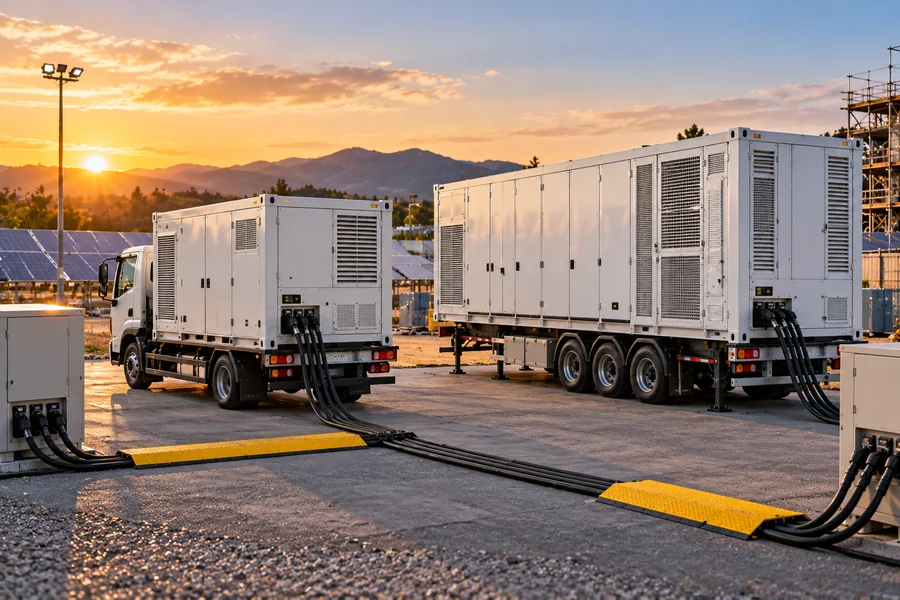
](https://voltcrave-battery.com/wp-content/uploads/2026/10/The-Ultimate-Mobile-Power-Guide-10ft-vs.-20ft-Mobile-Battery-Energy-Storage-Systems.webp)
Temporary power projects often face limited space, insufficient electricity, and high transportation costs. Choosing the wrong battery storage size can increase expenses and reduce operating efficiency.
The main difference between 10ft and 20ft Mobile Battery Energy Storage Systems (BESS) is their physical footprint and available space for energy storage equipment. A 10ft BESS is generally easier to position at constrained sites, while a 20ft system can accommodate larger battery capacity and power conversion equipment. Actual performance depends on the system design.
Choosing between 10ft and 20ft mobile BESS depends on capacity, power output, runtime, mobility, and charging infrastructure, not container size alone, ensuring efficient project deployment.
What Are the Main Differences Between 10ft and 20ft Mobile BESS?
Temporary electricity projects have different space and energy requirements. A small construction site may need a compact power system, while a large industrial operation may require substantially more storage capacity.
A 10ft mobile BESS uses an enclosure approximately 3 meters long, while a 20ft system is approximately 6 meters long. Both typically have widths close to 2.44 meters when based on standard container dimensions. The larger enclosure provides more space for batteries, cooling, and electrical equipment, but capacity and mobility depend on the manufacturer.
Physical Dimensions and Installation Footprint
The first difference is physical size.
Containerized battery storage systems often use enclosures based on standard shipping-container dimensions.
For example, SCU offers a 10ft battery storage configuration measuring approximately 2.991 × 2.438 × 2.896 meters.
Its 20ft configuration measures approximately 6.058 × 2.438 × 2.896 meters.
The following table compares the approximate enclosure dimensions of these specific configurations.
| Specification | 10ft BESS | 20ft BESS |
|---|---|---|
| Length | 2.99 m | 6.06 m |
| Width | 2.44 m | 2.44 m |
| Height | 2.90 m | 2.90 m |
| Ground footprint | 7.3 m² | 14.8 m² |
| Battery installation space | More limited | Greater |
| Typical positioning needs | Smaller sites | Larger sites |
| Transport considerations | Weight and vehicle dependent | Weight and trailer dependent |
These measurements describe example enclosures, not every mobile BESS.
Actual heights, widths, and transportation arrangements can vary with the manufacturer's design.
I also evaluate the total deployment footprint rather than enclosure dimensions alone.
A mobile BESS may require additional space for service access, electrical connections, emergency equipment, and fire safety clearances.
Mobility and Transportation Requirements
A compact enclosure can be easier to position at locations with limited access.
Some 10ft battery systems can be mounted on suitable trucks or transportable platforms.
However, container length alone does not determine whether transportation is easy.
The loaded equipment weight, axle limits, vehicle dimensions, road access, and local transportation regulations must be considered.
A heavily equipped 10ft system may still require specialized lifting or transport equipment.
Likewise, a 20ft battery enclosure can be installed on a road-compliant trailer when the complete design supports that application.
I would not assume that every 20ft containerized battery can be transported fully charged or moved frequently without additional engineering review.
Internal Equipment Configuration
Mobile BESS commonly integrates several electrical and mechanical systems.
These include battery modules, a Battery Management System (BMS), a Power Conversion System (PCS), an Energy Management System (EMS), thermal management, and protection equipment.
A larger enclosure may provide additional room for battery racks, cooling equipment, electrical distribution, and maintenance access.
However, some designs place the inverter or transformer outside the battery enclosure.
For this reason, I always check whether the published specifications describe a complete AC energy storage system or only a DC battery container.
How Do 10ft and 20ft Mobile BESS Compare in Capacity, Power, and Runtime?
A common misunderstanding is that a 20ft battery system always provides exactly twice the capacity of a 10ft system. Actual battery storage depends on cell technology, cooling architecture, electrical design, and available installation space.
A 20ft BESS can accommodate more battery capacity than a similarly engineered 10ft system, but there is no universal capacity assigned to either container size. Commercial products range widely. Some integrated 10ft systems exceed 1 MWh, while 20ft mobile systems are available with approximately 1–2 MWh or more of storage.
Real Product Specification Examples
I prefer comparing published manufacturer specifications rather than assuming that container size determines electrical performance.
SCU provides a useful example because it offers both 10ft and 20ft configurations within the same containerized storage series.
| Specification | SCU 10ft BESS | SCU 20ft BESS |
|---|---|---|
| Model | BRES-1040-500 | BRES-2080-1000 |
| Nominal capacity | 1,040 kWh | 2,080 kWh |
| Rated PCS power | 500 kW | 1,000 kW |
| Battery chemistry | LFP | LFP |
| Approximate weight | 13,000 kg | 26,000 kg |
| Enclosure length | 2.991 m | 6.058 m |
These are manufacturer specifications for containerized energy storage products.
They do not independently establish that either configuration is approved for frequent road transportation.
A separate mobility and transport assessment is necessary.
Examples of Commercial Mobile Systems
Commercial mobile BESS providers offer systems designed specifically for temporary deployment.
For example, NOMAD Power markets several 20ft containerized mobile systems.
Its published product range includes:
- Voyager Hawk: 1 MWh and 500 kW
- Voyager Falcon: 2 MWh and 500 kW
- Voyager Eagle: 2 MWh and approximately 1 MW
These products show that two systems using the same container length can have different output power and operating duration.
Aggreko also offers a 1 MW / 1.2 MWh battery storage solution designed for temporary power applications.
I believe these examples demonstrate why buyers should compare usable energy and power output rather than selecting equipment solely by enclosure size.
Battery Capacity vs. Power Output
Two measurements are essential.
Kilowatt-hours (kWh) describe how much energy the battery can store.
Kilowatts (kW) describe how much electrical power the system can deliver at a particular moment.
For example, consider two hypothetical battery systems.
System A has 1,000 kWh of nominal storage and a 500 kW inverter.
System B has 2,000 kWh of nominal storage and a 1,000 kW inverter.
Both systems have a nominal energy-to-power ratio of two hours.
However, usable operating time will be lower after accounting for discharge limits, conversion losses, and reserve requirements.
How to Calculate Mobile BESS Runtime
I use the following simplified formula:
Estimated Runtime (hours) = Usable AC Energy (kWh) ÷ Average Load (kW)
Suppose a system has:
- Nominal battery capacity: 1,000 kWh
- Usable discharge fraction: 90%
- Assumed delivery efficiency: 90%
- Average electrical load: 200 kW
The estimated available AC energy is:
1,000 × 0.90 × 0.90 = 810 kWh
The estimated operating duration is:
810 kWh ÷ 200 kW = 4.05 hours
A 2,000 kWh system under the same assumptions would provide approximately 8.1 hours.
These figures are theoretical estimates with a constant load and no additional charging.
Actual runtime depends on temperature, auxiliary loads, battery condition, inverter capability, and operating reserves.
I also verify that the inverter's continuous power rating can support the connected load.
A larger battery cannot compensate for insufficient instantaneous output power.
Which Applications Are Better Suited to 10ft or 20ft Mobile BESS?
Temporary power projects can differ substantially in electrical demand and duration. Selecting a storage system that is too small may require frequent recharging, while unnecessarily large equipment can increase deployment costs.
A 10ft mobile BESS is often attractive for space-constrained construction sites, temporary facilities, and moderate backup loads. A 20ft mobile BESS is generally better suited to larger energy requirements, industrial projects, fleet charging, and extended temporary operations. However, the final selection must be based on measured demand and verified equipment capabilities.
Construction Sites and Temporary Facilities
Construction projects may require electricity for lighting, site offices, security equipment, electric tools, and machinery.
I consider a compact mobile BESS attractive when the site has limited installation space and moderate electrical loads.
For example, a 10ft system may provide stored electricity during low-demand periods while working alongside a generator.
This arrangement can reduce generator runtime when the control system is designed appropriately.
Larger construction sites may require more substantial energy storage or several battery units operating together.
In these cases, a 20ft system may provide better capacity and power options.
However, I would compare the available installation space, operating duration, and electrical peak loads before choosing either configuration.
Outdoor Events and Festivals
Outdoor concerts and festivals often require power for sound systems, lighting, displays, refrigeration, and temporary commercial facilities.
Electricity consumption may vary significantly throughout the event.
A compact battery system can support selected electrical zones or smaller event installations.
A larger system may be more appropriate for main stages or events with greater energy demand.
I believe battery-generator hybrid operation is often practical for events with changing electrical loads.
Stored electricity can support low-demand periods, while additional generation can provide energy when necessary.
The battery system produces no on-site combustion exhaust during discharge, although its cooling equipment may generate some operating noise.
Emergency and Disaster Recovery
Mobile BESS can provide temporary electricity during outages and emergency recovery operations.
Potential applications include communications, temporary shelters, lighting, and selected critical equipment.
I consider transportation accessibility especially important in emergencies.
A smaller system may be easier to position in constrained areas.
However, larger batteries can provide more stored energy for extended operations when the site and transportation arrangements permit.
The correct choice depends on the importance of the loads, required runtime, charging access, and system reliability.
I would also verify backup transfer behavior because not every mobile BESS provides uninterruptible power.
EV Fleet Charging and Industrial Operations
Temporary electric vehicle charging can require substantial energy capacity and high output power.
For example, a commercial fleet may need to charge several vehicles within a limited operating window.
A 20ft mobile BESS with suitable integrated charging equipment may offer advantages for this type of application.
However, energy storage capacity does not automatically establish EV charging compatibility.
A complete charging solution must include suitable power conversion, charging equipment, connectors, and control systems.
For industrial operations, mobile BESS can also support peak demand management, temporary maintenance, and hybrid power generation.
Application Comparison
| Application | 10ft BESS | 20ft BESS |
|---|---|---|
| Small construction sites | Often suitable | May be unnecessary |
| Large construction projects | Depends on demand | Often suitable |
| Small outdoor events | Often suitable | Depends on demand |
| Large festivals | May support individual zones | Suitable options available |
| Emergency backup | Useful for constrained sites | Useful for greater energy demand |
| Temporary EV fleet charging | Depends on charger and capacity | Greater capacity options |
| Industrial peak management | Selected applications | Larger applications |
| Utility maintenance | Depends on load and access | Depends on load and access |
I would not treat these recommendations as fixed rules.
The available product specifications and actual operating conditions determine whether a particular system can support the application.
How Do You Choose Between a 10ft and 20ft Mobile BESS?
Selecting a mobile battery system based only on container length can lead to unnecessary costs, limited runtime, or difficult transportation. A successful project requires the electrical and logistical requirements to be evaluated together.
To choose between a 10ft and 20ft mobile BESS, I calculate peak power demand, daily energy consumption, required operating hours, charging availability, site footprint, transportation weight, and installation requirements. I then compare compatible equipment specifications and total project costs. The best option is the system that meets these requirements with suitable reliability and safety margins.
Step 1: Calculate Required Electrical Energy
I begin with the average electrical demand and expected operating duration.
Suppose a temporary industrial project requires 300 kW for five hours.
The estimated AC energy requirement would be:
300 kW × 5 hours = 1,500 kWh
Assume:
- Usable battery discharge fraction: 90%
- Energy delivery efficiency: 90%
The nominal storage requirement becomes:
1,500 kWh ÷ (0.90 × 0.90) = 1,851.9 kWh
A 2 MWh battery system could theoretically support this requirement under the stated assumptions, provided its power rating is sufficient.
However, I would also consider contingency reserves, auxiliary electricity consumption, and unexpected operating delays.
Step 2: Evaluate Continuous Power and Surge Demand
Battery capacity is only one part of the design.
I also evaluate the maximum electrical power required by the connected equipment.
Some machinery and electrical motors have starting loads that exceed their normal running demand.
The PCS must provide sufficient continuous output and appropriate transient performance.
For example, a battery system with 2 MWh of storage but only 250 kW of continuous output cannot directly supply a 500 kW load without another power source or suitable system configuration.
I recommend reviewing both the battery capacity and power conversion specifications.
Step 3: Check Transportation and Site Access
Transportation costs can be an important part of mobile BESS economics.
I evaluate the loaded equipment weight, trailer dimensions, road restrictions, lifting requirements, and deployment schedule.
A larger system may need additional transport equipment and site preparation.
The container's physical footprint is also different from the total operating space required.
Site plans must account for electrical connections, maintenance access, emergency response routes, and applicable fire separation requirements.
I would also check whether the equipment is designed for frequent relocation or simply delivered as a containerized stationary installation.
Step 4: Review Safety and Certification Requirements
Battery energy storage systems require appropriate electrical and fire safety measures.
For North American projects, relevant standards may include UL 9540 for energy storage systems and UL 9540A for thermal runaway fire-propagation testing.
NFPA 855 also provides important energy storage installation requirements, including provisions relevant to mobile storage.
I distinguish these requirements carefully.
UL 9540A is a test method, not a substitute for complete UL 9540 system certification.
Transportable equipment may also require additional transportation and operational approvals.
For example, New York City's Department of Buildings provides a specific approval process for outdoor mobile energy storage deployment.
I recommend confirming local requirements with the relevant authority before installing equipment.
Step 5: Compare Total Ownership or Rental Costs
I evaluate the full project cost rather than only the initial battery price.
Important cost factors include:
| Cost Factor | Why It Matters |
|---|---|
| Battery system price | Initial investment |
| Transportation | Delivery and relocation expenses |
| Installation | Site preparation and electrical connections |
| Charging electricity | Cost of replenishing stored energy |
| Maintenance | System inspection and servicing |
| Battery degradation | Long-term capacity and value |
| Permits and compliance | Legal and safety requirements |
| Downtime | Operational interruption risks |
| Expansion capability | Future capacity requirements |
A smaller system may reduce transportation and initial equipment costs.
However, it may require more frequent charging or additional units if the project uses substantial electricity.
A larger system may reduce the number of units needed, but increase transportation, infrastructure, and deployment costs.
I recommend comparing cost per delivered kilowatt-hour across the expected project duration.
My Insights: The Ultimate Mobile Power Guide-10ft vs. 20ft Mobile Battery Energy Storage Systems
Choosing between a 10ft and 20ft mobile BESS based only on container dimensions can produce an inefficient system. A larger enclosure does not automatically deliver better project economics.
I believe a 10ft mobile BESS is attractive when space, access, and transportation flexibility are important, while a 20ft system becomes more useful when projects require greater stored energy or higher output power. However, the final choice should be determined by usable capacity, operating duration, deployment requirements, and total ownership costs rather than physical size alone.
Energy Capacity Should Be the Starting Point
I do not consider container length the most important specification.
The first question I ask is how much electrical energy the project needs.
A smaller battery system may provide sufficient energy for a temporary construction office or small outdoor event.
A large industrial site may require several megawatt-hours of electricity.
I therefore calculate energy consumption before comparing available container configurations.
I also evaluate peak power requirements because a battery with sufficient stored energy may still have inadequate power conversion capability.
Mobility Has an Economic Value
I believe frequent relocation can influence the value of a mobile BESS significantly.
A system used at several short-duration construction projects has different requirements from equipment deployed at one site for several months.
Smaller enclosures may provide logistical advantages where access is restricted.
However, transportation weight, trailer design, and loading arrangements are more important than enclosure length alone.
A 10ft battery system is not automatically easier or cheaper to transport.
I recommend obtaining the actual loaded dimensions and weight of each complete configuration.
Larger Capacity Does Not Eliminate Charging Requirements
I also consider battery replenishment an important part of the operating plan.
A 20ft system may store more electricity than a smaller unit, but it still needs an external charging source.
A larger battery may also require more time to recharge if charging power remains unchanged.
For example, a battery containing twice as much energy can take approximately twice as long to recharge when the available charging rate and efficiency are similar.
I therefore evaluate the project through five connected factors:
Electrical Load → Energy Capacity → Output Power → Operating Duration → Charging Availability
This approach helps determine whether a project needs additional battery capacity or improved charging infrastructure.
System Safety and Long-Term Support Matter More Than Size
I believe safety and technical support should receive the same attention as storage capacity.
A mobile BESS must operate under changing transportation, weather, and electrical conditions.
I look for clear manufacturer documentation covering battery management, thermal protection, electrical isolation, and maintenance.
I also check system-level certification, monitoring capability, and the availability of technical support.
A larger container does not automatically provide better safety or reliability.
The overall engineering design determines system performance.
My Final Selection Approach
For compact sites with manageable energy demand, I generally consider a 10ft configuration worth evaluating first.
For projects with substantial electricity consumption, large power peaks, or extended operating periods, I would compare suitable 20ft configurations.
However, I would not make the decision until I had verified the complete product specifications and site requirements.
Ultimately, I believe the best mobile BESS is not the largest available container. It is the system that delivers the required electricity safely, efficiently, and economically throughout the project's operating schedule.
Conclusion
A 10ft mobile BESS can suit compact deployments, while a 20ft system offers larger storage options. Select based on load demand, runtime, transport, and safety.
](https://voltcrave-battery.com/wp-content/uploads/2026/06/Stationary-Storage-Battery-Key-Guardians-of-Energy-Security-768x512.jpg)
](https://voltcrave-battery.com/wp-content/uploads/2026/08/What-Are-the-Best-Solar-Battery-Storage-Systems-768x512.webp)
](https://voltcrave-battery.com/wp-content/uploads/2026/10/What-Is-the-Best-Portable-Power-Station-to-Purchase-768x512.webp)







































