
](https://voltcrave-battery.com/wp-content/uploads/2026/09/How-Long-Do-Electric-E-Bike-Batteries-Last.webp)
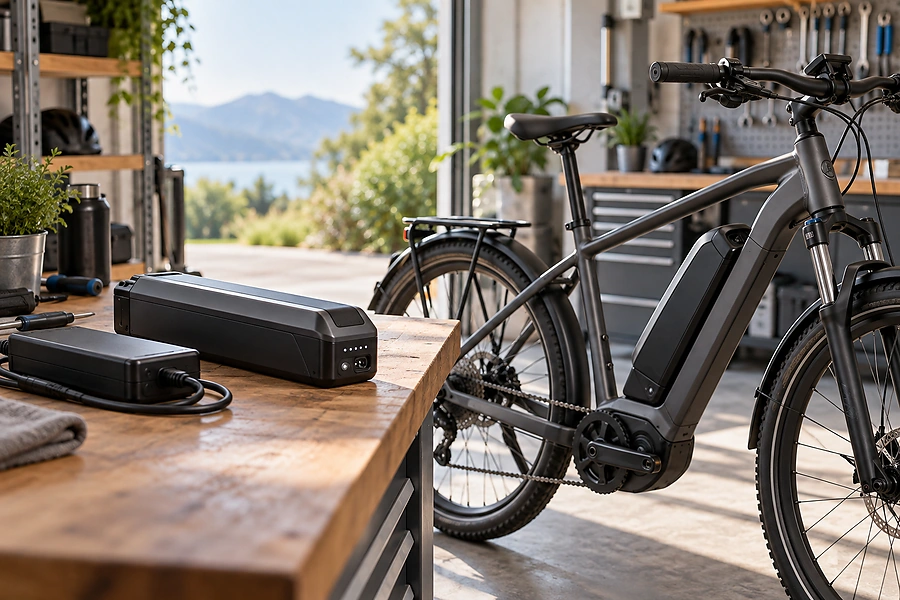
E-bike batteries gradually lose capacity with age and use. Riders often notice shorter range long before the battery becomes completely unusable.
A quality lithium-ion e-bike battery can often provide several years of useful service, but lifespan should be measured by both age and charge cycles. Manufacturer expectations vary: Shimano, for example, has specified up to 1,000 charges while retaining about 60% capacity. Temperature, charging, storage, discharge depth, and battery quality strongly affect actual life.
An e-bike battery therefore does not have one universal expiration date. A lightly used battery may age mainly because of time, while a delivery e-bike battery can accumulate hundreds of cycles much faster.
How Many Years Does an E-Bike Battery Last?
For most riders, calendar age is the easiest way to think about battery life.
A lithium-ion e-bike battery can remain useful for several years when properly used and stored, but there is no universal number of years that applies to every battery. Battery chemistry, cell quality, temperature, charging frequency, storage state of charge, riding demand, BMS design, and accumulated cycles all influence degradation.
Suppose Rider A travels:
2,000 km per year.
Rider B is a delivery rider traveling:
15,000 km per year.
Even with similar batteries, their aging patterns can be very different.
Rider B will usually accumulate substantially more:
charge throughput,
discharge throughput,
and operating cycles.
Rider A may reach a point where calendar aging becomes as important as cycling.
This is why a statement such as:
“Every e-bike battery lasts five years”
is too simplistic.
A better model is:
Battery Life = Calendar Aging + Cycle Aging + Operating Conditions
The battery gradually loses usable capacity through these processes.
Eventually, the owner decides that the reduced:
range,
power capability,
reliability,
or convenience
justifies replacement.
How Many Charge Cycles Does an E-Bike Battery Last?
Cycle life varies considerably between battery products.
A quality e-bike battery may provide hundreds of full-equivalent charge cycles, with some manufacturers specifying performance out to 1,000 cycles. Shimano has stated that its STEPS batteries can retain about 80% maximum capacity after 500 charges and about 60% after 1,000 charges under its specified conditions.
This provides a useful real-world manufacturer example.
But:
1,000 cycles ≠ Universal E-Bike Battery Rating.
Another battery may have different:
cells,
chemistry,
BMS settings,
temperature limits,
charge voltage,
and warranty criteria.
Cycle-life claims must therefore be interpreted according to the manufacturer's test conditions.
Another important concept is the full-equivalent cycle.
Suppose you use:
50%
of your battery today and recharge it.
Then you use:
50%
again tomorrow.
Those two partial discharges together represent approximately one full equivalent of the battery's capacity throughput.
So charging your battery twice does not necessarily mean you have consumed two complete cycles.
What Does 500 Battery Cycles Mean?
A cycle describes energy throughput rather than simply plugging the charger in once.
Five hundred battery cycles generally means the battery has experienced energy throughput equivalent to approximately 500 full charge-discharge cycles. Partial cycling can accumulate toward full-equivalent cycles, so topping up an e-bike after every ride should not automatically be interpreted as consuming one complete cycle each time.
Imagine a:
500 Wh
battery.
If you use:
250 Wh
and recharge it, you have used roughly half of its nominal energy capacity.
Repeat that:
twice
and the energy throughput is roughly comparable to:
one 500 Wh cycle.
Over 500 equivalent cycles, theoretical nominal energy throughput would be:
500 Wh × 500
= 250,000 Wh
or:
250 kWh.
Actual cycle accounting by a BMS or manufacturer can be more sophisticated.
The important lesson is that:
Charge Events ≠ Full Cycles.
This matters for riders who frequently top up their batteries.
Does an E-Bike Battery Stop Working After 500 or 1,000 Cycles?
Usually not simply because it crosses a specific cycle count.
Cycle-life figures normally describe degradation to a specified remaining capacity rather than a point at which the battery suddenly stops operating. A battery may continue functioning after hundreds of cycles but provide progressively less range. Replacement becomes practical when capacity, power, reliability, or safety no longer meets the rider's requirements.
Shimano's published figures illustrate this concept clearly.
Its materials describe approximately:
80% maximum capacity after 500 charges
and:
60% after 1,000 charges.
Imagine a battery originally providing:
60 miles
of range under a particular set of conditions.
At 80% of original usable capacity, a highly simplified range estimate would be:
60 × 0.80
= 48 miles.
At 60%:
60 × 0.60
= 36 miles.
Real range will also change with terrain, rider weight, assistance level, wind, tire pressure, temperature, and speed.
But the example illustrates the concept:
Battery Degradation → Reduced Capacity → Reduced Range
rather than:
Cycle Limit → Instant Failure.
What Causes an E-Bike Battery to Degrade?
Lithium-ion batteries age through both time and use.
Major factors affecting e-bike battery degradation include high temperature, time spent at extreme states of charge, cycling intensity, high current, deep discharge, charging conditions, cell quality, and storage practices. Battery degradation cannot be completely stopped, but appropriate charging, storage, and temperature management can reduce unnecessary stress.
Heat is particularly important.
Battery reactions generally accelerate as temperature increases.
That does not mean riders must keep a battery at one exact temperature.
It means unnecessary prolonged exposure to extreme heat should be avoided.
Examples include leaving a battery for extended periods:
inside a very hot vehicle,
in direct summer sunlight,
or near heating equipment.
Cold presents a different problem.
A cold battery may temporarily provide:
less power,
reduced range,
and different charging behavior.
Therefore:
Hot Storage → Can Accelerate Aging
while:
Cold Operation → Can Temporarily Reduce Performance
The battery manufacturer's temperature limits should always take priority over generic advice.
Does Charging an E-Bike Battery to 100% Reduce Its Life?
The effect depends on how long the battery remains at a high state of charge and how the battery system is designed.
Lithium-ion cells generally experience more aging stress when kept at high state of charge for extended periods, especially at elevated temperatures. However, riders should follow the e-bike manufacturer's charging instructions rather than inventing arbitrary voltage limits, because the BMS, charger, displayed state of charge, and cell operating window are designed as a system.
There is an important difference between:
charging to 100% before a ride
and:
storing at 100% for long periods in high heat.
The first may be completely reasonable when maximum range is required.
The second can create unnecessary aging stress.
For daily short trips, some riders may not need maximum battery capacity every day.
But I would not recommend bypassing the charger or modifying the battery to achieve a particular charge voltage.
Use:
the correct charger,
the correct battery,
and the manufacturer's charging instructions.
UL emphasizes that the charger is an important part of the e-bike system and should be compatible with the specific battery and e-bike.
Should You Fully Discharge an E-Bike Battery Before Charging?
Modern lithium-ion batteries generally do not need the deep-discharge routine associated with some older rechargeable technologies.
An e-bike lithium-ion battery generally does not need to be completely discharged before recharging. Partial charging is normal, and avoiding unnecessary deep discharge can reduce stress. Riders should follow the battery manufacturer's instructions because the BMS defines operational limits and the displayed 0% may not correspond to the cell's absolute electrochemical minimum.
Suppose your commute uses:
30%
of the battery.
You do not normally need to ride around deliberately until the display reaches zero before charging.
You can recharge according to your next riding requirement.
This also makes e-bikes more convenient.
For example:
Morning battery:
90%
After commute:
60%
After return:
30%
Charging at this point can be perfectly normal.
The battery management system controls important operational boundaries.
Therefore, the useful principle is:
Charge for the Next Ride, Not to Create Artificial Deep Cycles.
How Does Temperature Affect E-Bike Battery Life?
Temperature affects both immediate performance and long-term aging.
High temperatures can accelerate lithium-ion battery degradation, while low temperatures can temporarily reduce available capacity and power. Charging conditions are particularly important, so riders should follow the battery manufacturer's specified charging-temperature range and allow a battery exposed to extreme cold or heat to reach suitable conditions before charging when required.
Shimano's documentation illustrates that battery performance changes at low temperature and provides defined storage and usage temperature information for its systems.
Consider winter riding.
A battery might deliver less apparent range on a cold day.
That does not necessarily mean it has permanently lost that amount of capacity.
Part of the difference can be temperature-related.
Now consider prolonged summer storage.
If the battery remains very hot for weeks or months, accelerated aging can become a longer-term issue.
Therefore, I distinguish:
Temporary Temperature Effect
from:
Permanent Degradation.
They are not the same.
How Should You Store an E-Bike Battery During Winter?
Long-term storage deserves more attention than many riders give it.
For extended storage, follow the manufacturer's recommended state of charge and temperature conditions rather than leaving the battery completely empty or assuming 100% is always best. Shimano, for example, has recommended approximately 70% charge for winter storage in documentation for its STEPS batteries.
The exact recommendation can vary by manufacturer.
Therefore:
70% Is Not a Universal Rule for Every E-Bike Battery.
Check the manual for your specific system.
The general storage priorities are:
moderate temperature,
dry conditions,
manufacturer-recommended charge level,
and periodic condition checks where instructed.
One especially poor situation is leaving a depleted battery unattended for a very long time.
The battery electronics can consume small amounts of energy.
If voltage eventually falls too far, recovery may become difficult or impossible.
Long-term storage should therefore be treated as part of battery maintenance.
How Long Does an E-Bike Battery Last Per Charge?
Runtime and lifespan are completely different questions.
Battery life per charge depends mainly on usable watt-hours and energy consumption per mile or kilometer. A 500 Wh battery consuming 10 Wh per mile could theoretically provide about 50 miles, while consumption of 20 Wh per mile would reduce the estimate to about 25 miles. Real riding conditions can change these figures substantially.
The simple equation is:
Range ≈ Usable Battery Energy ÷ Energy Consumption
For a:
500 Wh
battery:
At 10 Wh/mile:
500 ÷ 10 = 50 miles
At 15 Wh/mile:
500 ÷ 15 = 33 miles
At 20 Wh/mile:
500 ÷ 20 = 25 miles
At 25 Wh/mile:
500 ÷ 25 = 20 miles
Actual range depends on:
assistance level,
terrain,
rider weight,
cargo,
wind,
temperature,
speed,
tire pressure,
motor efficiency,
and battery condition.
A battery's range will gradually decline as its usable capacity decreases with age.
How Can You Tell When an E-Bike Battery Is Wearing Out?
Reduced range is often the first noticeable symptom.
Common signs of an aging e-bike battery include significantly reduced range, faster percentage drop under load, difficulty delivering expected power, unusual charging behavior, or a substantial decline in measured capacity. Physical damage, swelling, overheating, unusual odors, or other abnormal behavior should be treated as safety concerns rather than ordinary aging.
Suppose a rider historically achieved:
40 miles
under similar conditions.
After several years, comparable rides provide:
25 miles.
That is a meaningful change.
However, one short ride does not prove battery degradation.
Range can fall because of:
cold weather,
low tire pressure,
headwinds,
steep terrain,
higher assistance,
or additional cargo.
A better assessment compares performance across:
similar routes,
similar weather,
similar assistance levels,
and similar rider/load conditions.
Diagnostic information from an authorized service provider can also be useful for batteries with integrated battery-management data.
When Should You Replace an E-Bike Battery?
Replacement should be based on performance, condition, compatibility, and safety rather than age alone.
Consider replacing an e-bike battery when its usable capacity or range no longer meets your needs, it cannot reliably provide required power, diagnostics identify a significant problem, or the manufacturer recommends replacement. A damaged, swollen, abnormally hot, leaking, or otherwise unsafe battery should not simply remain in service because it still holds charge.
For one rider, a battery at:
70% capacity
may still be perfectly useful.
Their daily trip may require only:
10 miles.
For another rider, 70% may be unacceptable because the commute requires nearly the battery's original range.
Therefore:
End of Useful Life Is Application-Dependent.
This is an important difference from complete battery failure.
A battery can reach the end of its useful life for one owner while still retaining substantial measurable capacity.
Replacement decisions should also consider cost.
A replacement battery needs to match:
voltage,
mounting,
connector,
charger,
BMS,
communication,
and electrical requirements.
Compatibility should never be assumed from voltage alone.
Can You Extend the Life of an E-Bike Battery?
Good operating habits can reduce avoidable degradation.
You can support longer e-bike battery life by avoiding unnecessary heat exposure, using the correct compatible charger, following manufacturer charging and storage instructions, avoiding prolonged storage at unsuitable charge levels, protecting the battery from physical damage, and storing it under appropriate conditions when the bike will not be used for extended periods.
The goal is not to make the battery last forever.
Lithium-ion cells age even when treated carefully.
Instead, the goal is to avoid adding unnecessary stress.
For example:
A battery stored in moderate conditions is generally preferable to one repeatedly left in a hot vehicle.
A manufacturer-approved charger is preferable to an unknown charger with apparently similar voltage.
Following storage instructions is preferable to leaving the battery fully depleted for months.
UL specifically emphasizes battery-and-charger compatibility in e-bike safety and notes that UL 2849 evaluates the e-bike electrical drive train, battery, and charger as a system.
Battery care should therefore focus on the complete system.
Does Battery Size Affect E-Bike Battery Lifespan?
A larger battery can sometimes accumulate less relative cycling for the same daily trip, but size alone does not determine lifespan.
Battery capacity affects how deeply a battery is cycled for a given ride. If two otherwise comparable batteries power the same bike over the same route, the larger battery may experience a smaller percentage discharge. However, cell chemistry, temperature, design, charging strategy, current, age, and manufacturing quality also affect lifespan.
Imagine the same trip consumes:
300 Wh.
Battery A:
500 Wh
Depth of use:
300 ÷ 500 = 60%
Battery B:
750 Wh
Depth of use:
300 ÷ 750 = 40%
Battery B uses a smaller fraction of its nominal energy on the trip.
But that does not automatically prove it will last:
50% longer.
Real degradation is not that simple.
Battery B could use different cells.
It could operate at different temperatures.
Its BMS settings could differ.
Therefore:
Larger Capacity Can Reduce Relative Cycling
but:
Larger Capacity ≠ Guaranteed Longer Calendar Life.
Does E-Bike Battery Chemistry Affect Lifespan?
Yes, but the exact cell design matters as much as the chemistry label.
E-bike batteries commonly use lithium-ion chemistry, but lithium-ion includes multiple cathode systems and cell designs. Cycle life, energy density, power capability, temperature behavior, and aging can differ. Buyers should therefore rely on the battery manufacturer's specifications rather than assuming every lithium-ion e-bike battery has the same lifespan.
For e-bikes, weight and energy density matter because the battery travels with the rider.
A chemistry optimized for extremely long stationary-storage cycle life may not automatically be the best solution for a lightweight bicycle.
Battery designers balance:
energy density,
weight,
power,
cycle life,
cost,
temperature,
and safety.
This explains why asking:
“Which chemistry lasts longest?”
does not completely solve the e-bike battery-selection problem.
The better question is:
“Which battery system provides suitable life, range, weight, power, safety, and compatibility for this bicycle?”
Does UL Certification Mean an E-Bike Battery Will Last Longer?
Safety certification and cycle-life performance are different issues.
UL certification should not be interpreted as a guarantee that an e-bike battery will provide a particular number of years or charge cycles. UL 2271 addresses batteries for light electric vehicle applications, while UL 2849 addresses the electrical system of e-bikes. These standards focus on safety rather than promising a specific service lifespan.
This distinction matters when shopping.
A seller might advertise:
UL Certified
and:
1,000 cycles.
Those are two different claims.
One concerns safety certification.
The other concerns battery performance and degradation under defined conditions.
UL documentation for UL 2271 explicitly distinguishes safety evaluation from performance or reliability evaluation.
Therefore:
Safety Certification ≠ Cycle-Life Rating
and:
Cycle-Life Claim ≠ Safety Certification.
Both can matter, but they answer different questions.
My Insights: What Really Determines E-Bike Battery Life
I would measure e-bike battery life through usable capacity rather than asking only how many years have passed.
An e-bike battery's useful life depends on the interaction of calendar age, charge throughput, temperature, storage, charging practices, cell quality, BMS design, and riding demand. The battery does not normally become useless at a predetermined cycle number; instead, its capacity and performance gradually decline until they no longer satisfy the rider's requirements.
My First Insight: Battery Life Should Be Measured in Both Years and Cycles
A five-year-old battery with:
150 cycles
is different from a two-year-old battery with:
800 cycles.
The first has experienced more calendar aging.
The second has experienced much more cycling.
Therefore, I would evaluate:
Age + Cycles + Remaining Capacity
together.
My Second Insight: Remaining Capacity Matters More Than a Cycle Number
Shimano's published figures provide a useful example:
500 charges → about 80% maximum capacity
1,000 charges → about 60% maximum capacity.
This shows why cycle life should not be interpreted as an on/off switch.
The battery can continue operating while its range gradually decreases.
My Third Insight: Heat and Storage Habits Can Matter as Much as Riding
A lightly used battery can still age badly if it spends long periods under stressful storage conditions.
This is why I would not evaluate battery health solely by:
odometer mileage.
Storage temperature and state of charge can matter even when the bike is parked.
My Fourth Insight: Battery Life and Battery Safety Are Separate Questions
A battery can have excellent remaining capacity while still requiring attention because of:
physical damage,
abnormal heating,
or another safety issue.
Likewise, a safely designed battery will still experience normal capacity degradation.
UL 2271 and UL 2849 address relevant battery and e-bike electrical-system safety rather than guaranteeing a particular cycle life.
Therefore:
Healthy Capacity ≠ Complete Safety Assessment.
My Fifth Insight: How Long Do Electric E-Bike Batteries Last?
Electric e-bike batteries typically provide several years of useful service, but there is no universal lifespan. Quality lithium-ion batteries can deliver hundreds of full-equivalent cycles, and some manufacturers specify performance through 1,000 charges. Actual life depends on temperature, calendar age, cycling, storage, charging habits, cell quality, BMS design, and how much remaining range the rider requires.
A useful framework is:
| Battery-Life Factor | Effect |
|---|---|
| Calendar age | Battery degrades even when lightly used |
| Charge cycles | More throughput contributes to aging |
| High temperature | Can accelerate degradation |
| Cold conditions | Can temporarily reduce performance |
| Storage | Charge level and temperature matter |
| Deep cycling | Can increase battery stress |
| Cell quality | Influences consistency and aging |
| BMS | Helps maintain operating limits |
| Charger | Must be compatible with the system |
| Rider demand | Determines when reduced capacity becomes unacceptable |
Rather than expecting one exact lifespan, I would think of the battery as moving through three stages:
New Battery → Gradual Capacity Loss → Replacement When Performance No Longer Meets the Application
For an occasional recreational rider, reduced capacity may remain acceptable for years.
For a commuter, range requirements may make replacement necessary earlier.
For a delivery rider accumulating heavy daily mileage, cycle aging can become much more important.
So the best answer is not simply:
“An e-bike battery lasts X years.”
It is:
“An e-bike battery lasts until normal aging reduces its safe, usable performance below what the rider needs—and good temperature, charging, and storage practices can help delay that point.”
Conclusion
E-bike batteries can provide several years and hundreds of cycles, but lifespan varies. Temperature, cycling, storage, charging, battery quality, and required range determine useful service life.
](https://voltcrave-battery.com/wp-content/uploads/2026/09/What-Is-the-Best-Portable-Jump-Starter-for-2026-768x512.webp)
](https://voltcrave-battery.com/wp-content/uploads/2026/08/What-Are-the-Key-Differences-Between-Stackable-and-Non-Stackable-Solar-Batteries-768x512.webp)
](https://voltcrave-battery.com/wp-content/uploads/2026/10/Which-Is-Better-LiFePO4-or-Lithium-Battery-768x512.webp)