
](https://voltcrave-battery.com/wp-content/uploads/2026/10/Data-Center-Construction-and-Operations-Power-Mobile-BESS.webp)
Data centers require reliable electricity, but delayed grid connections and growing power demand can disrupt construction schedules. Temporary power shortages also create operational risks.
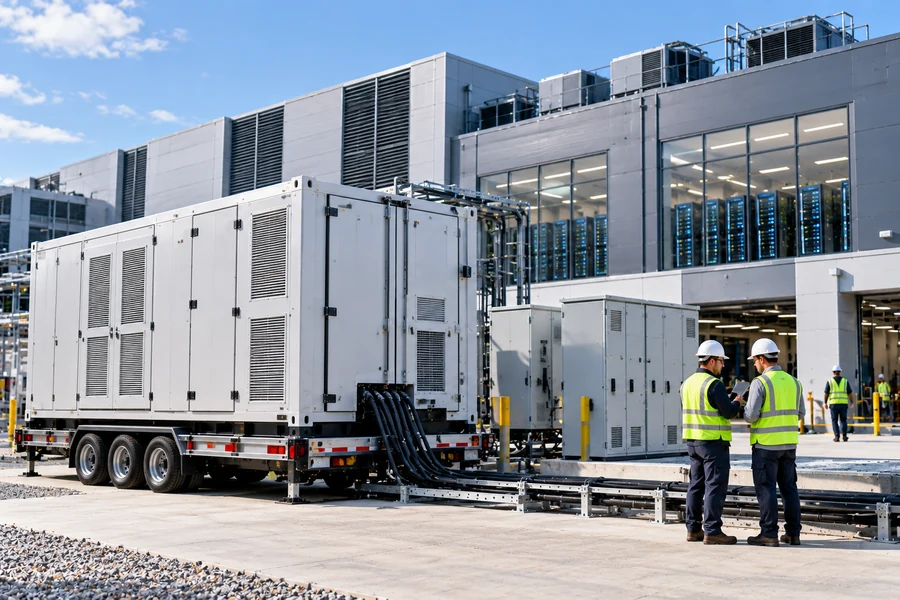
Mobile battery energy storage systems (Mobile BESS) provide flexible electricity for data center construction, commissioning, and selected operational requirements. These transportable battery systems store energy from available sources and deliver controlled power to temporary loads, equipment, and facility infrastructure. They can also work with generators, renewable energy, and existing electrical systems.
I believe Mobile BESS offers practical value when data center developers need additional power capacity before permanent infrastructure is ready. However, its effectiveness depends on correct system sizing, electrical integration, and reliable energy replenishment.
What Is Mobile BESS and How Does It Supply Power to Data Centers?
Data center construction and operations require different types of electrical support. A mobile battery system can provide temporary energy, but it must be configured for the intended application.
Mobile BESS is a transportable battery energy storage system that stores electricity and supplies power through integrated conversion equipment. In data center projects, it can support temporary construction loads, commissioning activities, peak demand management, and selected backup functions. Its operation depends on battery capacity, discharge power, control systems, and available charging sources.
Main Components of a Mobile BESS
A typical mobile battery storage system includes several important components.
Battery Energy Storage System
The battery stores electricity for later use. Many commercial systems use lithium iron phosphate (LiFePO4) batteries because of their cycle life and thermal stability.
Battery Management System (BMS)
The BMS monitors battery temperature, voltage, current, and operating limits.
It helps prevent the battery from operating outside its permitted conditions.
Power Conversion System (PCS)
The PCS converts electricity between DC battery power and the AC power required by connected equipment.
Some systems also support grid-forming or grid-following operating modes.
Energy Management System (EMS)
The EMS manages charging, discharging, power limits, and operating schedules.
It can coordinate the battery with generators, renewable generation, and other electrical equipment.
How Does Mobile BESS Deliver Electricity?
I divide the operating process into three stages.
First, the battery receives electricity from a compatible source, such as a utility connection, generator, or renewable energy system.
Second, the battery stores this electricity until power is required.
Third, the PCS supplies regulated electricity to the connected load within the system's rated limits.
A Mobile BESS does not generate electricity by itself. It must be recharged after its stored energy is used.
Construction vs. Operations Applications
| Project Stage | Mobile BESS Application |
|---|---|
| Site Construction | Temporary power for selected construction equipment |
| Electrical Installation | Support for temporary electrical loads |
| Commissioning | Controlled power for suitable testing activities |
| Early Operations | Supplemental energy where site architecture permits |
| Normal Operations | Peak shaving and energy management |
| Backup Support | Additional reserve energy in an approved system design |
I consider this flexibility particularly useful for projects where utility connections and construction schedules do not develop at the same speed.
How Can Mobile BESS Support Data Center Construction and Commissioning?
Data center projects often require electricity long before permanent utility infrastructure becomes available. Delayed grid connections can prevent contractors from completing electrical and mechanical commissioning.
Mobile BESS can support data center construction by supplying temporary electricity for compatible equipment, reducing generator operating hours, and assisting selected commissioning activities. When integrated with generators or other power sources, it can help manage changing site loads while permanent electrical infrastructure is installed and tested.
Temporary Power During Construction
Construction sites require electricity for lighting, tools, temporary offices, ventilation, and selected mechanical equipment.
A mobile battery system can supply some of these loads without continuously running a conventional generator.
For example, a temporary construction office may require relatively low electricity demand for extended periods.
A battery system can supply this load while a generator remains off, provided enough stored energy is available.
When the battery reaches a defined operating limit, the generator or another available source can recharge it.
This operating arrangement is often called a hybrid power system.
Generator and Battery Integration
I believe generator integration is one of the most practical applications for Mobile BESS.
Construction loads can change significantly during the working day.
Some equipment creates short periods of high power demand, while other loads remain relatively small.
A properly designed battery system can help manage these fluctuations.
For example, a hybrid system may allow the generator to operate closer to its preferred loading range while the battery supports temporary peaks.
This arrangement can reduce unnecessary low-load generator operation.
However, savings depend on the load profile, generator characteristics, battery efficiency, and control strategy.
Supporting Data Center Commissioning
Commissioning verifies whether installed equipment operates according to project requirements.
Data center commissioning may involve:
- Electrical distribution testing
- Cooling equipment testing
- Generator and transfer system verification
- Load bank testing
- Control system integration
- Power system performance checks
Mobile BESS may support selected testing activities when its voltage, power capacity, and operating mode match the approved test requirements.
It should not automatically be considered a replacement for the permanent power source required during final acceptance.
The test engineer must confirm that the temporary power supply provides the required fault performance, power quality, grounding arrangement, and operating duration.
Managing Utility Connection Delays
I consider delayed utility connections a significant risk for data center developers.
A construction project may reach an advanced stage before the permanent grid connection is available.
Temporary power systems can help contractors continue suitable construction or commissioning activities.
However, battery storage alone is usually not sufficient to supply a large data center continuously for long periods without a substantial recharge source.
For major projects, Mobile BESS may be only one component of a larger temporary power system that also includes generators, transformers, switchgear, and fuel or renewable energy infrastructure.
How Does Mobile BESS Improve Data Center Operations and Power Reliability?
Operating data centers require continuous electricity to protect servers, networking equipment, and cooling systems. Even short interruptions can affect digital services and facility operations.
Mobile BESS can support data center operations through peak shaving, supplemental backup energy, load management, and integration with on-site generation. However, conventional Mobile BESS should not be treated as a direct replacement for a dedicated UPS, which is designed to provide continuous protection for critical IT loads during power disturbances.
Mobile BESS vs. UPS Systems
I consider the distinction between battery energy storage and uninterruptible power supply systems essential.
Both technologies use stored electricity, but they serve different purposes.
| Feature | Mobile BESS | Dedicated UPS |
|---|---|---|
| Main Function | Energy storage and site-level power support | Continuous protection of critical loads |
| Typical Application | Peak shaving, temporary power, reserve energy | Server and network power continuity |
| Operating Duration | Depends on battery capacity and load | Usually designed for short-duration bridging |
| Power Transfer | Depends on inverter and switching architecture | Designed for specified no-break or ride-through performance |
| Mobility | Transportable configurations available | Usually integrated into facility infrastructure |
| System Integration | Often parallel with facility power systems | Normally connected to protected critical-load circuits |
A conventional UPS helps keep critical equipment operating while other backup systems respond to a power failure.
Mobile BESS can provide additional reserve energy at the facility level when properly integrated.
Specialized battery systems may be engineered for UPS-like functions, but these capabilities require suitable architecture and verified performance.
Peak Shaving and Energy Management
Data centers can experience periods of high electricity demand.
Some facilities also face changes in power consumption caused by AI computing workloads, cooling requirements, and equipment operation.
A battery system can charge during periods of lower demand and discharge during selected high-demand periods.
This may reduce peak electricity purchases or help manage a constrained grid connection.
However, the economic benefit depends on local tariffs, charging costs, battery cycling, and operational requirements.
I recommend evaluating actual load data before estimating savings.
Backup Power and Operating Duration
Battery capacity determines how much stored energy is available.
Charging and discharging power determine how quickly that energy can be transferred.
For example, consider a Mobile BESS with the following assumed specifications:
- Rated battery capacity: 600 kWh
- Usable energy fraction: 80%
- Assumed delivery efficiency: 90%
- Supported site load: 300 kW
The estimated deliverable energy is:
600 × 0.80 × 0.90 = 432 kWh
The estimated operating duration is:
432 ÷ 300 = 1.44 hours
Under these assumptions, the system could support a constant 300 kW load for approximately 1.44 hours.
This is an illustrative calculation, not a guaranteed backup duration.
Real performance depends on auxiliary consumption, battery conditions, discharge limits, inverter efficiency, and the characteristics of the connected load.
For critical applications, I recommend using an engineering load study rather than relying only on nominal battery capacity.
Cooling and Facility Infrastructure
Cooling is an important part of data center power planning.
Servers cannot operate reliably without suitable environmental controls.
If Mobile BESS is intended to support backup operation, the load assessment must consider the required cooling equipment as well as the electrical demand of the IT systems.
Supporting servers while ignoring essential cooling loads may create an incomplete backup strategy.
I believe this is one reason data center power planning must evaluate the complete facility rather than focusing only on rack-level demand.
What Should EPC Teams Consider Before Deploying Mobile BESS at a Data Center?
Mobile battery systems offer deployment flexibility, but engineering teams must verify electrical compatibility, site conditions, and safety requirements before installation.
EPC teams should evaluate load demand, battery capacity, power conversion requirements, grounding, electrical protection, control compatibility, and site safety before deploying Mobile BESS. They should also confirm commissioning procedures, generator integration, emergency response requirements, and applicable energy storage standards.
Evaluate the Actual Load Profile
I recommend separating electrical loads into three categories.
Critical Loads
These include equipment that requires continuous protected power, such as essential IT and networking systems.
Essential Supporting Loads
These may include required cooling, controls, safety systems, and other infrastructure necessary to support critical operations.
Noncritical Loads
These include equipment that can tolerate interruption or controlled shutdown.
This classification helps engineers identify the loads suitable for Mobile BESS support.
It also prevents the system from being sized solely around total building demand when only selected loads require support.
Confirm Electrical Compatibility
The engineering team should verify:
- Rated AC voltage and frequency
- Battery and PCS power limits
- Grounding and neutral configuration
- Short-circuit and protection coordination
- Grid-forming or grid-following capability
- Generator synchronization requirements
- Transfer switching and control logic
- Communication between BMS, PCS, and EMS
These requirements become particularly important when the system connects to an existing data center power architecture.
I recommend documenting electrical interfaces before equipment procurement.
Review Site and Safety Requirements
A mobile battery installation must have suitable access, placement, and safety arrangements.
Important considerations include equipment clearance, ventilation, ambient temperature, cable protection, emergency access, and fire protection requirements.
For applicable U.S. projects, relevant standards may include:
UL 9540: Energy storage system safety certification requirements.
UL 9540A: Test method for evaluating thermal runaway and fire propagation.
NFPA 855: Installation safety requirements for stationary energy storage systems, where applicable.
NFPA 70: Electrical installation requirements.
The latest published NFPA 855 edition is 2026, but the edition adopted by the local authority may differ.
I recommend verifying the complete equipment certification and the applicable installation requirements before deployment.
Establish Commissioning and Acceptance Procedures
EPC contractors should define acceptance criteria before the system arrives at the site.
Testing may include:
| Test Area | Main Verification |
|---|---|
| Electrical Connections | Correct installation and connection integrity |
| BMS–PCS Communication | Reliable exchange of operating limits |
| EMS Controls | Correct charging and discharging commands |
| Load Testing | Stable operation under approved test loads |
| Generator Integration | Correct coordination and operating transitions |
| Protection Systems | Correct settings and response to approved tests |
| Monitoring | Accurate alarms and operating records |
A factory acceptance test can identify integration issues before shipment.
Site acceptance testing confirms that the system operates correctly after transportation and installation.
I believe these procedures are essential for projects where equipment must be moved or reconfigured regularly.
Evaluate Total Operating Costs
The initial battery price is only one part of the project cost.
I recommend including transportation, installation, maintenance, battery degradation, electricity replenishment, and auxiliary equipment.
A Mobile BESS may reduce generator use, but it does not automatically eliminate fuel consumption or operating emissions.
Its environmental and financial performance depends on where the stored electricity comes from and how the system is operated.
My Insight: What Is the Role of Mobile BESS in Data Center Construction and Operations Power
I believe Mobile BESS is most valuable as a flexible supporting power resource rather than a universal replacement for utility infrastructure, UPS equipment, or standby generators.
During construction, its main advantage is the ability to supply controlled temporary electricity before permanent infrastructure is fully available.
During operations, it can help manage electricity demand, provide additional reserve energy, and support selected power management functions.
However, I consider the distinction between these two stages important.
Construction power often involves changing loads, temporary connections, and equipment that may tolerate limited interruptions.
Operational data center power requires much stricter coordination because critical IT systems must remain continuously available.
For this reason, I recommend evaluating five factors before selecting Mobile BESS.
1. Project Stage
Determine whether the system will support construction, commissioning, early operations, or ongoing energy management.
2. Required Power and Energy
Compare peak power demand in kW with total energy requirements in kWh.
Both values are necessary for correct equipment sizing.
3. Energy Replenishment
Identify how the battery will recharge and whether sufficient electricity will be available throughout the operating schedule.
4. Electrical Integration
Verify compatibility with existing UPS equipment, generators, switchgear, and control systems.
5. Deployment Economics
Compare transportation, installation, maintenance, and energy costs with alternative temporary power solutions.
I also believe modular deployment can offer advantages for projects that expand in phases.
Instead of installing unnecessary temporary capacity immediately, an operator may add compatible battery modules or units as requirements increase.
However, modular expansion must remain within the system's approved electrical and safety design.
For data center developers and EPC contractors, I recommend choosing equipment based on proven integration capability, technical support, and documented performance rather than battery capacity alone.
A well-designed Mobile BESS can help reduce some construction delays, improve operational flexibility, and support energy management.
Its greatest benefit comes when it is integrated into a complete and carefully engineered power strategy.
Conclusion
Mobile BESS supports data center construction and operations through temporary power, energy management, and supplemental backup. Successful deployment requires appropriate sizing, electrical integration, and reliable recharging.
](https://voltcrave-battery.com/wp-content/uploads/2026/10/Can-I-Have-a-Whole-House-Battery-Backup-Without-Solar-Panels-768x512.webp)
](https://voltcrave-battery.com/wp-content/uploads/2026/09/What-Are-the-Pros-and-Cons-of-the-Pure-Sine-Wave-Inverter-768x512.webp)
](https://voltcrave-battery.com/wp-content/uploads/2026/08/Industrial-Energy-Storage-Smarter-Systems-and-Better-Power-768x512.webp)







































