

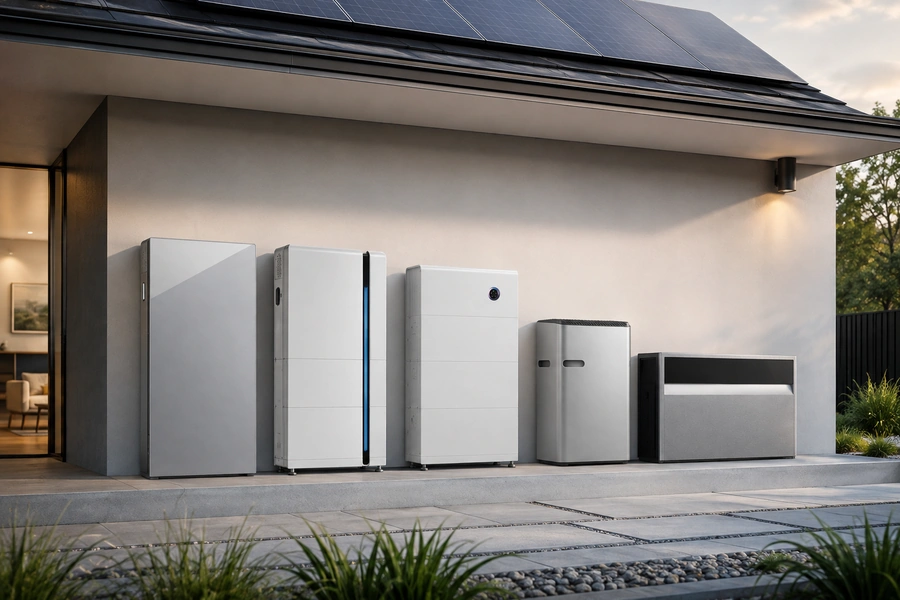
Residential batteries are becoming easier to install, but capacity alone does not tell me whether a system will handle solar, outages, HVAC, or future electrification well.
The best all-in-one energy storage systems for residential solar in 2026 include Tesla Powerwall 3, FranklinWH aPower S, EcoFlow OCEAN Pro, Sigenergy SigenStor, Enphase IQ Battery 10C, and Anker SOLIX X1. I rank Powerwall 3 best overall, while the others stand out for expansion, high-power backup, EV integration, or retrofit flexibility.
I define an all-in-one residential ESS as a system that combines most of the battery, inverter or PCS, controls, BMS, monitoring, and backup functions into a pre-engineered platform. I still check the complete architecture because some products require a separate gateway, backup switch, solar inverter, or smart electrical panel.
What Are the Best All In One Energy Storage Systems for Residential Solar in 2026?
I do not think one home battery wins every category. I rank systems according to how well they combine battery capacity, inverter power, solar integration, backup performance, scalability, controls, warranty, and installation simplicity.
My 2026 ranking starts with Tesla Powerwall 3 as the best overall residential solar storage system. I place FranklinWH aPower S second for solar integration and long-term expansion, EcoFlow OCEAN Pro third for high-power homes, Sigenergy SigenStor fourth for deep integration, Enphase IQ Battery 10C fifth for AC-coupled solar ecosystems, and Anker SOLIX X1 sixth for modularity.
My 2026 All-in-One Residential ESS Ranking
| Rank | System | Best for | Key strength |
|---|---|---|---|
| 1 | Tesla Powerwall 3 | Best overall | Strong balance of solar, battery and backup |
| 2 | FranklinWH aPower S | Solar-first whole-home storage | 15 kWh, hybrid inverter, long warranty |
| 3 | EcoFlow OCEAN Pro | Large electrified homes | Very high output and large solar input |
| 4 | Sigenergy SigenStor | Maximum system integration | Solar, battery, PCS, EMS and EV integration |
| 5 | Enphase IQ Battery 10C | Existing Enphase solar | AC-coupled, grid-forming microinverters |
| 6 | Anker SOLIX X1 | Modular expansion | 5–180 kWh platform scalability |
I rank Tesla first because Powerwall 3 is a genuinely integrated solar-and-storage platform. Tesla specifies 13.5 kWh of nominal battery energy, up to 11.5 kW continuous AC output, up to 20 kW DC solar input, six solar inputs, and 185 LRA load-start capability. Tesla also supports separate Powerwall 3 Expansion batteries when a homeowner needs more energy without adding another full inverter.
FranklinWH is particularly strong for buyers who want a larger battery per unit and a longer warranty. Its current aPower S combines a 15 kWh LFP battery with a built-in hybrid inverter, four MPPTs, up to 20 kW of solar STC input, and expansion to 225 kWh through 15 units per aGate. FranklinWH specifies a 15-year or 60 MWh throughput warranty.
EcoFlow takes a different approach. OCEAN Pro is designed around high-power whole-home operation. EcoFlow currently specifies 24 kW continuous output, up to 40 kW solar input, and storage expansion from 10 to 80 kWh.
These differences show why I prefer category-based recommendations rather than declaring that the battery with the most kWh is automatically the best.
Why Is Tesla Powerwall 3 My Best Overall Choice?
I think Powerwall 3 provides the most balanced combination of battery capacity, inverter power, direct solar integration, backup capability, expansion, and mature residential system architecture.
Tesla Powerwall 3 is my best overall all-in-one solar ESS because each unit combines 13.5 kWh of storage with up to 11.5 kW continuous AC output and an integrated solar inverter. It can accept up to 20 kW DC of solar and support large household loads, while Expansion batteries increase runtime without duplicating the complete inverter system.
Powerwall 3 Is Designed Around Solar Plus Storage
I see one major advantage in new solar installations: the solar array can connect directly to Powerwall 3.
Tesla specifies:
| Powerwall 3 feature | Specification |
|---|---|
| Battery energy | 13.5 kWh |
| Continuous AC output | Up to 11.5 kW |
| Maximum DC solar support | Up to 20 kW |
| Solar inputs | 6 |
| Motor start | 185 LRA |
| Solar-to-home/grid efficiency | 97.5% |
| Warranty | 10 years |
A strong inverter-to-capacity ratio matters because homeowners increasingly want to operate more than refrigerators and lights during an outage.
Homes can contain:
- Central air conditioning
- Heat pumps
- Well pumps
- Electric cooking
- Pool pumps
- Electric water heating
- EV charging
A battery may contain plenty of kWh but still disappoint if its inverter cannot supply the required simultaneous load.
I therefore give Powerwall 3 significant credit for combining 13.5 kWh with up to 11.5 kW of continuous output.
Expansion Separates Energy From Power
Tesla also allows Powerwall 3 Expansion batteries to add 13.5 kWh of energy capacity to compatible systems.
That makes sense when I need longer backup but do not need another 11.5 kW inverter.
For example:
One Powerwall 3 = 13.5 kWh
Powerwall 3 + one Expansion = 27 kWh
Powerwall 3 + two Expansions = 40.5 kWh
That architecture can reduce unnecessary duplication of power electronics.
However, Powerwall 3 is not literally every backup component in one enclosure. Tesla's installation architecture still uses a supported islanding device such as Gateway 3, Backup Switch, or Backup Gateway 2 for outage operation.
I think that distinction is important whenever manufacturers use the phrase all-in-one.
Why Is FranklinWH aPower S One of the Best Solar Storage Systems?
FranklinWH aPower S is especially competitive when I want more capacity from each battery, strong solar integration, high peak power, and a long warranty.
FranklinWH aPower S is one of my top 2026 choices because it integrates a 15 kWh LFP battery, hybrid inverter, four solar MPPTs, and direct PV connection. It delivers up to 11.5 kW continuous output with PV contribution, reaches 15 kW peak output for ten seconds, and scales to 225 kWh per aGate.
I Like the 15 kWh Starting Capacity
Fifteen kilowatt-hours is a useful residential size.
It provides more storage from one main battery than Powerwall 3's 13.5 kWh.
FranklinWH specifies:
| aPower S feature | Specification |
|---|---|
| Usable energy | 15 kWh |
| Maximum discharge with PV input | 11.5 kW continuous |
| Battery-only discharge | 10 kW continuous |
| Peak output | 15 kW for 10 seconds |
| Solar MPPTs | 4 |
| Maximum solar STC input | 20 kW |
| Round-trip efficiency | 90.5% |
| Maximum expansion | 225 kWh per aGate |
| Warranty | 15 years or 60 MWh |
I consider the warranty especially noteworthy.
A residential ESS represents a long-term investment. FranklinWH's 15-year or 60 MWh throughput commitment gives me a longer stated calendar warranty than Powerwall 3's current ten-year datasheet warranty.
It Is a True Solar-and-Battery Product
FranklinWH describes aPower S as a battery storage device with integrated inverters and direct PV connection. It also supports parallel AC-coupled connection with aPower 2 batteries.
That hybrid architecture gives me several expansion options.
I could start with a solar-connected aPower S and add storage later as the home's demand increases.
That can be useful when a homeowner expects to add:
- An EV
- Heat-pump HVAC
- Electric water heating
- More rooftop solar
- Additional backup loads
I still need the FranklinWH aGate to coordinate the broader home energy system, so I do not interpret “all-in-one” as meaning that every site component is physically inside the aPower S enclosure.
I interpret it as highly integrated battery and power conversion with one coordinated ecosystem.
Which All-in-One ESS Is Best for Large Homes and Heavy Electrical Loads?
Large all-electric homes create a different problem. Battery energy capacity matters, but high simultaneous power becomes just as important.
For a large home with multiple HVAC systems, pool equipment, EV charging, and other heavy loads, EcoFlow OCEAN Pro is one of the strongest 2026 options on paper. EcoFlow specifies up to 24 kW continuous output, 205 A LRA surge capability, 40 kW of solar input, and battery expansion from 10 to 80 kWh.
EcoFlow OCEAN Pro Prioritizes High Power
Twenty-four kilowatts is far above the output of many single residential batteries.
EcoFlow specifically positions OCEAN Pro for simultaneous operation of loads such as HVAC, pool pumps, EV chargers, and other large appliances.
Its current platform offers:
| OCEAN Pro feature | Specification |
|---|---|
| Continuous output | Up to 24 kW |
| Load-start capability | 205 A LRA |
| Maximum solar input | 40 kW |
| Battery capacity | 10–80 kWh |
| Battery chemistry | LFP |
| Warranty | 15 years |
I see this system as especially relevant for newer electrified houses.
A traditional house may use gas for:
- Heating
- Water heating
- Cooking
An electrified house may move all three loads onto the electrical system.
Then the homeowner might add two EVs.
The result is not just higher daily kWh consumption. It is much higher possible instantaneous kW demand.
That is where a 20+ kW home energy platform becomes attractive.
Generator Integration Is Another Useful Feature
EcoFlow also supports charging from portable generators through its OCEAN Pro ecosystem. The manufacturer describes integration among solar, grid, batteries, portable generators, and compatible power stations.
I think this is useful for multi-day outages.
Solar can extend battery runtime dramatically, but several cloudy days can eventually deplete even a large battery bank.
A generator creates another energy source.
My main caution is that OCEAN Pro is a newer residential platform than Tesla Powerwall. I would therefore give installer availability, commissioning experience, warranty service, and local spare-parts support greater weight before selecting it.
Strong specifications matter.
A strong local service network matters too.
Is Sigenergy SigenStor the Most Integrated Residential Energy Storage System?
Sigenergy takes the phrase all-in-one particularly far by combining several home-energy functions into one modular platform.
SigenStor is one of the most integrated residential solar ESS designs I see in 2026. Sigenergy describes it as a five-in-one platform integrating a solar inverter, EV DC charger, battery PCS, battery pack, and EMS. I consider it especially attractive for homeowners who want solar, storage, smart energy management, and future EV integration within one ecosystem.
Five Systems Become One Platform
Sigenergy defines its architecture as:
Solar inverter + EV DC charger + battery PCS + battery pack + EMS
This is different from a traditional home storage project where I may have:
Solar inverter on wall A
Battery inverter on wall B
Battery cabinet on wall C
EV charger beside the garage
Energy controller in the electrical room
SigenStor consolidates these functions into a modular family.
That can reduce installation complexity and provide a cleaner energy-management experience.
EV Integration Is the Most Interesting Difference
Most residential ESS platforms treat the EV as an external load.
Sigenergy treats the vehicle more directly as part of the home energy architecture.
Its current DC charging module supports up to 25 kW bidirectional charging capability, although actual vehicle-to-home or vehicle-to-grid functionality depends on compatible vehicles, local rules, firmware, and supported installation configurations.
I see this as a major long-term direction for residential storage.
A stationary home battery might contain:
10–30 kWh
An EV could contain:
60–100+ kWh
If the car can participate safely in home energy management, the total available storage resource becomes much larger.
SigenStor therefore appeals to me when I am designing a future-oriented home around:
- Solar
- Stationary storage
- EV charging
- Backup
- Smart energy optimization
My main caution is market maturity. Product approvals, installer networks, available module configurations, and EV compatibility vary by country.
I would verify the exact regional specification before treating a global SigenStor feature as available in every residential market.
When Are Enphase IQ Battery 10C and Anker SOLIX X1 Better Choices?
Not every homeowner is building a new DC-coupled solar-plus-storage system. Existing solar equipment can make an AC-coupled or modular storage platform more attractive.
I prefer Enphase IQ Battery 10C for many homes already using Enphase microinverters, while Anker SOLIX X1 is attractive when modular battery expansion and flexible power scaling are priorities. These systems do not integrate solar in exactly the same way as Powerwall 3 or FranklinWH aPower S, but they can still provide highly integrated residential storage.
Enphase IQ Battery 10C Is Strong for Existing Enphase Homes
Enphase officially describes IQ Battery 10C as an all-in-one, AC-coupled storage system.
It provides:
- 10 kWh usable energy
- 7.08 kW continuous power
- Four embedded grid-forming microinverters
- Backup capability
- Integration with the wider Enphase Energy System
I particularly like it for an existing Enphase solar installation.
The home can continue using its rooftop microinverters, while storage is added on the AC side.
This can make retrofitting simpler than replacing working solar-conversion equipment.
Its architecture also provides distributed inverter functionality inside the battery instead of relying on one conventional central battery inverter.
I would choose Enphase over Tesla when the existing solar ecosystem makes integration and installer familiarity more valuable than Powerwall 3's higher output per battery.
Anker SOLIX X1 Is Highly Modular
Anker SOLIX X1 combines battery and power modules in a thin integrated stack and supports a wide range of system configurations.
Anker currently specifies:
- 5–30 kWh per system
- Up to 6 kW per system
- Up to six systems in parallel
- Up to 180 kWh and 36 kW
- Up to 90.2% RTE
- Less than 20 ms grid-to-backup switching
- 10-year warranty
I consider its modularity the main advantage.
A homeowner can start small and add capacity as needs change.
However, Anker's current U.S. architecture shows its separate microinverter as part of the solar ecosystem.
I therefore rank X1 below Powerwall 3 and aPower S when I specifically want the solar inverter and battery architecture integrated as tightly as possible.
What Should I Look for Before Buying an All-in-One Residential ESS?
The best all-in-one ESS is not necessarily the one with the most features. I first match the system to the home's electrical architecture.
Before buying an all-in-one residential ESS, I compare usable kWh, continuous and surge kW, direct solar input, MPPT count, backup architecture, battery chemistry, round-trip efficiency, expansion limits, warranty, local certification, installer support, and compatibility with existing solar equipment. I also check which “all-in-one” components still require separate gateways or electrical equipment.
I Separate kWh From kW
This is my most important sizing rule.
kWh = how long the battery can run
kW = what the battery can run at the same time
Consider two systems:
System A: 20 kWh / 5 kW
System B: 13.5 kWh / 11.5 kW
System A stores more energy.
System B can operate much larger simultaneous loads.
Neither one is automatically better.
The right choice depends on whether I prioritize:
- Runtime
- HVAC
- Well pump starting
- EV charging
- Essential-load backup
- Whole-home backup
I Compare Solar Architecture
For a completely new solar installation, I generally prefer a system with direct PV integration.
Examples include:
- Tesla Powerwall 3
- FranklinWH aPower S
- Sigenergy SigenStor
- EcoFlow OCEAN Pro
Tesla supports direct PV connection through its integrated solar inverter. FranklinWH aPower S includes four MPPTs and up to 20 kW solar STC input. EcoFlow specifies up to 40 kW solar input on OCEAN Pro. Sigenergy integrates the solar inverter into SigenStor itself.
For an existing solar system, AC-coupled storage may be easier.
That can move Enphase IQ Battery 10C much higher on my shortlist.
My 2026 Buying Checklist
| Specification | Why I check it |
|---|---|
| Usable capacity | Determines practical runtime |
| Continuous power | Determines simultaneous loads |
| Surge power | Important for HVAC and pumps |
| Solar input | Determines PV compatibility |
| MPPT count | Important for complex roof orientations |
| Battery chemistry | Affects safety and cycling |
| Backup transition | Important during outages |
| Expansion | Allows future electrification |
| Warranty | Protects long-term value |
| EMS/app | Controls TOU and solar self-consumption |
| Gateway requirements | Affects installation complexity |
| Local certification | Determines legal installation |
| Installer support | Affects commissioning and service |
I would obtain complete installed quotations rather than compare battery hardware prices alone.
The final project can also include:
- Gateway
- Backup switch
- Main-panel work
- Smart load controls
- Permitting
- Solar rewiring
- Labor
- Additional batteries
The best all-in-one system is the one that minimizes total system complexity, not merely the number of boxes shown in a product photo.
My Insights: Best All In One Energy Storage Systems for Residential Solar in 2026
I see the residential ESS market moving away from stand-alone batteries and toward complete home energy platforms.
The best all-in-one energy storage systems for residential solar in 2026 are the platforms that combine storage, power conversion, solar control, backup, and intelligent energy management without sacrificing scalability. I rank Tesla Powerwall 3 best overall, FranklinWH aPower S best for long-term solar storage, EcoFlow OCEAN Pro best for very high-power homes, and SigenStor best for deep system integration.
My Ranking Depends on the Home, Not Only the Battery
I would use this decision framework:
| Homeowner situation | My first choice |
|---|---|
| New solar + battery installation | Tesla Powerwall 3 |
| Long warranty + large expansion | FranklinWH aPower S |
| Very large electrical loads | EcoFlow OCEAN Pro |
| Solar + battery + EV ecosystem | Sigenergy SigenStor |
| Existing Enphase solar | Enphase IQ Battery 10C |
| Highly modular expansion | Anker SOLIX X1 |
Tesla remains my first choice because its technical balance is difficult to ignore. A 13.5 kWh battery with up to 11.5 kW continuous power, direct solar integration, large motor-start capability, and separate expansion batteries creates a strong configuration for a typical modern home.
FranklinWH comes extremely close. Its 15 kWh aPower S, built-in hybrid inverter, four MPPTs, 15-year or 60 MWh warranty, and expansion to 225 kWh make it especially attractive when I expect the home to become more electrified over time.
EcoFlow OCEAN Pro changes the comparison for very large houses. Its current stated 24 kW output and 40 kW solar-input capability are far beyond what many single residential storage systems provide.
Sigenergy represents the direction I expect home energy systems to move. Instead of treating solar, batteries, EVs, and energy controls as separate products, SigenStor combines the solar inverter, battery PCS, battery, EMS, and optional DC EV charging within one coordinated architecture.
“All-in-One” Will Increasingly Mean Energy Ecosystem
I think this is the biggest shift in 2026.
The older residential architecture looked like:
Solar panels → solar inverter
Battery → battery inverter
EV → separate charger
Backup → separate controller
The emerging architecture looks more like:
Solar + battery + EV + backup + EMS → one coordinated home energy system
This approach can improve:
- Installation simplicity
- Energy visibility
- Solar self-consumption
- Time-of-use optimization
- Backup management
- Future expansion
However, I still avoid taking the phrase all-in-one literally.
Tesla requires supported backup-islanding equipment. FranklinWH uses aGate as part of its wider home-energy architecture. EcoFlow makes some advanced device-level management dependent on its Smart Electrical Panel.
The better definition is therefore:
A pre-engineered ecosystem in which the major energy-storage and power-conversion functions are designed to work together.
That is the standard I use when comparing the best residential solar ESS products in 2026.
Conclusion
Tesla Powerwall 3 is my best overall all-in-one residential solar ESS for 2026, while FranklinWH, EcoFlow, Sigenergy, Enphase, and Anker excel in specific home-energy applications.
](https://voltcrave-battery.com/wp-content/uploads/2026/08/What-Safety-Related-Designs-Are-Used-in-Energy-Storage-Systems-768x512.webp)
](https://voltcrave-battery.com/wp-content/uploads/2026/08/Complete-Guide-to-Commercial-and-Industrial-Battery-Storage-Systems-768x512.webp)
](https://voltcrave-battery.com/wp-content/uploads/2026/08/How-Can-We-Make-Energy-Storage-Systems-Denser-768x512.webp)