

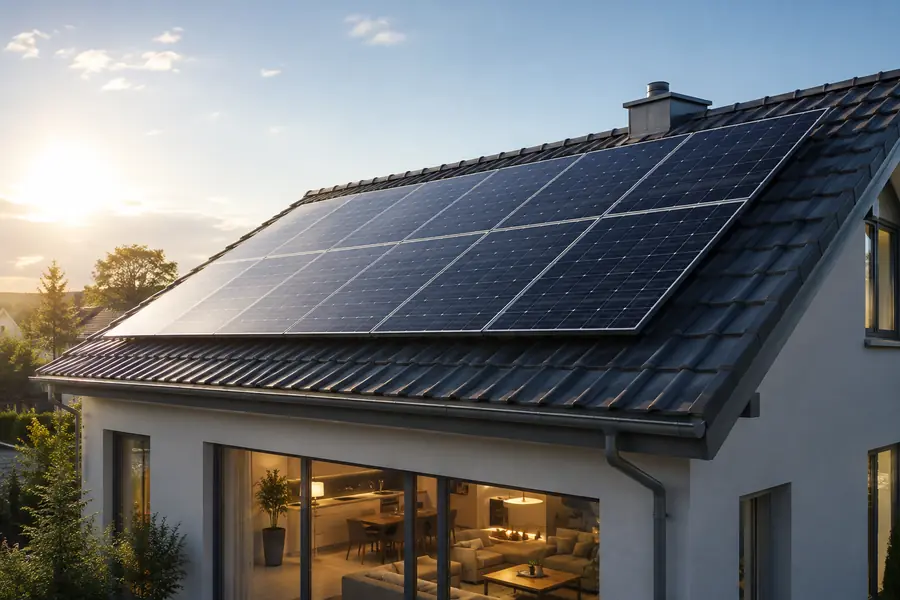
](https://voltcrave-battery.com/wp-content/uploads/2026/09/Solar-with-Battery-System-Cost-Benefits-and-How-to-Choose.webp)
Solar panels can reduce grid electricity purchases, but without energy storage, much of the electricity produced during the day may not be available when you need it most.
A solar with battery system combines photovoltaic panels, an inverter, battery storage, controls, and electrical protection to produce and store electricity for later use. Costs depend on solar size, battery kWh, inverter power, installation, and backup requirements. The right system should match electricity consumption, peak loads, solar production, outage needs, and local electricity rates.
I view solar and battery storage as one integrated energy system. The goal is not simply to install the largest battery possible, but to balance generation, storage capacity, power output, recharge capability, and actual household or business loads.
What Is a Solar with Battery System?
A solar battery system stores electricity that would otherwise be exported, curtailed, or used immediately.
A solar with battery system combines photovoltaic panels with rechargeable energy storage. Solar panels generate DC electricity, while an inverter converts electricity into usable AC power. The battery stores excess energy for nighttime use, peak-rate periods, or outages. A controller, BMS, monitoring system, and electrical protection coordinate safe charging and discharging.
A simplified energy path can look like this:
Sunlight → Solar Panels → Inverter/Charger → Battery → Home or Business Loads
In a grid-connected system, another path exists:
Solar/Battery ↔ Grid
The exact architecture depends on whether the battery is:
AC-coupled
or:
DC-coupled.
The system may also include:
a hybrid inverter,
automatic transfer equipment,
backup gateway,
smart meter,
energy management system,
disconnects,
and dedicated critical-load circuits.
The battery is therefore only one component.
A reliable solar storage system depends on how all these components communicate and operate together.
How Much Does a Solar with Battery System Cost?
There is no single price because solar-plus-storage systems can differ dramatically in size and functionality.
The cost of a solar with battery system depends on PV capacity, usable battery capacity, inverter power, battery chemistry, installation complexity, electrical upgrades, backup equipment, permitting, labor, and local market conditions. A small residential system may require one battery, while whole-home backup or commercial systems can require multiple batteries and much higher inverter capacity.
I separate project cost into several categories:
| Cost Component | What It Covers |
|---|---|
| Solar panels | PV modules that generate electricity |
| Battery | Stored energy capacity |
| Inverter | DC/AC power conversion |
| Mounting | Roof or ground-mounted solar structure |
| BMS | Battery monitoring and protection |
| Backup equipment | Transfer switch, gateway, critical-load panel |
| Electrical work | Wiring, breakers, disconnects, panel upgrades |
| Installation | Engineering and labor |
| Permitting | Local approvals and inspections |
| Monitoring | App, meter, gateway, EMS |
Battery capacity is only one cost driver.
A 10kWh battery installed as part of a new solar project can have a different installed cost from the same nominal capacity added later to an existing PV system.
Site conditions matter as well.
Long cable runs, difficult equipment locations, service-panel upgrades, structural work, and additional backup circuits can increase project cost.
For that reason, I compare installed system cost, not just advertised battery price.
What Are the Main Benefits of Solar with Battery Storage?
The biggest advantage is control over when solar electricity is used.
Solar with battery storage can increase solar self-consumption, provide backup electricity, reduce exposure to peak electricity rates, shift daytime solar production into evening hours, and reduce dependence on the grid. For businesses, batteries may also help manage peak demand, improve resilience, and support more sophisticated energy-management strategies.
Without storage, solar generation follows sunlight.
A typical home may produce its strongest solar output around midday while electricity consumption becomes high again in the evening.
That creates a timing mismatch.
A battery changes the timing.
Instead of exporting excess midday solar, the system can store some of it.
Later:
Battery → Evening Loads
This can be especially valuable under electricity tariffs where exported solar energy is worth less than electricity purchased from the grid later.
Backup power is another major benefit.
However, I do not assume that simply installing solar panels provides backup during an outage.
A grid-connected solar system normally requires appropriate inverter and isolation architecture to safely operate when the grid is down.
Battery storage can provide backup when the system is specifically designed and configured for that purpose.
Does Solar with Battery Storage Save Money?
It can, but the economics depend heavily on electricity rates and system operation.
A solar battery can save money when it stores lower-cost or excess solar electricity and discharges during periods when grid electricity is more expensive. Financial value depends on electricity tariffs, solar export compensation, battery efficiency, usable capacity, degradation, installation cost, incentives, and how frequently the battery can perform valuable energy shifting.
Consider a simplified example.
A home produces excess solar at noon.
If that electricity is exported for a low credit but electricity purchased at 7 p.m. is expensive, storing the solar energy can create additional value.
The battery performs:
low-value period → storage → high-value period.
However, batteries are not free energy.
Charging and discharging involve losses.
The battery also ages.
So the economic calculation should include:
installed cost,
round-trip efficiency,
degradation,
warranty,
electricity price differences,
and expected cycling.
I therefore avoid assuming that a battery automatically produces a fast financial payback.
In some homes, resilience may be the primary reason to buy it.
The energy savings are then an additional benefit.
Can Solar Batteries Power a Home During an Outage?
Yes, if the system is designed for backup operation.
A properly configured solar-plus-battery system can power selected household loads during a grid outage. Backup duration depends on usable battery capacity in kWh and the average power consumption of the protected loads. Whole-home backup requires substantially more power and energy than a critical-load system serving only refrigerators, lights, communications, and essential equipment.
Suppose critical loads average:
800W.
If I want them to operate for:
10 hours,
the simplified energy requirement is:
0.8kW × 10h = 8kWh.
That is the theoretical load energy.
Real sizing should also consider:
inverter losses,
battery reserve,
battery aging,
temperature,
and changing appliance loads.
If the battery has 10kWh of nominal capacity, I would not automatically assume I can deliver exactly 10kWh of useful AC electricity.
Usable capacity and system losses matter.
Solar generation during the outage can extend runtime.
But it depends on weather and the system's ability to recharge the battery while operating in backup mode.
How Many kWh of Battery Storage Do I Need?
Battery capacity should be based on energy consumption and the operating objective.
To estimate solar battery capacity, multiply the average power of the loads you want to support by the required operating time, then adjust for usable battery capacity, inverter losses, reserve margin, and expected solar recharge. A battery sized for evening self-consumption can be much smaller than one designed for overnight or multi-day backup.
Consider two homeowners.
Home A wants to move:
5kWh
of excess afternoon solar into the evening.
Home B wants to support:
1.5kW
of critical loads for:
12 hours.
Home B's theoretical requirement is:
1.5 × 12 = 18kWh.
These are completely different storage objectives.
The same home could therefore require:
5kWh,
10kWh,
20kWh,
or more
depending on what the battery is expected to accomplish.
This is why I ask:
What is the battery supposed to do?
before asking:
How large should the battery be?
What Is the Difference Between kW and kWh in a Solar Battery System?
Confusing power with energy is one of the most common storage-sizing mistakes.
Kilowatts (kW) measure power—the rate at which electricity is delivered. Kilowatt-hours (kWh) measure energy—the amount of electricity stored or consumed over time. A battery may have enough kWh for long runtime but still lack sufficient kW to start or operate high-power appliances. Both specifications must match the application.
Think of it this way:
kW = how much can run at once
kWh = how long it can run
Suppose Battery A has:
10kWh capacity
and:
3kW continuous output.
Battery B also stores:
10kWh
but can deliver:
6kW continuously.
They contain the same nominal energy.
Battery B can support a larger simultaneous load.
Now compare:
Battery C:
20kWh / 3kW
with Battery B:
10kWh / 6kW.
Battery C may provide longer runtime.
Battery B can support higher power.
Neither is automatically better.
What Size Solar System Do I Need with a Battery?
PV size should be based on energy consumption, solar resource, system losses, available installation area, and battery charging requirements.
A solar array should generate enough energy to support daytime loads while providing sufficient surplus electricity to charge the battery when required. A simple starting estimate divides daily electricity consumption by local peak-sun-hours and then adjusts upward for system losses, weather, seasonal variation, orientation, shading, and the desired battery recharge rate.
Suppose a home consumes:
24kWh per day.
Assume:
5 peak-sun-hours
and an initial system factor of:
80%.
A simplified calculation is:
24 ÷ (5 × 0.8) = 6kW.
So approximately:
6kW of PV
is a mathematical starting point.
It is not automatically the final design.
A battery changes the calculation because I may want additional PV capacity to:
serve daytime loads
and:
recharge the battery.
Off-grid systems require even more conservative design because they cannot simply rely on grid electricity after several cloudy days.
Is LiFePO4 Good for Solar Battery Storage?
LiFePO4 has become an important chemistry for stationary energy storage.
LiFePO4, or LFP, is well suited to many solar battery systems because it combines strong cycle-life potential, thermal stability, and suitability for repeated charging and discharging. However, chemistry alone does not determine system quality. Battery management, thermal control, inverter compatibility, installation, operating temperature, warranty, and safety design remain essential.
A solar battery may cycle frequently.
That makes cycle durability important.
But I never choose a battery based only on:
“LFP = long life.”
Actual lifetime depends on:
depth of discharge,
average state of charge,
temperature,
charge and discharge rate,
cycle frequency,
cell quality,
and BMS operation.
Cold conditions also deserve attention.
Some lithium batteries restrict charging at low temperatures unless the system includes suitable thermal management.
Therefore, climate must be part of battery selection.
AC-Coupled vs DC-Coupled Solar Battery: Which Is Better?
Both architectures can work well, but they solve different integration problems.
DC-coupled systems connect solar generation and battery storage on the DC side before electricity is converted for AC loads, while AC-coupled systems connect storage through its own AC-side conversion path. DC coupling can reduce unnecessary conversion steps in some new systems, while AC coupling is often convenient when adding batteries to existing solar installations.
A simplified DC-coupled path can be:
Solar DC → Battery/DC Bus → Hybrid Inverter → AC Loads
An AC-coupled system may look like:
Solar → Solar Inverter → AC Bus ↔ Battery Inverter → Battery
AC coupling can be attractive for retrofits because an existing solar inverter may remain in place.
DC coupling can be elegant for a new integrated installation.
But neither architecture is automatically superior.
I consider:
existing equipment,
backup requirements,
conversion efficiency,
PV sizing,
battery voltage,
inverter compatibility,
and future expansion.
The correct architecture is the one that supports the complete system objective.
How Long Do Solar Batteries Last?
Battery life is determined by both time and usage.
Solar battery lifespan depends on chemistry, temperature, depth of discharge, average state of charge, cycling frequency, charge and discharge power, BMS operation, and environmental conditions. A warranty provides an important reference, but warranty length should not be treated as a precise prediction of actual battery life.
Battery aging occurs in two broad ways.
Calendar aging happens with time.
Cycle aging happens through repeated charging and discharging.
A battery can therefore age even if it is rarely used.
Likewise, aggressive daily cycling can increase wear.
Temperature can accelerate degradation.
Very deep cycles can also create more stress than shallower operation, depending on the chemistry and design.
For this reason, I compare more than warranty years.
I also examine:
warranted energy throughput,
retained capacity,
cycle conditions,
operating-temperature limits,
and warranty exclusions.
Is a Bigger Solar Battery Always Better?
No. Oversizing can increase cost without creating proportional value.
A larger battery provides more stored energy, but it is not automatically better. If the solar array cannot regularly recharge it or the household rarely uses its available capacity, the additional battery may remain underutilized. The best storage size balances usable kWh, load requirements, solar generation, backup goals, recharge speed, and project economics.
Imagine installing:
30kWh
of storage in a home that has only:
4kWh
of regular excess solar production.
If the grid is allowed to charge the battery, that may still have a purpose.
But if the objective is exclusively storing excess solar, the battery may rarely reach full charge.
Similarly, an enormous battery paired with a small inverter can provide long runtime but insufficient instantaneous power.
Bigger equipment does not automatically create a better-balanced system.
I prefer:
correctly sized
over:
maximum size.
How Do I Choose the Right Solar with Battery System?
I start with the load profile, not the battery catalog.
To choose the right solar with battery system, determine daily electricity consumption, peak power demand, critical backup loads, required backup duration, local solar production, electricity tariff, available installation space, and expansion plans. Then match PV capacity, usable battery kWh, inverter kW, surge capability, charging power, and system architecture to those requirements.
A useful design sequence is:
Load profile → Goal → PV size → Battery kWh → Inverter kW → Recharge capability → Backup architecture → Safety → Economics
For residential systems, the goal may be:
lower electricity bills,
evening solar use,
or outage backup.
For businesses, additional goals can include:
peak shaving,
demand-charge management,
resilience,
and solar self-consumption.
The correct system changes when the objective changes.
I also check compatibility carefully.
The battery, BMS, inverter, monitoring equipment, and control system need to work together.
A battery with excellent specifications can still be a poor choice if it cannot communicate correctly with the selected inverter.
What Safety Features Should a Solar Battery System Have?
Battery storage should be treated as an engineered electrical system.
A solar battery installation should include an appropriate BMS, overcurrent protection, disconnects, correct wiring, thermal management, grounding, monitoring, and equipment certified or approved for the intended application and jurisdiction. Installation requirements depend on battery chemistry, system size, location, electrical code, fire requirements, and local permitting rules.
The BMS monitors conditions such as:
cell voltage,
battery current,
temperature,
and state of charge.
But a BMS is not the entire safety system.
The installation also depends on:
proper conductor sizing,
fuses or breakers,
disconnects,
inverter protection,
equipment spacing,
and correct commissioning.
For larger systems, thermal and fire-safety considerations become increasingly important.
This is another reason I prefer evaluating the complete energy storage system rather than buying batteries as isolated components.
My Insights: Solar with Battery System-Cost, Benefits, and How to Choose
A solar battery project works best when solar generation, battery capacity, inverter power, loads, and economics are designed together.
A solar with battery system can reduce grid dependence, increase solar self-consumption, provide backup power, and shift energy into higher-value periods. Its cost depends on PV capacity, battery kWh, inverter power, installation, and backup equipment. The best system is not necessarily the largest—it is the one correctly matched to the load profile, solar resource, tariff, and operating objective.
My First Insight: The Battery Should Be Sized From a Job
I do not begin with:
“Should I buy a 10kWh or 20kWh battery?”
I begin with:
“What does the battery need to accomplish?”
Evening self-consumption may require one capacity.
Overnight backup may require another.
Whole-home resilience may require far more.
The battery size should follow the operating objective.
My Second Insight: kW Can Be More Important Than kWh During an Outage
Large storage capacity sounds impressive.
But a battery must also deliver enough instantaneous power.
A:
20kWh / 3kW
system may provide substantial energy.
But it still cannot continuously support a:
5kW load.
For backup systems, I therefore calculate both:
energy requirement
and:
power requirement.
Ignoring either one can result in poor system performance.
My Third Insight: Solar Recharge Determines Real Resilience
A battery is finite.
If an outage lasts long enough, it eventually reaches its minimum state of charge.
Solar changes this by creating a potential daily recharge cycle.
That means true resilience depends on:
battery autonomy + daytime solar recovery.
A smaller battery with strong solar recharge can sometimes support extended outages more effectively than a very large battery connected to an undersized solar array.
Weather still matters, so backup design should consider poor solar conditions rather than only perfect sunny days.
My Fourth Insight: Battery Economics Depend on Timing
The value of stored electricity depends on:
when it is charged
and:
when it is discharged.
If solar electricity has low export value at noon but grid electricity is expensive in the evening, storage can create economic value by moving energy through time.
If electricity prices barely change and solar exports are highly compensated, the financial case may be different.
So I do not calculate battery ROI from battery price alone.
I calculate it from:
battery behavior inside the local tariff.
My Fifth Insight: Solar with Battery System: Cost, Benefits, and How to Choose
This directly answers the H1.
| Decision | What I Evaluate |
|---|---|
| Cost | PV, battery, inverter, installation, electrical work |
| Battery capacity | Required usable kWh |
| Power | Continuous and surge kW |
| Solar size | Daily load and recharge requirement |
| Main benefit | Self-consumption, savings, backup, resilience |
| Battery chemistry | Cycle life, safety, temperature behavior |
| Architecture | AC-coupled or DC-coupled |
| Backup duration | Critical load × required hours |
| Economics | Tariff, export value, cycling, incentives |
| Expansion | Future PV, battery, and load requirements |
| Safety | BMS, protection, thermal design, installation |
| Best system | Correctly balanced system, not largest battery |
My central design principle is:
Load profile + solar resource + operating goal + grid conditions = system architecture.
Then:
System architecture = PV + inverter + battery + controls + protection + monitoring.
This is why I do not recommend selecting solar panels first and randomly adding a battery later.
Suppose a home consumes:
30kWh per day
but only needs:
8kWh
of critical backup overnight.
A 30kWh battery may be unnecessary.
On the other hand, suppose another home wants whole-home backup including:
air conditioning,
well pumps,
cooking,
and EV charging.
A small 10kWh battery may have insufficient:
energy,
power,
or both.
The correct design begins with measured electricity consumption.
Hourly or interval data is even better than a monthly electricity bill because it reveals:
when electricity is used,
how high peak demand becomes,
and how consumption overlaps with solar production.
From there, I determine the objective.
If the priority is:
bill savings,
I focus on solar self-consumption and tariff timing.
If the priority is:
backup,
I focus on critical loads, outage duration, surge power, and recharge.
If the priority is:
off-grid independence,
I focus heavily on winter solar production, battery autonomy, generator backup, and recovery after poor-weather periods.
For a business, I may also examine:
demand peaks,
operating schedules,
critical production loads,
and the financial cost of downtime.
This leads to a more useful definition of the best solar battery system:
The best solar with battery system is the smallest well-balanced system that reliably meets the required energy, power, backup, and economic objectives with sufficient reserve and future flexibility.
Not the system with the largest battery.
Not the system with the most solar panels.
And not automatically the system with the lowest purchase price.
The components need to work together.
That is what turns solar panels and batteries into a reliable energy system.
Conclusion
A good solar battery system balances PV generation, usable kWh, inverter kW, recharge capability, backup needs, safety, and economics instead of simply maximizing battery size.
](https://voltcrave-battery.com/wp-content/uploads/2026/08/What-Happens-to-Home-Battery-Storage-During-a-Power-Outage-768x512.webp)
](https://voltcrave-battery.com/wp-content/uploads/2026/08/How-Long-Does-a-BESS-Battery-Normally-Last-768x512.webp)
](https://voltcrave-battery.com/wp-content/uploads/2026/08/What-Are-Solar-Panels-in-Simple-Words-768x512.webp)