
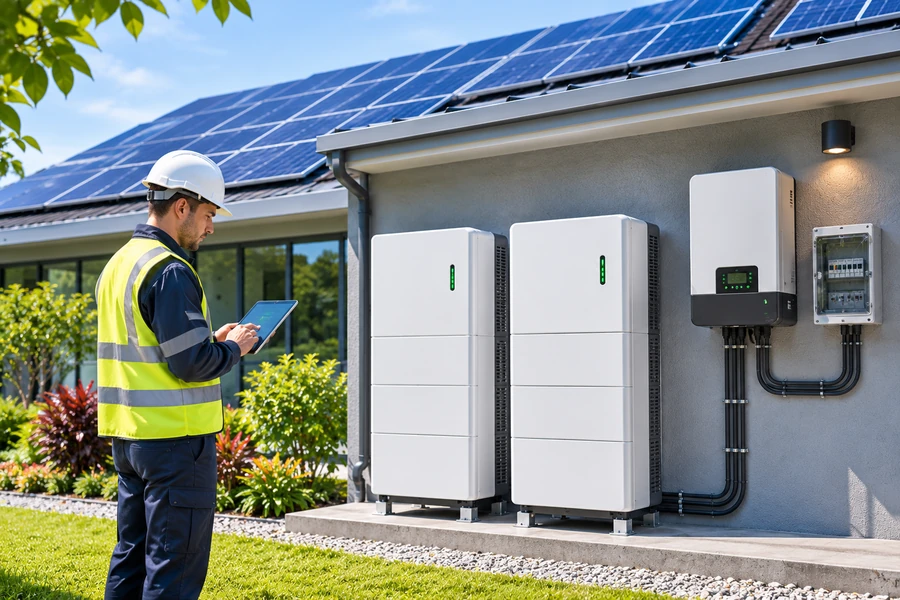
](https://voltcrave-battery.com/wp-content/uploads/2026/11/Which-Lithium-Battery-Is-Best-for-Solar-900x600-1.webp)
Choosing the wrong solar battery can increase energy costs, reduce backup performance, and create long-term maintenance problems. Different lithium battery technologies offer different advantages.
Lithium iron phosphate (LiFePO4 or LFP) is generally the best lithium battery for solar energy storage because it offers long cycle life, good thermal stability, and competitive costs. NMC batteries provide higher energy density where space and weight matter, while lithium titanate (LTO) can be useful for specialized applications requiring exceptional cycle durability.
Solar battery selection depends on more than battery chemistry. System capacity, inverter compatibility, operating temperature, safety certification, and lifecycle costs are also important. Understanding these factors helps homeowners, solar installers, and commercial energy storage buyers choose suitable battery technology.
Why Is LiFePO4 Considered the Best Lithium Battery for Solar?
Solar energy storage systems often charge during daylight and discharge in the evening. This repeated operation makes battery durability, efficiency, and safety particularly important.
LiFePO4 is considered one of the best lithium battery chemistries for solar because it combines long cycle life, stable thermal behavior, and relatively low manufacturing costs. It is suitable for residential solar batteries, commercial energy storage systems, and large-scale solar installations that require frequent charging and discharging over many years.
Long Battery Cycle Life
I consider battery cycle life one of the most important factors when evaluating solar storage technology.
Solar batteries may complete hundreds of charge and discharge cycles every year.
A battery designed for frequent cycling can provide more useful energy throughout its operating life.
Many modern LiFePO4 battery products advertise approximately 3,000–6,000 equivalent full cycles before reaching a specified remaining-capacity threshold.
However, these ratings depend on the manufacturer and testing conditions.
For example, a battery may be rated for 4,000 cycles while retaining 80% of its original capacity.
This does not mean the battery stops working after 4,000 cycles.
It means the battery is expected to retain approximately 80% capacity under the specified test conditions.
The remaining capacity may still be useful for many solar energy storage applications.
Good Thermal Stability
Battery safety is another major advantage of LiFePO4 technology.
The lithium iron phosphate cathode generally has better thermal stability than several high-nickel lithium-ion chemistries.
This can reduce some battery failure risks when combined with appropriate system protection.
However, LiFePO4 batteries are not completely fireproof.
Electrical faults, physical damage, manufacturing defects, and unsuitable operating conditions can still create hazardous situations.
I recommend evaluating the complete energy storage system rather than relying only on the battery chemistry.
A suitable battery management system, thermal management, electrical protection, and tested enclosure design remain essential.
Competitive Long-Term Costs
LFP technology has gained an important cost advantage in stationary energy storage.
It does not require nickel or cobalt in its cathode chemistry.
This can reduce exposure to the costs of those materials.
LFP batteries also offer a favorable balance between battery durability and initial investment.
For solar installations that operate daily, long cycle life can help reduce the cost of stored electricity over time.
I consider lifetime economics more meaningful than the initial battery purchase price alone.
Suitable for Different Solar Applications
LiFePO4 batteries are widely used in:
- Residential solar energy storage
- Commercial and industrial BESS
- Off-grid solar installations
- Solar-powered microgrids
- Containerized energy storage systems
- Portable solar power stations
The same battery chemistry can be used in different configurations.
However, equipment design, battery management, cooling, and electrical protection must match each application.
A residential battery module should not automatically be considered suitable for a large commercial installation without the required system-level engineering.
How Do LiFePO4, NMC, and LTO Batteries Compare for Solar Storage?
Lithium-ion batteries are available with different electrode chemistries. LiFePO4, NMC, and LTO systems offer different combinations of energy density, cycle life, thermal behavior, and cost.
LiFePO4 batteries generally offer the best balance for everyday stationary solar storage. NMC batteries provide higher energy density when installation space or weight is limited. LTO batteries can support specialized applications requiring very high cycling performance or demanding operating conditions, although their higher cost and lower energy density limit widespread solar adoption.
LiFePO4 vs. NMC vs. LTO
| Feature | LiFePO4 (LFP) | NMC | LTO |
|---|---|---|---|
| Main Advantage | Cycle life and cost balance | High energy density | Exceptional cycling capability |
| Energy Density | Moderate | Higher | Lower |
| Thermal Stability | Generally favorable | More demanding thermal design | Generally favorable |
| Cycle Durability | High | Depends on design | Very high in suitable designs |
| Relative Cost | Often competitive | Usually higher than LFP in comparable stationary applications | Generally high |
| Solar Application | Residential, C&I, utility-scale | Space-constrained systems | Specialized energy storage |
| Main Limitation | Lower energy density than NMC | Thermal management and cost | Cost and system size |
This table shows broad technology characteristics. Actual product specifications, cycle-life ratings, operating limits, and costs must be verified for the specific battery design.
LiFePO4: Best for Most Stationary Solar Systems
I recommend considering LFP as the starting point for most conventional solar battery projects.
Stationary applications often have more flexibility in equipment weight and physical space than electric vehicles.
This reduces the importance of maximum energy density.
Instead, cycle durability, safety performance, and lifetime costs become more important.
LFP offers a practical balance between these requirements.
Its strong position in stationary energy storage also means buyers can evaluate a wide range of commercial products and system configurations.
NMC: Useful When Space and Weight Matter
Nickel manganese cobalt oxide batteries are another major lithium-ion technology.
NMC cells typically have higher gravimetric and volumetric energy density than LFP cells.
This means a given amount of battery energy can occupy less space or weigh less.
For some projects, this advantage can be significant.
For example, weight and space may be major constraints in mobile energy storage equipment or compact installations.
However, NMC battery systems require appropriate thermal management and protection.
I recommend comparing the complete battery systems rather than individual cell energy density alone.
LTO: Suitable for Specialized Applications
Lithium titanate batteries use a different negative-electrode material from the graphite commonly used in many LFP and NMC cells.
LTO technology can provide excellent cycle durability and high charge-discharge capability.
It can also offer useful performance in certain low-temperature applications.
However, LTO systems generally have lower energy density and higher costs than conventional LFP systems.
These disadvantages limit their competitiveness in many residential and commercial solar installations.
I consider LTO most appropriate when the project's operational requirements justify its additional cost.
Are LiFePO4 and Lithium-Ion Batteries Different?
This is an important technical distinction.
LiFePO4 is a type of lithium-ion battery.
NMC and LTO-based batteries also belong to the broader lithium-ion battery family.
Therefore, comparing “LiFePO4 versus lithium-ion” is not technically precise.
The correct comparison is between different lithium-ion battery chemistries.
For solar storage projects, I recommend comparing LiFePO4 with specific alternatives such as NMC or LTO rather than treating all lithium-ion batteries as one identical technology.
What Size Lithium Battery Do You Need for a Solar System?
Selecting the correct battery chemistry is only the first step. Battery capacity must also match daily electricity consumption, backup requirements, and available solar generation.
The right solar battery size depends on the amount of electricity you need to store, the expected backup duration, usable depth of discharge, and energy conversion losses. Home backup installations may require several kilowatt-hours, while commercial and utility-scale solar projects can require hundreds or thousands of kilowatt-hours.
Battery Capacity vs. Power Output
I recommend understanding two important specifications before selecting a solar battery.
Battery Capacity (kWh)
Battery capacity describes the amount of electricity a battery can store.
For example, a 10 kWh battery contains a nominal energy capacity of 10 kilowatt-hours.
Power Output (kW)
Power output describes how quickly the battery system can deliver electricity.
For example, a system with a 5 kW output rating can supply up to its rated continuous power under approved conditions.
A large battery capacity does not automatically mean high power output.
Both specifications must match the intended electrical loads.
Solar Battery Sizing Formula
I use the following simplified calculation to estimate required nominal battery capacity:
Required Capacity (kWh) = Daily Energy Demand (kWh) × Backup Days ÷ (Usable DoD × Delivery Efficiency)
Suppose a home requires 12 kWh of energy for essential appliances during a power outage.
Assume:
- Daily critical energy demand: 12 kWh
- Required backup duration: 1 day
- Usable depth of discharge: 90%
- Assumed delivery efficiency: 90%
The estimated nominal battery capacity is:
12 ÷ (0.90 × 0.90) = 14.8 kWh
Under these assumptions, approximately 15 kWh of rated battery capacity would be required.
This estimate assumes no solar replenishment during the backup period.
It also does not include an additional planning margin for battery aging, unusual loads, or extended bad weather.
Example: Solar Battery Capacity by Application
| Application | Illustrative Capacity | Main Purpose |
|---|---|---|
| Small Home Backup | 5–10 kWh | Selected essential appliances |
| Residential Solar Storage | 10–20 kWh | Self-consumption and backup |
| Larger Residential System | 20–40 kWh | Extended backup or higher demand |
| Commercial Solar Storage | 50–500 kWh | Peak shaving and energy management |
| Industrial BESS | 500 kWh–5 MWh | Load management and renewable integration |
| Utility-Scale Solar Storage | Multiple MWh | Grid support and energy shifting |
These are illustrative project ranges, not universal recommended sizes. Actual requirements must be calculated from the load profile, system architecture, and project objectives.
Depth of Discharge and Usable Capacity
Depth of discharge (DoD) indicates how much of the battery's rated capacity is used.
For example, a 10 kWh battery operated with a 90% usable depth of discharge provides approximately 9 kWh before accounting for conversion losses.
Manufacturers may specify different usable operating ranges.
Some battery systems also reserve energy for protection, backup, or battery management functions.
I recommend checking usable energy rather than relying only on nominal battery capacity.
Solar Generation and Charging Requirements
Battery capacity must be coordinated with the solar panel system.
A large battery may not recharge sufficiently if the available solar generation is too small.
For example, a battery that stores energy for evening consumption requires enough daytime solar output to replenish the energy removed.
Solar energy production depends on:
- Installed PV capacity
- Daily solar irradiance
- Panel orientation and shading
- Seasonal weather conditions
- Inverter and conversion losses
- Electricity consumed directly during daylight
For off-grid projects, I recommend using seasonal generation data rather than annual averages alone.
Periods of low sunlight can be more important than average sunny-day performance.
What Should You Consider Before Buying a Lithium Solar Battery?
A good solar battery should meet technical, safety, and economic requirements. Battery chemistry alone does not guarantee compatibility or reliable long-term operation.
Before buying a lithium solar battery, evaluate usable capacity, inverter compatibility, battery management, safety certification, operating temperature, cycle-life specifications, warranty terms, and lifecycle costs. The selected system should also support the intended solar configuration, electrical loads, and local installation requirements.
Solar Inverter Compatibility
I consider inverter compatibility one of the most important purchasing requirements.
A solar battery must operate within the inverter's supported voltage, power, and communication limits.
Some systems use low-voltage batteries, while others use high-voltage battery configurations.
The battery management system and inverter may communicate through CAN, RS485, or another supported interface.
However, having the same physical communication port does not guarantee that two products can communicate correctly.
The inverter manufacturer should confirm compatibility with the specific battery model and firmware configuration.
AC-Coupled vs. DC-Coupled Storage
Solar batteries can be integrated using different electrical architectures.
AC-Coupled Systems
These systems connect the battery storage equipment to the AC side of the installation.
They can offer flexibility when adding batteries to an existing solar system.
DC-Coupled Systems
These connect the PV and battery systems on a common DC-side architecture, often using a compatible hybrid inverter.
They can reduce certain conversion stages and may offer integration advantages in new installations.
I recommend selecting the architecture based on the existing equipment, project design, and expected operating strategy.
Battery Management and Temperature Protection
A reliable battery management system should monitor important operating conditions.
These include battery voltage, current, temperature, state of charge, and protection limits.
Temperature protection is particularly important.
Many conventional lithium-ion batteries cannot be charged normally below freezing without specific controls or heating systems.
LiFePO4 batteries also require suitable low-temperature charging protection.
I recommend checking the manufacturer's charging and discharging temperature specifications separately.
A battery that can discharge below freezing may still be restricted from charging at the same temperature.
Safety Certifications
For solar storage projects, certification requirements depend on the country, installation type, and applicable regulations.
Important standards can include:
| Standard | Main Application |
|---|---|
| UL 1973 | Safety of batteries used in stationary applications |
| UL 9540 | Complete energy storage system safety |
| UL 9540A | Thermal runaway and fire propagation testing |
| IEC 62619 | Safety requirements for industrial lithium battery cells and batteries |
| IEC 63056 | Additional safety requirements for lithium batteries used in electrical energy storage systems |
| UN 38.3 | Lithium battery transport testing |
These standards address different aspects of battery performance and safety.
A battery cell test report is not automatically equivalent to complete system certification.
For example, UL 9540 evaluates the energy storage system as an integrated product.
I recommend verifying the actual certification documents and approved equipment combinations before procurement.
Battery Warranty and Long-Term Costs
Warranty terms vary significantly between manufacturers.
Some solar batteries include warranty provisions based on years of operation.
Others also specify total energy throughput, operating conditions, and minimum remaining capacity.
I recommend checking three important items:
Warranty Duration
How long does the manufacturer provide coverage?
Capacity Retention
What remaining battery capacity is guaranteed under the stated conditions?
Energy Throughput
How much cumulative charging or discharging is covered?
These conditions help buyers understand the long-term value of the system.
I also recommend comparing total project costs, including installation, electrical equipment, monitoring, maintenance, and possible future battery replacement.
The cheapest battery on the purchase date may not provide the lowest cost over the project's operating life.
My Insight: Which Lithium Battery Is Best for Solar
I believe LiFePO4 is the best overall lithium battery chemistry for most residential, commercial, and stationary solar energy storage projects.
Its combination of long cycle life, thermal stability, and competitive costs makes it suitable for applications that require frequent charging and discharging.
However, I do not believe battery chemistry should be the only factor in equipment selection.
A high-quality LiFePO4 battery connected to an incompatible inverter may create more problems than a properly integrated alternative system.
For this reason, I recommend evaluating five factors.
1. Battery Chemistry
I generally recommend starting with LiFePO4 for conventional solar storage applications.
NMC or LTO may be appropriate when specific technical requirements justify their advantages.
2. Usable Energy Capacity
I recommend calculating the actual electricity demand and backup duration before selecting nominal battery capacity.
A larger battery does not automatically provide better value.
3. System Compatibility
The battery, inverter, battery management system, and energy management controls must operate together correctly.
I consider verified equipment compatibility especially important for OEM and commercial storage projects.
4. Safety and Reliability
I recommend reviewing system certifications, thermal management, electrical protection, and the manufacturer's technical documentation.
Battery chemistry alone cannot eliminate installation or operating risks.
5. Total Cost of Ownership
I believe long-term economics should include battery degradation, usable energy, operating efficiency, maintenance, and warranty conditions.
For residential solar systems, a well-designed LFP battery can provide a practical combination of daily cycling and backup energy.
For commercial projects, I recommend evaluating the operating load profile, required discharge duration, and energy management strategy.
For large containerized BESS projects, I place additional emphasis on electrical integration, cooling, fire safety, commissioning, and technical support.
I also consider supplier capability important.
A reliable battery manufacturer should provide clear specifications, suitable testing documentation, compatible system configurations, and support throughout the project lifecycle.
The best lithium solar battery is not necessarily the product with the highest advertised capacity or longest cycle-life claim.
It is the battery system that safely delivers the required energy, integrates correctly with the solar installation, and provides dependable long-term performance.
Conclusion
LiFePO4 is generally the best lithium battery for solar storage because of its cycle life, thermal stability, and cost advantages. Final selection depends on system requirements and compatibility.
](https://voltcrave-battery.com/wp-content/uploads/2026/09/What-Are-the-Different-Types-of-LiFePO4-Battery-Cells-768x512.webp)
](https://voltcrave-battery.com/wp-content/uploads/2026/11/What-Is-the-Life-Expectancy-of-a-Portable-Power-Station-768x512.webp)
](https://voltcrave-battery.com/wp-content/uploads/2026/09/What-Are-BESS-Containers-Made-Of-768x512.webp)







































