
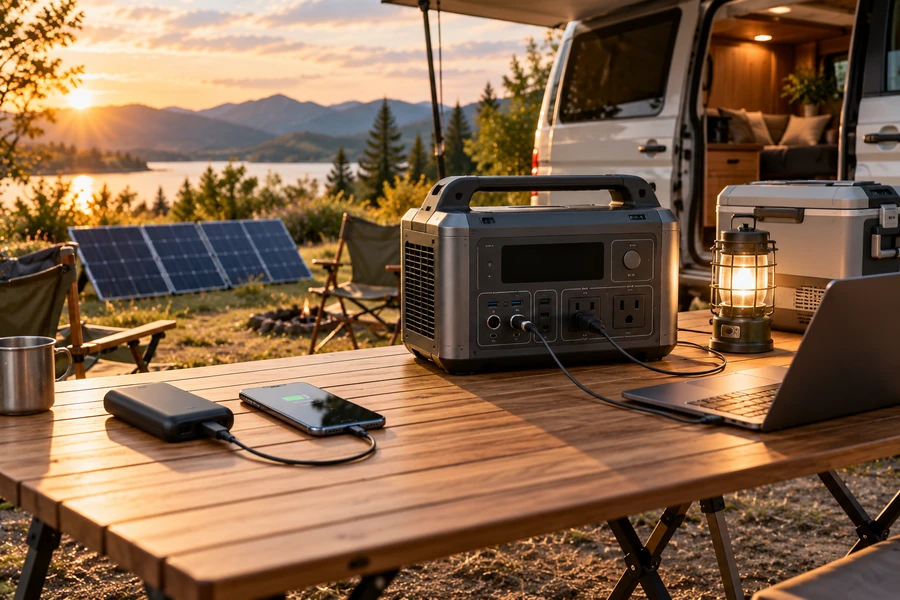
](https://voltcrave-battery.com/wp-content/uploads/2026/10/Which-Is-Better-a-Powerbank-or-a-Power-Station.webp)
Running out of battery can interrupt travel, work, and outdoor activities. Choosing the wrong portable power solution may leave important devices without sufficient electricity.
A power bank is better for charging smartphones, tablets, and compatible USB-C laptops because it is lightweight, compact, and affordable. A portable power station is better for camping appliances, refrigerators, power tools, and emergency backup because it offers larger battery capacity and AC outlets. The best choice depends on your energy needs.
I recommend choosing between power banks and portable power stations based on device requirements, battery capacity, output power, portability, and intended usage for reliable charging.
What Is the Difference Between a Power Bank and a Portable Power Station?
Power banks and portable power stations both provide electricity away from a wall outlet. However, their different capacities and electrical interfaces can make choosing between them confusing.
A power bank is a compact rechargeable battery designed mainly for charging USB-powered electronics. A portable power station is a larger energy storage device that typically includes an inverter, AC outlets, USB ports, and other DC connections. Power banks prioritize portability, while portable power stations provide more energy and support a wider range of electrical equipment.
What Is a Power Bank?
A power bank is a rechargeable battery designed to charge portable electronic devices.
Most power banks use lithium-ion or lithium-polymer battery cells.
They commonly include USB-A or USB-C connections and a Battery Management System (BMS).
Typical applications include charging:
- Smartphones
- Tablets
- Wireless headphones
- Smartwatches
- Digital cameras
- Portable gaming devices
- Compatible USB-C laptops
I consider power banks especially useful for commuting, business travel, and everyday mobile work.
A small power bank can fit inside a backpack, handbag, or pocket.
Some high-performance models also support USB-C Power Delivery at 65W, 100W, or higher.
This allows compatible laptops to charge directly from a power bank without requiring an AC inverter.
However, most conventional USB power banks cannot operate household appliances that require AC electricity.
What Is a Portable Power Station?
A portable power station is a rechargeable energy storage system designed to provide electricity for multiple devices and selected appliances.
It typically combines a battery pack, inverter, charging equipment, BMS, and output connections.
Most models include:
- AC power outlets
- USB-C and USB-A ports
- DC output connections
- AC charging input
- Compatible solar charging input
- Battery monitoring and protection
Many modern portable power stations use lithium iron phosphate (LiFePO4) batteries.
I consider this chemistry attractive because of its cycling durability and thermal stability.
Portable power stations are commonly used for camping, recreational vehicles, outdoor work, and emergency backup.
However, not every product supports the same appliances.
The inverter must provide sufficient continuous output power, and the battery must contain enough energy for the required operating time.
Power Bank vs. Portable Power Station Comparison
| Feature | Power Bank | Portable Power Station |
|---|---|---|
| Main purpose | Mobile USB charging | Portable AC and DC electricity |
| Typical capacity | 5,000–27,000mAh | Around 200Wh to several thousand Wh |
| Output connections | Mainly USB-C and USB-A | AC outlets, USB, and DC |
| Laptop charging | Possible with compatible USB-C PD models | Usually supported within ratings |
| Household appliances | Usually unsuitable | Selected appliances supported |
| Solar charging | Limited model availability | Common on many models |
| Weight | Generally lightweight | Generally heavier |
| Air travel | Possible within applicable limits | Most larger models exceed flight limits |
| Initial cost | Usually lower | Usually higher |
| Best applications | Travel and everyday electronics | Camping, RVs, and backup power |
I would not assume that power stations always provide faster charging for smartphones.
A high-quality USB-C power bank may charge a compatible phone just as quickly as a larger power station.
The actual charging speed depends on the output protocol, wattage, and device requirements.
How Do Power Banks and Portable Power Stations Compare in Capacity and Runtime?
Battery capacity is one of the main differences between these products. However, manufacturers often describe power banks in milliamp-hours and power stations in watt-hours, making direct comparisons difficult.
Portable power stations generally store substantially more energy than conventional power banks. A 20,000mAh power bank rated at 3.7V contains approximately 74Wh, while a 1,000Wh power station stores about 13.5 times more nominal energy. Actual charging performance depends on conversion efficiency, available output power, battery condition, and connected devices.
Understanding mAh and Wh
Power bank capacity is commonly advertised in milliamp-hours (mAh).
Portable power station capacity is usually advertised in watt-hours (Wh).
These specifications describe related but different measurements.
Milliamp-hours (mAh) measure electrical charge capacity.
Watt-hours (Wh) measure stored electrical energy.
I prefer using watt-hours when comparing products because energy capacity also depends on battery voltage.
The basic formula is:
Battery Energy (Wh) = Nominal Voltage (V) × Capacity (Ah)
For example, consider a 20,000mAh power bank rated at 3.7V.
First, convert milliamp-hours into amp-hours:
20,000mAh = 20Ah
Then calculate stored energy:
3.7V × 20Ah = 74Wh
This means the power bank contains approximately 74Wh of nominal battery energy.
Comparing Common Battery Capacities
The following power bank examples assume a nominal cell voltage of 3.7V.
| Battery Type | Advertised Capacity | Approximate Energy |
|---|---|---|
| Small power bank | 5,000mAh | 18.5Wh |
| Standard power bank | 10,000mAh | 37Wh |
| High-capacity power bank | 20,000mAh | 74Wh |
| Large power bank | 25,000mAh | 92.5Wh |
| Small power station | 300Wh | 300Wh |
| Medium power station | 1,000Wh | 1,000Wh |
| Large power station | 2,000Wh | 2,000Wh |
The exact energy rating depends on the manufacturer's battery configuration.
I always check the official watt-hour specification rather than assuming every product uses the same nominal cell voltage.
How Many Times Can a Power Bank Charge a Smartphone?
I estimate charging performance using stored energy and the phone battery's energy capacity.
Suppose a smartphone has a battery containing approximately 18Wh.
A 20,000mAh power bank contains approximately 74Wh.
If the combined energy delivery and charging efficiency is assumed to be 80%, the usable charging energy is:
74Wh × 0.80 = 59.2Wh
The estimated number of full charges would be:
59.2Wh ÷ 18Wh = 3.3 charges
This is a simplified estimate.
Actual charging performance depends on battery voltage conversion, charging losses, temperature, device usage, and battery condition.
I would not assume that a 20,000mAh power bank can fully charge every 5,000mAh smartphone four times.
How Long Can a Portable Power Station Run Appliances?
Portable power stations are usually evaluated according to appliance runtime.
I use the following formula:
Runtime (hours) = Available AC Energy (Wh) ÷ Average Appliance Load (W)
Suppose a portable power station has 1,000Wh of nominal capacity.
Assume 80% of its stored energy becomes available as AC electricity.
Available energy would be:
1,000Wh × 0.80 = 800Wh
If a connected appliance consumes 100W continuously:
800Wh ÷ 100W = 8 hours
The station could theoretically operate that appliance for approximately eight hours.
Actual runtime may vary because of inverter efficiency, auxiliary power consumption, battery reserves, and operating conditions.
Estimated Portable Power Station Runtime
| Nominal Capacity | 100W Load | 300W Load | 500W Load |
|---|---|---|---|
| 300Wh | 2.4 hours | 0.8 hours | 0.5 hours |
| 500Wh | 4 hours | 1.3 hours | 0.8 hours |
| 1,000Wh | 8 hours | 2.7 hours | 1.6 hours |
| 2,000Wh | 16 hours | 5.3 hours | 3.2 hours |
These figures assume 80% usable AC energy and a constant load.
I recommend measuring actual appliance consumption before purchasing a power station.
A refrigerator, for example, may use significantly less power on average than its running wattage suggests because its compressor cycles on and off.
Which Is Better for Travel, Camping, Laptops, and Home Backup?
Different activities require different amounts of electricity. A power bank that works well during a business trip may be unsuitable for running camping appliances or household equipment.
A power bank is usually better for daily travel, flights, and USB-C laptop charging. A portable power station is better for camping, RV use, outdoor equipment, and selected home backup applications. The decision depends on whether the connected devices require USB power, AC electricity, extended operating time, or a combination of outputs.
Best for Everyday Travel: Power Bank
I prefer a compact power bank for commuting and ordinary travel.
Most mobile users need to recharge smartphones, tablets, headphones, or other small electronic devices.
A 10,000mAh power bank can provide useful emergency charging without adding substantial weight to a bag.
For longer travel, a 20,000–25,000mAh model may offer greater flexibility.
However, larger batteries are heavier.
I recommend choosing capacity according to how many charging sessions are actually needed.
A portable power station would generally be unnecessary for someone who only needs smartphone charging.
Best for Laptop Charging: Depends on USB-C Compatibility
Some buyers assume that laptops require portable power stations.
I do not consider this universally correct.
Many laptops support USB-C Power Delivery.
A compatible power bank with sufficient single-port output can recharge these devices directly.
For example, a laptop requiring 65W USB-C charging may work with a suitable 100W USB-C power bank.
However, the power bank must support the correct voltage and charging protocol.
The cable must also be rated for the required power.
For laptops that require an AC adapter or higher sustained power, a portable power station may be more appropriate.
I recommend checking the laptop manufacturer's charging requirements before selecting equipment.
Best for Camping: Portable Power Station for Appliances
Camping equipment may include lighting, phones, laptops, refrigerators, fans, and cooking appliances.
A power bank can handle many small USB devices.
However, it usually cannot operate a conventional AC refrigerator or other household-style appliances.
I consider a portable power station more suitable when camping requires AC electricity.
For example, a 1,000Wh station may support a small refrigerator and selected electronics for a limited period.
However, operating duration depends on actual power consumption.
I would calculate daily energy demand before selecting the power station's capacity.
Best for Air Travel: Power Bank
Airline restrictions are an important difference.
Under U.S. Federal Aviation Administration guidance, power banks are treated as spare lithium batteries and must be carried in cabin baggage.
General FAA limits include:
| Battery Energy Rating | General FAA Rule |
|---|---|
| Up to 100Wh | Generally permitted in carry-on baggage |
| Above 100Wh up to 160Wh | Airline approval required, with quantity limits |
| Above 160Wh | Not permitted as an ordinary passenger lithium battery |
Airlines and other jurisdictions may impose stricter conditions.
I recommend checking the exact watt-hour rating and airline rules before traveling.
Most larger portable power stations exceed these limits and cannot be transported on ordinary passenger flights.
Best for Home Backup: Portable Power Station
For household emergencies, I generally prefer a properly sized portable power station over a small power bank.
A power bank can maintain phone communication and charge USB devices.
However, a power station may support selected household appliances.
These can include refrigerators, routers, lights, fans, and compatible low-power equipment.
I would not assume that every power station can operate an entire home.
For permanent household electrical connections, the equipment must be approved for that installation and use suitable transfer and protection devices.
Application Comparison
| Application | Better Starting Choice |
|---|---|
| Smartphone charging | Power Bank |
| Tablet charging | Power Bank |
| Compatible USB-C laptop | High-output Power Bank |
| Air travel | Power Bank within airline limits |
| Backpacking | Power Bank |
| Camping with refrigerators | Portable Power Station |
| RV appliances | Portable Power Station |
| Outdoor tools | Portable Power Station |
| Emergency household appliances | Portable Power Station |
| Extended whole-home backup | Properly engineered home ESS |
I believe the best option is the smallest and simplest system that safely meets the actual electrical requirements.
How Do You Choose a Safe and Cost-Effective Power Bank or Power Station?
Battery-powered products can appear similar in advertisements, but their electrical ratings and safety features can differ greatly. Selecting equipment based only on capacity or price may create compatibility and reliability problems.
To choose between a power bank and a portable power station, I check battery energy capacity, output power, charging protocols, port compatibility, weight, safety certification, and warranty support. I also evaluate whether AC electricity is necessary. The best product provides enough usable energy without unnecessary conversion losses, size, or cost.
Match Output Power to Your Devices
I always check the power requirements of connected equipment.
For USB charging, the important specifications include USB-C Power Delivery support, single-port output, cable compatibility, and charging voltage.
For AC appliances, the inverter's continuous output rating becomes important.
For example, a 1,000Wh portable power station may contain substantial energy.
However, if its AC inverter is rated for only 500W, it cannot continuously support an appliance requiring 800W.
I also evaluate temporary surge requirements.
Refrigerators, pumps, and other motor-driven appliances may require additional power during startup.
Consider Conversion Efficiency
Power conversion consumes energy.
A typical USB power bank converts its battery voltage to the output required by the device.
A portable power station may convert DC battery electricity into AC electricity using an inverter.
The appliance may then convert that AC electricity back into DC.
I consider this important when charging laptops and other electronics.
If a device supports direct USB-C charging, using an appropriate USB-C output can avoid unnecessary AC conversion stages.
However, actual efficiency depends on the equipment and operating conditions.
I would not assume every DC charging configuration is more efficient without examining the product specifications.
Compare Battery Chemistry
Both power banks and portable power stations use rechargeable battery technology.
Power banks commonly use lithium-ion or lithium-polymer cells because of their compact size and energy density.
Many modern portable power stations use LiFePO4 batteries because of their cycle-life potential and thermal stability.
However, chemistry alone does not determine product safety.
I consider cell quality, BMS design, thermal protection, and manufacturing standards equally important.
Understand UL 2056 and UL 2743
In North America, two relevant product safety standards are:
| Standard | Main Scope |
|---|---|
| UL 2056 | Qualifying power banks for low-voltage electronic devices |
| UL 2743 | Portable and movable power packs within its defined scope |
UL 2056 includes product requirements for power banks with a rated capacity not exceeding 100Wh.
UL 2743 applies to qualifying portable power packs that supply different types of equipment.
I would not assume that every product is certified simply because it is advertised as safe.
I recommend checking the exact model's certification with a recognized testing organization.
Check Battery Safety Features
Important safety features can include overcurrent protection, short-circuit protection, temperature monitoring, and charging controls.
I also recommend avoiding damaged or recalled battery products.
A swollen, leaking, overheating, or physically damaged battery should not be charged or used.
The manufacturer should provide clear instructions covering charging, storage, and operating temperatures.
For larger portable power stations, adequate ventilation and proper electrical loading are particularly important.
Compare Long-Term Value
I do not evaluate portable battery equipment using purchase price alone.
A small power bank may cost significantly less and provide all the charging capacity needed for daily electronics.
A portable power station may justify its higher cost when it supports several appliances and can recharge from solar panels.
I compare the following factors:
Usable Energy → Output Compatibility → Portability → Charging Options → Safety and Warranty
I also consider how often the equipment will be used.
A portable power station purchased only for rare emergencies has a different economic value than one used regularly for camping or mobile work.
A well-matched product can provide better long-term value than the largest battery available.
My Insights: Which Is Better, a Powerbank or a Power Station
Buyers often compare power banks and portable power stations only by battery size. This can lead to unnecessary spending or equipment that cannot support the intended devices.
I believe a power bank is better for everyday electronics, travel, and compatible USB-C laptops because it offers lightweight, efficient charging. A portable power station is better when users need AC outlets, larger energy capacity, or emergency appliance power. The right choice depends on the devices, required runtime, and mobility needs.
I Prioritize Device Compatibility Over Maximum Capacity
I do not believe larger battery capacity automatically provides better practical value.
A 1,000Wh power station contains far more energy than a typical 20,000mAh power bank.
However, that additional energy may be unnecessary for smartphone charging.
For someone who needs to carry a charger every day, the power bank's lower weight can be more valuable than additional storage capacity.
I recommend checking device requirements before comparing battery size.
USB-C Charging Reduces the Need for AC Power
I consider modern USB-C charging one of the most important developments in portable electricity.
Many laptops now support high-power USB-C charging.
This means users can operate or recharge compatible devices without carrying a large AC power station.
I would choose a suitable USB-C power bank for a laptop that requires only 65W charging.
However, I would select a portable power station when the laptop or other equipment requires an AC connection that cannot be replaced with approved USB-C charging.
Appliance Runtime Changes the Decision
I believe the need to operate appliances is the clearest reason to choose a portable power station.
A refrigerator, fan, or electric tool may require electricity for several hours.
These devices can consume much more energy than a phone or tablet.
A portable power station provides larger storage capacity and an inverter for compatible AC loads.
However, I would calculate actual runtime rather than rely only on nominal capacity.
Solar Charging Creates Additional Flexibility
I also see value in solar-compatible portable power stations.
A compatible solar panel can replenish electricity during daylight hours.
This may extend the operating period during camping, RV travel, or emergency backup.
However, solar generation depends on available sunlight.
A portable power station does not produce electricity independently simply because it is advertised as a solar generator.
I always compare daily electricity consumption with expected solar energy production.
Owning Both Can Be the Most Practical Solution
I do not consider a power bank and portable power station mutually exclusive products.
They solve different problems.
A small power bank can support daily commuting and air travel.
A portable power station can remain at home or in a vehicle for camping and emergency use.
For users who regularly need both mobile electronics charging and appliance backup, owning both may be more practical than expecting one product to handle every situation.
My Final Recommendation
I evaluate the choice through five factors:
Device Requirements → Battery Capacity → Output Power → Portability → Charging Availability
For smartphones, tablets, and compatible USB-C laptops, I generally recommend a power bank.
For camping appliances, RV equipment, outdoor tools, and selected home backup loads, I recommend a properly sized portable power station.
For permanent whole-house backup, I would evaluate a dedicated residential energy storage system rather than a conventional consumer power bank.
Ultimately, I believe the best portable power solution is the one that delivers enough electricity safely and efficiently for the intended equipment without unnecessary weight, complexity, or expense.
Conclusion
Power banks are better for lightweight USB charging, while portable power stations support larger appliances and backup needs. Choose based on capacity, output, portability, and safety.
](https://voltcrave-battery.com/wp-content/uploads/2026/09/How-Long-Does-a-Solar-Lithium-Battery-Last-768x512.webp)
](https://voltcrave-battery.com/wp-content/uploads/2026/10/Which-Power-Bank-Is-Best-for-Outdoor-Use-in-2026-768x512.webp)
](https://voltcrave-battery.com/wp-content/uploads/2026/10/What-Are-the-Downsides-of-Using-a-Pure-Sine-Wave-Inverter-768x512.webp)