
](https://voltcrave-battery.com/wp-content/uploads/2026/10/What-Is-the-Best-Type-of-Solar-Battery-for-Home-Storage.webp)
Choosing the wrong solar battery can increase replacement costs, reduce usable storage, and leave a home with insufficient power when the grid fails.
For most homes, lithium iron phosphate (LFP or LiFePO4) is the best solar-battery chemistry because it combines long cycle life, competitive cost, strong thermal stability, and practical power. NMC can offer higher energy density, while lead-acid costs less initially, but LFP usually provides the strongest overall balance for modern residential storage systems.
LFP offers the best overall balance for home storage, NMC suits compact installations, while lead-acid costs less upfront but generally provides a shorter service life.
Which Battery Chemistry Is Best for Home Solar Storage?
Home batteries have different priorities from EV batteries because stationary storage does not need to minimize every kilogram of weight.
For most residential solar-storage applications, LFP is the best overall chemistry. It offers strong cycle performance, competitive cost, favorable thermal characteristics, and sufficient power for household loads. Its lower energy density than NMC is usually less important because a home battery remains permanently installed rather than moving with a vehicle.
The shift toward LFP is visible across the wider storage industry.
The International Energy Agency reported in 2026 that LFP batteries account for approximately 90% of global battery-storage deployments. The IEA notes that LFP is less energy-dense than competing chemistries commonly used in EVs, but is typically cheaper and well suited to frequent cycling.
That matters for solar storage because a home battery may charge and discharge almost every day.
A typical operating cycle might be:
Morning → Solar begins producing
Midday → Solar charges battery
Evening → Battery supplies household loads
Night → Battery continues discharging
The same process can occur hundreds of times each year.
A battery chemistry optimized for regular cycling therefore has a significant advantage.
LFP is also used in current residential products.
The Enphase IQ Battery 5P uses:
Lithium iron phosphate chemistry
with:
5.0 kWh usable capacity
and up to:
3.84 kVA continuous output in its North American configuration.
FranklinWH's current aPower 2 also uses LFP and provides:
15 kWh usable energy
with:
10 kW continuous discharge power.
These products illustrate why LFP works well in residential storage.
The chemistry is not selected because it provides the highest possible:
Wh/kg.
It is selected because stationary batteries place greater emphasis on:
cycle performance,
safety engineering,
usable energy,
cost,
power,
and long-term reliability.
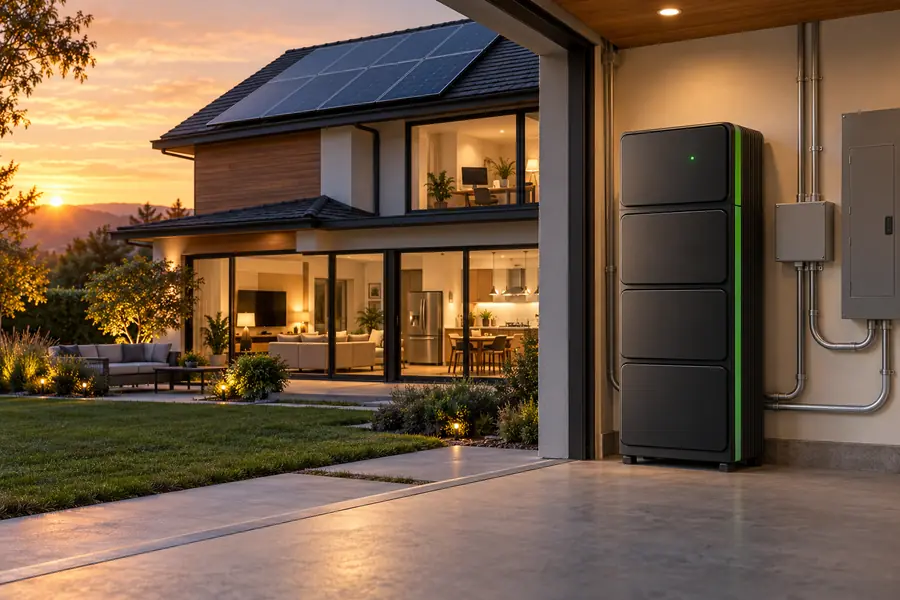
For a battery attached to a garage wall or exterior pad:
an extra kilogram matters much less than it does in an electric vehicle.
That makes LFP's trade-offs particularly suitable for home solar storage.
Is LFP Better Than NMC or Lead-Acid for Solar Batteries?
Different chemistries optimize different characteristics, so “best” depends partly on the homeowner's priorities.
LFP is generally preferable to NMC when long cycling, cost, and thermal stability are the priorities, while NMC is useful when higher energy density and smaller physical size matter. Lead-acid remains inexpensive and proven, but lower usable energy, heavier weight, maintenance considerations, and shorter cycling performance make it less attractive for frequent residential solar use.
The most important distinction between LFP and NMC is:
stationary performance versus energy density.
NMC has traditionally been attractive in applications where engineers need to store more energy in less:
weight
and:
volume.
That is particularly valuable in:
EVs,
e-bikes,
drones,
and portable electronics.
A home battery is different.
Once installed, homeowners usually care more about:
how many useful cycles it delivers,
how much usable energy is available,
how much power the inverter provides,
how efficiently solar energy moves through the system,
and whether the installation meets residential safety requirements.
This shifts the balance toward LFP.
LFP vs NMC
A simplified comparison is:
| Feature | LFP | NMC |
|---|---|---|
| Energy density | Moderate | Higher |
| Cycle suitability | Strong | Strong, product-dependent |
| Thermal stability | Favorable | More demanding thermal management |
| Stationary-storage adoption | Very high | Lower |
| Weight importance | Usually minor for homes | Advantage where compactness matters |
| Typical fit | Solar storage, home ESS, BESS | EVs, weight-sensitive batteries |
LFP's lower energy density should not be ignored.
A physically smaller NMC battery may store the same energy.
But in a residential application, a modest increase in enclosure size is often an acceptable trade-off if the system meets the homeowner's:
cost,
cycling,
safety,
and warranty
requirements.
What About Lead-Acid Batteries?
Lead-acid batteries remain relevant, particularly in:
off-grid systems,
low-cost projects,
and existing installations.
Their biggest advantage is:
low initial purchase cost.
But comparing only purchase price can be misleading.
A solar battery may cycle frequently.
If a lower-cost battery provides fewer useful cycles or less usable energy before replacement, lifetime economics can be less attractive.
Lead-acid batteries are also much heavier for a given amount of stored energy.
That matters in:
rack design,
floor loading,
transport,
installation,
and maintenance.
For a modern grid-connected home that expects daily solar cycling, I would generally choose:
LFP before lead-acid.
For occasional backup in a highly cost-sensitive installation, lead-acid can still make sense.
The correct comparison is therefore not:
Which battery is cheapest to buy?
It is:
Which battery provides the best lifetime value for the intended cycling pattern?
How Much Solar Battery Capacity and Power Does a Home Need?
Choosing the right chemistry does not automatically create the right home battery system. Capacity and power must also match the household.
A typical home may use roughly 10–20 kWh of battery storage for essential-load backup and solar energy shifting, while larger whole-home systems may require 20–40 kWh or more. The correct size depends on average backup load, desired runtime, solar production, appliance demand, usable capacity, reserve settings, and whether the system must support HVAC.
The two most important specifications are:
kWh = Energy
and:
kW = Power.
These numbers answer different questions.
kWh Determines Runtime
Suppose critical household loads average:
1 kW.
For:
10 hours
the theoretical energy requirement is:
1 kW × 10 h
= 10 kWh.
If average demand increases to:
2 kW
for the same period:
2 × 10
= 20 kWh.
This means the same house can require dramatically different battery capacity depending on which circuits remain active.
A homeowner backing up:
refrigeration,
Wi-Fi,
lights,
phones,
computers,
and selected outlets
may need much less storage than someone trying to operate:
central air conditioning,
electric cooking,
water heating,
pool pumps,
and EV charging.
kW Determines What the Battery Can Run
A battery can store plenty of energy while still lacking enough inverter power to operate several large appliances simultaneously.
For example:
15 kWh / 3 kW system
and:
15 kWh / 10 kW system
store the same energy.
But their appliance capabilities are very different.
FranklinWH's current aPower 2 illustrates this distinction.
It combines:
15 kWh usable energy
with:
10 kW continuous discharge
and:
15 kW peak output for 10 seconds.
Enphase's IQ Battery 5P provides a smaller modular approach:
5 kWh usable energy
and:
3.84 kVA continuous power in its 240V North American configuration.
Neither size is automatically better.
The right architecture depends on the home.
Solar Changes Required Storage
Solar production can extend backup duration because it can recharge batteries after the outage begins when the complete system is designed for islanded operation.
This is important because a battery without solar starts an outage with:
finite stored energy.
A solar-plus-battery system can potentially add energy each day.
That means a smaller battery paired with sufficient solar can sometimes provide better multi-day resilience than a larger battery with no recharge source.
However, homeowners should not assume:
Solar = Unlimited Backup.
Solar output varies with:
weather,
season,
roof orientation,
shade,
temperature,
and array size.
A good system therefore balances:
Solar kW + Battery kWh + Battery/Inverter kW + Household Load.
What Should You Check Besides Solar Battery Chemistry?
The word “LFP” alone does not tell homeowners whether a battery system is suitable, safe, efficient, or compatible with their solar installation.
After choosing a chemistry, compare usable capacity, continuous and peak power, AC- or DC-coupling, inverter compatibility, round-trip efficiency, warranty, throughput limits, operating temperature, expansion capability, backup controls, installation requirements, and system-level safety certification. A well-engineered complete ESS matters more than chemistry alone.
One major consideration is:
usable energy.
A battery may advertise:
15 kWh nominal capacity
while providing a different usable amount depending on its operating reserve and manufacturer design.
Always compare:
usable kWh
when possible.
Another important metric is:
continuous power.
A battery designed mainly for solar self-consumption may not have enough instantaneous output to start every large appliance in a home.
Motor loads such as:
air conditioners,
well pumps,
and compressors
can create short starting surges.
Therefore, homeowners considering whole-home backup should examine both:
continuous output
and:
peak or motor-start capability.
AC-Coupled vs DC-Coupled Batteries
Residential solar batteries can also differ in how they connect to the solar system.
An:
AC-coupled battery
has its own inverter architecture and can often be convenient for retrofit installations.
A:
DC-coupled battery
can integrate more directly with compatible solar inverter architectures.
Neither is universally superior.
The best choice depends on:
existing equipment,
new-build versus retrofit,
backup architecture,
conversion efficiency,
and installer design.
FranklinWH's aPower 2 is an example of an AC-coupled LFP battery.
The Enphase IQ Battery 5P is also an AC-coupled LFP storage system with embedded grid-forming microinverters.
Safety Is a Complete-System Requirement
Homeowners should not treat LFP as meaning:
“fire risk is impossible.”
A residential ESS still contains:
electrical connections,
power electronics,
cells,
BMS controls,
inverters,
and high fault-current potential.
The system should therefore be evaluated as a complete product.
UL explains that UL 9540 is the system-level standard for energy storage systems and equipment, while UL 9540A is used to evaluate thermal-runaway and fire-propagation behavior. The 2026 edition of NFPA 855 references UL 9540A for relevant fire and explosion testing.
UL also developed UL 9540B specifically for certain residential ESS fire-propagation evaluations involving systems of 20 kWh or less; it supplements rather than simply replacing the existing UL 9540A framework.
For homeowners, the practical priority is:
Certified System + Correct Installation + Local Code Compliance
rather than:
Chemistry Label Alone.
Warranty matters too.
For example, Enphase currently lists a:
15-year limited warranty
for its IQ Battery 5P under applicable conditions.
FranklinWH lists a:
15-year / 60 MWh throughput warranty
for aPower 2.
The exact warranty terms matter more than the headline number, so buyers should compare:
years,
remaining capacity,
throughput,
operating conditions,
labor coverage,
and replacement terms.
My Insights: What Is the Best Type of Solar Battery for Home Storage
Choosing a solar battery by price or capacity alone can create poor lifetime value, because chemistry, cycle life, power, safety, and system integration all affect performance.
For most homes, LFP is the best type of solar battery because it combines strong cycle life, competitive cost, favorable thermal stability, and practical power for daily solar storage and backup. NMC remains useful where compact size matters, while lead-acid suits some budget applications, but LFP offers the strongest overall residential balance.
The wider storage market supports this conclusion. LFP now represents around 90% of global battery-storage deployments, according to the IEA, reflecting its strong fit for frequent cycling and stationary energy storage.
However, I would never select a home battery using chemistry alone. The better buying sequence is:
LFP Chemistry → Usable kWh → Continuous kW → Solar Compatibility → Backup Capability → Warranty → Safety Certification → Installation
A smaller well-designed LFP system that matches the home's loads can be a better investment than a much larger battery with poor inverter compatibility or insufficient output.
For most residential solar projects, I would therefore start with:
LFP
then determine:
how many kWh are required
followed by:
how many kW the home must support.
That approach produces a solar-storage system designed around actual household energy needs rather than one specification on a battery datasheet.
Conclusion
For most homes, LFP is the best solar-battery chemistry. Prioritize usable capacity, power, compatibility, warranty, and complete-system safety alongside the chemistry itself.
](https://voltcrave-battery.com/wp-content/uploads/2026/08/Complete-Guide-to-Commercial-and-Industrial-Battery-Storage-Systems-768x512.webp)
](https://voltcrave-battery.com/wp-content/uploads/2026/10/What-Is-the-Best-Type-of-Solar-Battery-for-Residential-Use-768x512.webp)
](https://voltcrave-battery.com/wp-content/uploads/2026/10/Which-Portable-Power-Station-Is-the-Most-Recommended-768x512.webp)








































