
](https://voltcrave-battery.com/wp-content/uploads/2026/09/What-Is-a-Battery-Energy-Storage-System-and-How-Does-a-BESS-Work.webp)
Electricity must normally be produced when it is needed. That becomes challenging when demand changes quickly or renewable generation does not match consumption.
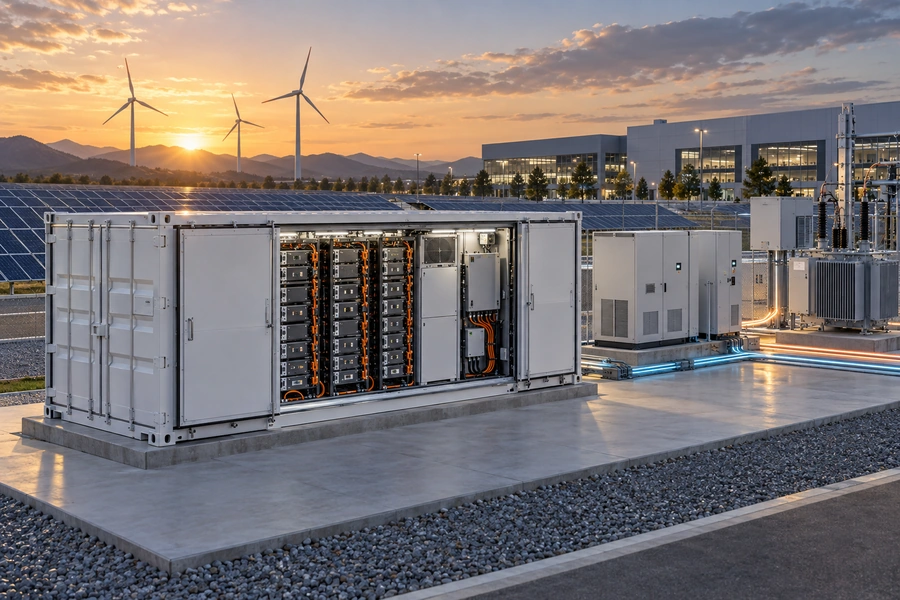
A Battery Energy Storage System (BESS) stores electrical energy in rechargeable batteries and releases it when needed. A typical BESS combines battery cells, modules, racks, a Battery Management System (BMS), Power Conversion System (PCS), Energy Management System (EMS), thermal management, and protection equipment to control safe charging, storage, and discharging.
I find the easiest way to understand a BESS is to think of it as an energy buffer between electricity generation and electricity consumption. It allows electricity produced now to be stored and used minutes or hours later.
What Is a Battery Energy Storage System?
A battery alone stores energy, but a BESS combines batteries with the equipment needed to turn stored energy into a controllable electrical resource.
A Battery Energy Storage System is an integrated system that captures electrical energy, stores it electrochemically in rechargeable batteries, and delivers it later to a load or electrical grid. In addition to batteries, a BESS normally includes monitoring, power conversion, controls, thermal management, protection, communications, and safety systems.
The basic energy flow is:
Electricity Source → BESS → Electricity Load
The source could be:
solar PV,
wind,
utility grid,
generator,
or:
another electrical source.
When electricity is available, the BESS charges.
When electricity is needed, it discharges.
A more detailed architecture looks like:
Battery Cells → Modules → Racks → DC Bus → PCS → Transformer → Grid/Load
The control architecture adds:
BMS + EMS + Plant Controller
Each part performs a different job.
The battery provides stored energy.
The BMS protects and monitors the battery.
The PCS converts electricity between AC and DC.
The EMS decides how the system should operate.
Together, these components turn battery cells into an energy-storage system.
How Does a BESS Work?
A BESS works through three basic stages: charging, storing, and discharging.
During charging, electrical energy from the grid or renewable generation is converted into a form that can be stored by the battery. The BESS holds this energy until required. During discharge, stored DC electricity passes through the PCS, which converts it into AC electricity for a building, industrial load, microgrid, renewable plant, or utility grid.
The basic process is:
Step 1: Electricity becomes available
For example:
Solar PV → Electricity
Step 2: The BESS charges
If the electricity is AC, the PCS converts it into DC as required by the battery system.
Step 3: Energy is stored
Battery cells store the electrical energy electrochemically.
Step 4: The EMS identifies a need for discharge
This might happen because:
electricity demand increases,
solar generation decreases,
electricity prices rise,
the grid requests support,
or:
an outage occurs.
Step 5: The battery discharges
Stored DC energy flows toward the PCS.
Step 6: The PCS converts DC to AC
The electricity can then serve:
loads,
the grid,
or:
other compatible AC equipment.
The complete cycle can be represented as:
AC Grid / Renewable Source ↔ PCS ↔ DC Battery System
The arrows point both ways because a BESS is normally bidirectional.
What Are the Main Components of a BESS?
A complete BESS requires much more than battery cells.
The main BESS components include battery cells and modules, battery racks, BMS, PCS, EMS, thermal management, electrical protection, monitoring, communications, fire-risk controls, and balance-of-system equipment. Large projects may also include transformers, switchgear, HVAC or liquid cooling, SCADA, auxiliary power, and grid-interconnection equipment.
The main components can be summarized as follows:
| Component | Main Function |
|---|---|
| Battery cells | Store energy electrochemically |
| Battery modules | Group cells into manageable units |
| Battery racks | Organize modules into larger storage assemblies |
| BMS | Monitors and protects battery operation |
| PCS | Converts electricity between DC and AC |
| EMS | Controls charging and discharging strategy |
| Thermal management | Controls battery temperature |
| Protection equipment | Responds to abnormal electrical conditions |
| Fire-risk management | Detects and helps manage battery safety events |
| Transformer | Matches system and grid voltage where required |
| Switchgear | Controls and isolates electrical circuits |
| SCADA/communications | Enables monitoring and system-level control |
A failure in one subsystem can affect the performance of the entire BESS.
That is why I evaluate a BESS as an integrated system rather than comparing battery cells alone.
What Does the Battery Management System Do in a BESS?
Battery cells require continuous monitoring because their operating limits affect safety, performance, and lifetime.
The Battery Management System monitors parameters such as cell voltage, battery current, temperature, state of charge, and system status. It helps keep the battery within defined operating limits and can coordinate alarms, protection actions, balancing, and communication with higher-level BESS controls.
In a large BESS, monitoring can be hierarchical.
A simplified structure may look like:
Cell → Module → Rack → System BMS → EMS
The BMS can monitor whether:
a cell voltage is too high,
a cell voltage is too low,
temperature is outside limits,
current is excessive,
or:
another abnormal condition exists.
It can then communicate operating restrictions or protection commands.
The BMS also contributes to estimating:
SOC — State of Charge
and, depending on system architecture:
SOH — State of Health.
SOC answers:
How much usable charge is currently available?
SOH helps describe:
How has the battery's condition changed relative to its reference state?
Accurate monitoring becomes especially important in systems containing thousands of individual cells.
What Does the PCS Do in a Battery Energy Storage System?
The battery stores DC electricity, while many grids and facilities operate primarily with AC electricity.
The Power Conversion System is the bidirectional electrical interface between the battery and the AC power system. During charging, it converts or controls AC power into the DC power required by the battery. During discharge, it converts battery DC into controlled AC electricity suitable for the connected grid or load.
The PCS can be represented as:
Grid AC ↔ PCS ↔ Battery DC
During charging:
AC → DC
During discharging:
DC → AC
This makes the PCS one of the most important components when evaluating BESS power capability.
Suppose the battery contains:
20MWh
of energy.
But the PCS is rated:
5MW.
The system cannot simply discharge all 20MWh instantaneously.
At a theoretical constant:
5MW
output, nominal duration would be:
20MWh ÷ 5MW = 4 hours
before accounting for usable SOC, efficiency, operating reserve, and other constraints.
This is why battery energy and PCS power must be considered together.
What Does an EMS Do in a BESS?
The EMS determines how available battery capability should be used.
An Energy Management System coordinates BESS operation using information such as battery SOC, load demand, renewable production, electricity prices, forecasts, grid commands, reserve requirements, and operating limits. It determines when the BESS should charge, discharge, remain idle, or preserve stored energy for another application.
Imagine a solar-plus-storage system.
At noon:
solar production is high.
The EMS may command:
BESS → Charge
During the evening:
solar production falls while demand remains high.
The EMS may command:
BESS → Discharge
During an outage:
the EMS may prioritize:
Critical Loads
instead of normal economic operation.
If backup reserve is required, it may maintain:
minimum SOC = 20%
as an example.
That reserved energy is then unavailable for normal energy shifting.
This illustrates an important concept:
The battery creates flexibility.
The EMS decides how to use it.
As BESS projects combine more applications, control strategy becomes increasingly important.
What Is the Difference Between MW and MWh in BESS?
MW and MWh describe different characteristics of an energy-storage system.
MW measures BESS power—the rate at which the system can charge or discharge. MWh measures stored energy—the amount of electricity the system can deliver over time. Dividing MWh by MW provides a simplified nominal duration. For example, a 20MW/80MWh BESS has approximately four hours of nominal storage duration.
The formula is:
Duration = Energy ÷ Power
For example:
80MWh ÷ 20MW = 4 hours
Compare several systems:
| BESS Rating | Nominal Duration |
|---|---|
| 20MW / 10MWh | 0.5 hour |
| 20MW / 20MWh | 1 hour |
| 20MW / 40MWh | 2 hours |
| 20MW / 80MWh | 4 hours |
| 20MW / 160MWh | 8 hours |
These values describe nominal mathematical duration.
Real usable duration depends on:
SOC limits,
efficiency,
temperature,
degradation,
reserve,
auxiliary consumption,
and:
operating strategy.
The easiest way I remember the distinction is:
MW = how much power at once.
MWh = how much energy over time.
How Does a BESS Work With Solar Energy?
Solar production and electricity demand frequently occur at different times.
A solar BESS stores electricity when PV generation exceeds immediate consumption or desired grid export and discharges that stored energy later when solar production falls. This allows solar electricity generated during daylight to serve evening loads, improve solar self-consumption, support peak management, and potentially reduce some renewable curtailment.
Consider a solar farm producing:
20MW
while immediate demand/export is:
15MW.
Potential surplus is:
20 – 15 = 5MW
If the BESS can charge at:
5MW
for:
3 hours,
the theoretical energy charged is:
5MW × 3h = 15MWh
before losses and operating limitations.
After sunset:
BESS → Load/Grid
can return some of that energy.
The energy flow becomes:
Daytime Solar → BESS → Evening Electricity
The battery has not created additional solar energy.
It has changed:
when the solar energy can be delivered.
This is known as:
energy shifting
or:
time shifting.
How Does a BESS Work With Wind Energy?
Wind generation can vary according to weather conditions and does not always match electricity demand.
A BESS can charge during periods of strong wind generation and discharge when wind output falls or demand rises. Depending on project design, storage can also help smooth changes in plant output, support grid services, reduce some renewable curtailment, and make wind-generated electricity more controllable.
Suppose a wind farm generates:
100MW
but the grid can temporarily accept:
80MW.
Potential excess is:
20MW.
A BESS with sufficient charging power and available capacity could absorb part of this energy.
Later:
Stored Wind Energy → Grid
can be delivered when conditions are more favorable.
Again, storage does not eliminate renewable variability.
Instead, it creates a controllable buffer.
This principle is the same for solar and wind:
Variable Generation + BESS = More Controllable Energy Delivery
The appropriate battery duration depends on the specific application.
Short-duration storage may focus on:
rapid power response.
Longer-duration battery systems may focus more heavily on:
energy shifting.
What Is a Containerized BESS?
Large battery projects often use modular enclosures to simplify deployment and expansion.
A containerized BESS packages battery racks and supporting equipment inside a purpose-built modular enclosure. Depending on the product architecture, the container may include BMS, thermal management, fire-risk controls, DC distribution, monitoring, and auxiliary systems, while the PCS may be integrated into the same enclosure or installed separately.
A simplified project architecture is:
Battery Container → PCS → Transformer → Switchgear → Grid
For a larger project:
Container 1
Container 2
Container 3
Container 4
↓
PCS / MV System
↓
Grid
Containerization makes storage scalable.
Suppose one hypothetical container provides:
5MWh.
A:
100MWh
project might require approximately:
100 ÷ 5 = 20 containers
before considering actual manufacturer architecture, redundancy, reserve, and project-specific requirements.
Modern BESS enclosures should not automatically be thought of as ordinary shipping containers.
They can be purpose-built energy-storage enclosures designed around:
battery density,
cooling,
electrical protection,
monitoring,
maintenance access,
and:
fire-risk management.
What Are the Main Applications of BESS?
The same battery can potentially support several applications because charging and discharging can be controlled according to system needs.
Major BESS applications include renewable energy shifting, peak shaving, frequency and grid support, backup power, microgrids, solar self-consumption, EV charging support, demand management, and capacity-related services. The optimal battery power, energy capacity, and control strategy depend on which applications have the highest priority.
For example:
Renewable Energy Shifting
Solar/Wind → BESS → Later Demand
The objective is to move electricity through time.
Peak Shaving
BESS → Load During Peak
The objective is to reduce maximum grid demand.
Backup Power
Stored Energy → Critical Loads
The objective is resilience.
Grid Support
BESS ↔ Grid
The objective is rapid power balancing or another specified grid service.
EV Charging
Grid + Solar + BESS → Chargers
The objective can include reducing charging peaks and improving renewable-energy utilization.
One BESS can sometimes perform several of these functions.
But its available:
MW
and:
MWh
are finite.
The EMS must allocate them carefully.
How Does a BESS Provide Backup Power?
A battery can reserve stored energy for use when normal power is interrupted.
A BESS provides backup power by maintaining sufficient stored energy and discharging it to selected loads after a grid outage or other supply interruption. Backup capability depends on usable battery kWh or MWh, critical-load demand, PCS power, system architecture, switching and controls, and the amount of battery capacity reserved before the outage occurs.
Suppose:
Critical load = 1MW
Required backup = 4 hours
The theoretical energy requirement is:
1MW × 4h = 4MWh
But I would not automatically specify a:
4MWh nominal BESS.
Additional factors include:
conversion losses,
usable SOC,
reserve margin,
battery degradation,
temperature,
auxiliary consumption,
and:
load variation.
If the site also has solar:
Solar → Critical Load
can reduce the energy the battery needs to supply during daylight.
Surplus solar may potentially:
Solar → BESS
and extend backup duration.
This is why solar-plus-storage can be valuable for resilience.
How Does BESS Improve Grid Stability?
The electrical grid must continuously manage changing generation and consumption.
BESS can support grid stability because its power electronics can rapidly adjust charging and discharging according to control commands. Depending on the project and market, batteries may provide frequency response, balancing, renewable smoothing, ramp control, capacity support, congestion management, and other ancillary or flexibility services.
Consider:
Supply suddenly exceeds demand.
The BESS can:
charge.
Now consider:
Demand suddenly exceeds available supply.
The BESS can:
discharge.
This creates a simple balancing mechanism:
Excess Electricity → BESS
Electricity Deficit → BESS Discharge
The battery's usefulness depends on both:
response power
and:
available stored energy.
A high-MW, low-MWh battery can provide strong short-duration power.
A high-MWh battery can sustain discharge for longer.
Grid applications therefore determine the appropriate power-to-energy ratio.
How Efficient Is a Battery Energy Storage System?
A BESS consumes some energy during charging, storage, conversion, thermal management, and discharging.
BESS efficiency is commonly evaluated using round-trip efficiency, which compares the electrical energy recovered during discharge with the electrical energy originally used to charge the system. Actual efficiency depends on battery chemistry, PCS performance, auxiliary consumption, operating power, temperature, SOC, system architecture, and how the measurement boundary is defined.
The simplified formula is:
Round-Trip Efficiency = Energy Out ÷ Energy In × 100%
Suppose:
Energy charged = 100MWh
Energy returned = 90MWh
Then:
90 ÷ 100 × 100% = 90%
The missing:
10MWh
represents system losses within the assumed measurement boundary.
But efficiency is not necessarily constant.
PCS conversion performance can vary with load.
Thermal-management systems consume energy.
Battery internal losses change with operating conditions.
Auxiliary systems also require power.
Therefore, project modeling should use actual equipment data rather than assuming one universal BESS efficiency.
How Long Does a BESS Last?
Battery lifetime depends on both time and usage.
BESS lifetime depends on battery chemistry, cycle frequency, depth of discharge, SOC range, temperature, C-rate, thermal management, cell quality, operating strategy, and required end-of-life capacity. Project life should therefore consider calendar aging, cycle aging, energy throughput, degradation, warranty conditions, and potential augmentation.
Suppose a battery performs:
1 equivalent full cycle per day.
Annual cycling is approximately:
365 cycles.
Over:
10 years:
365 × 10 = 3650 equivalent full cycles
Over:
15 years:
365 × 15 = 5475 equivalent full cycles
But real BESS operation is usually more complicated.
Grid-service batteries can perform many partial cycles.
Solar-shifting batteries may cycle daily.
Backup systems may remain at high SOC for long periods.
Each operating strategy produces different degradation behavior.
Therefore, I would not evaluate BESS life from:
cycle count alone.
The more useful framework is:
Calendar Age + Cycling + Temperature + Throughput + Operating Conditions = Battery Degradation
Are Battery Energy Storage Systems Safe?
Large batteries store substantial energy, so safety must be engineered at cell, module, rack, enclosure, and site levels.
BESS safety depends on battery design, BMS protection, thermal management, electrical protection, fault detection, enclosure design, fire-risk management, installation, operating procedures, and applicable standards. Battery chemistry can influence risk, but no lithium-ion chemistry should be treated as automatically risk-free simply because it has favorable thermal characteristics.
In North American ESS discussions, two terms frequently appear:
UL 9540
and:
UL 9540A.
They are different.
UL 9540 addresses energy storage systems and equipment as complete products/systems.
UL 9540A is a thermal-runaway fire-propagation test method.
Installation requirements may also involve standards and codes such as:
NFPA 855
depending on jurisdiction and application.
This distinction is important because:
cell certification ≠ complete BESS certification
and:
battery chemistry ≠ complete system safety.
The entire architecture must be evaluated.
What Is the Difference Between BESS, Battery, and ESS?
These terms are related but should not automatically be treated as identical.
A battery is the electrochemical device that stores energy. BESS means Battery Energy Storage System and includes batteries plus the equipment required to manage, convert, protect, and control electrical energy. ESS is the broader term Energy Storage System and can include battery-based storage as well as other energy-storage technologies.
The relationship is:
Battery → component
BESS → complete battery-based storage system
ESS → broader energy-storage category
For example:
A lithium battery module by itself is not necessarily a complete BESS.
Add:
BMS,
PCS,
EMS,
thermal management,
protection,
monitoring,
and:
balance-of-system equipment,
and it becomes part of a complete battery energy-storage architecture.
This distinction matters when comparing:
equipment specifications,
certification,
project costs,
and:
system performance.
My Insights: What Is a Battery Energy Storage System and How Does a BESS Work
The easiest way to understand BESS is to stop thinking about it as a battery product and start thinking about it as a controllable energy system.
A Battery Energy Storage System stores electricity in rechargeable batteries and releases it when needed. It works by coordinating battery storage, BMS protection, PCS power conversion, EMS controls, thermal management, electrical protection, and communications so electricity can be charged, stored, and discharged according to renewable generation, load demand, grid conditions, or backup requirements.
My First Insight: A Battery Stores Energy, but a BESS Controls Energy
This distinction is fundamental.
A battery provides:
stored electrochemical energy.
A BESS adds:
monitoring + protection + conversion + intelligence.
That is what allows batteries to participate in:
solar projects,
wind farms,
microgrids,
commercial facilities,
and:
utility grids.
My Second Insight: MW and MWh Explain Most BESS Sizing Questions
When I see a BESS specification, I immediately look for:
MW
and:
MWh.
MW answers:
How much power can it provide?
MWh answers:
How long can it provide energy?
Together:
MWh ÷ MW = nominal duration.
A:
50MW / 200MWh
BESS therefore represents approximately:
4 hours
at rated power before real operating constraints are considered.
My Third Insight: Renewable Energy Makes Time More Important
Solar may generate strongly at noon.
Demand may peak later.
Wind may be strong when electricity demand is low.
BESS solves part of this mismatch through:
time shifting.
The energy flow becomes:
Renewable Energy Now → Battery → Electricity Later
That ability is one of the central reasons battery storage and renewable generation complement each other.
My Fourth Insight: The EMS Determines Whether Battery Capacity Creates Value
A battery can only be:
full,
empty,
or:
somewhere between.
The EMS must decide how that finite capacity is allocated.
Should it:
charge from solar?
reduce peak demand?
provide grid support?
reserve energy for an outage?
The physical battery creates the opportunity.
The control strategy determines how the opportunity is used.
My Fifth Insight: What Is a Battery Energy Storage System and How Does a BESS Work?
This directly answers the H1.
A BESS is an integrated electrical energy-storage system rather than simply a large battery.
Its complete operating process can be summarized as:
| Stage | What Happens |
|---|---|
| 1. Generate/Receive Electricity | Energy comes from solar, wind, grid, or another source |
| 2. Convert Power | PCS manages AC/DC conversion |
| 3. Charge Battery | Electrical energy is stored electrochemically |
| 4. Monitor Battery | BMS tracks battery conditions and operating limits |
| 5. Store Energy | Battery holds energy until required |
| 6. Make Control Decision | EMS determines when and how much to discharge |
| 7. Discharge Battery | Stored DC energy leaves the battery |
| 8. Convert DC to AC | PCS supplies usable AC electricity |
| 9. Serve Grid or Load | Energy supports buildings, grids, microgrids, or other loads |
| 10. Repeat Cycle | System charges again when conditions are appropriate |
The complete architecture can therefore be represented as:
Generation → PCS → Battery → PCS → Grid/Load
with:
BMS + EMS + Thermal Management + Protection
controlling and protecting the process.
When electricity is abundant:
BESS charges.
When electricity is needed:
BESS discharges.
When renewable generation and demand occur at different times:
BESS shifts energy.
When demand peaks:
BESS can supply additional power.
When the grid needs short-term flexibility:
BESS can adjust charging or discharging.
When normal electricity supply fails:
BESS can use reserved energy for backup loads when the system is designed for that function.
This is the core principle behind battery energy storage.
A BESS transforms electricity from something that normally needs to be consumed when generated into an energy resource that can be stored, controlled, and delivered later.
Conclusion
A BESS stores electricity and releases it when needed, using batteries, BMS, PCS, EMS, thermal management, and protection to make energy flexible and controllable.
](https://voltcrave-battery.com/wp-content/uploads/2026/08/What-Is-an-Energy-Management-Backup-Unit-for-Telecom-Base-Stations-768x512.webp)
](https://voltcrave-battery.com/wp-content/uploads/2026/09/What-Is-the-Number-One-Portable-Power-Station-768x512.webp)
](https://voltcrave-battery.com/wp-content/uploads/2026/08/How-Can-We-Make-Energy-Storage-Systems-Denser-768x512.webp)







































