
](https://voltcrave-battery.com/wp-content/uploads/2026/10/Which-Is-Better-a-Power-Station-or-a-Power-Inverter.webp)
Choosing the wrong power equipment can increase costs, limit backup time, and create electrical compatibility problems. Many buyers confuse portable power stations with standalone inverters.
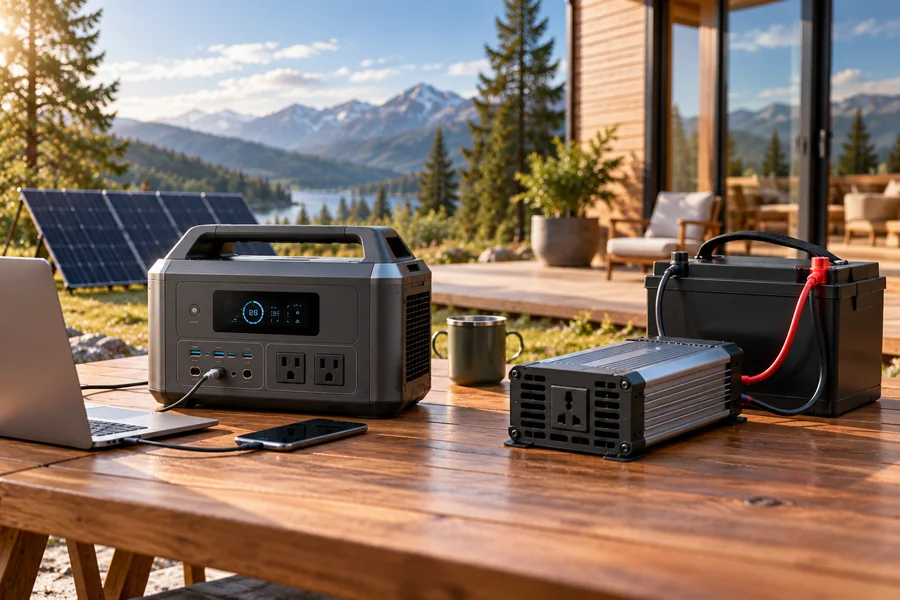
A portable power station is generally better for camping, outdoor work, and emergency backup because it combines a battery, inverter, charger, and outlets in one unit. A standalone power inverter is better when you already have a compatible battery or need a customized RV, solar, or off-grid energy system.
I recommend choosing portable power stations for integrated battery backup and inverters for existing battery systems, considering capacity, output, runtime, portability, installation, and overall cost.
What Is the Difference Between a Power Station and a Power Inverter?
Portable power stations and inverters are often advertised for similar applications. However, their internal components and functions are different, which can lead buyers to choose equipment that does not meet their requirements.
The main difference is that a portable power station stores electricity and supplies power, while a standalone inverter converts DC electricity into AC electricity without storing energy. Most portable power stations contain batteries, inverters, charging electronics, and output connections. A standalone inverter generally requires a compatible external battery and additional equipment for charging and protection.
How Does a Portable Power Station Work?
A portable power station is an integrated battery energy storage device.
It combines several electrical components inside one enclosure.
Most modern products include:
- Rechargeable battery modules
- Battery Management System (BMS)
- DC-to-AC inverter
- Battery charging equipment
- AC electrical outlets
- USB-C and USB-A connections
- DC output ports
- Monitoring and protection systems
Many modern power stations use lithium iron phosphate (LiFePO4) batteries because of their cycle-life potential and thermal characteristics.
The battery stores electricity from an approved charging source.
When an appliance requires AC power, the inverter converts stored DC electricity into AC electricity.
I consider this integrated design particularly useful for users who do not want to install separate batteries, electrical protection components, and charging equipment.
The equipment is usually ready to operate through its integrated outlets after charging.
However, I would not assume that every portable power station supports the same electrical loads or charging methods.
How Does a Standalone Power Inverter Work?
A standalone power inverter converts DC electricity into AC electricity.
For example, a 12V inverter can convert electricity from a compatible 12V battery system into 120V AC power for suitable appliances.
The inverter itself generally does not contain a large energy storage battery.
It needs an external DC source.
This source may include:
- A compatible 12V vehicle battery
- A 24V battery bank
- A 48V LiFePO4 energy storage system
- An RV house battery system
- An appropriately configured off-grid solar battery installation
I consider this arrangement useful when the buyer already owns suitable batteries.
However, a conventional inverter does not automatically recharge those batteries.
Some products are specifically designed as inverter-chargers.
These combine DC-to-AC conversion with battery charging and, in many cases, transfer-switching functionality.
I recommend checking the exact product category before purchasing.
Power Station vs. Power Inverter Comparison
| Feature | Portable Power Station | Standalone Power Inverter |
|---|---|---|
| Main function | Stores and supplies electricity | Converts DC into AC |
| Internal battery | Usually included | Usually not included |
| Inverter | Integrated | Main component |
| Battery charging | Usually integrated | Separate charger or inverter-charger required |
| AC outlets | Usually included | Model-dependent |
| USB charging | Common | Model-dependent |
| Portability | Usually convenient | Depends on complete system |
| Installation | Generally simple for outlet use | Requires suitable DC connections |
| Energy storage capacity | Integrated battery specification | Determined by external batteries |
| Expansion | Model-dependent | Often more flexible |
| Typical application | Camping and portable backup | RVs, solar systems, and custom installations |
I believe these differences explain why the two products should not be compared solely by their advertised wattage.
A power station is a complete portable energy storage product.
An inverter is a component that can become part of a larger electricity system.
Is an Inverter the Same as an Inverter Generator?
No.
A power inverter is an electronic device that converts DC electricity into AC electricity.
An inverter generator is a fuel-powered generator that uses power electronics to produce regulated AC electricity.
I distinguish these products because their energy sources and operating requirements are very different.
A battery power station can discharge without an operating combustion engine.
A fuel-powered inverter generator produces electricity by burning fuel and must be operated according to generator safety requirements.
Which Is Better for Camping, RVs, Solar Systems, and Home Backup?
Camping, RV travel, household backup, and permanent solar installations have different electricity requirements. A compact power station may work well for temporary use but become inconvenient for a larger installed system.
A portable power station is generally better for camping, outdoor events, mobile work, and temporary emergency backup. A standalone inverter with a suitable battery system is often better for RV electrical installations, off-grid cabins, and customized solar storage. For permanent home backup, a properly certified and professionally installed battery-inverter system may be more appropriate.
Best for Camping: Portable Power Station
I generally prefer a portable power station for ordinary camping.
Camping equipment often includes smartphones, laptops, lighting, cameras, fans, and portable refrigerators.
A power station provides integrated battery storage and electrical connections.
This reduces the need to transport separate components.
For example, a 1,000Wh power station may support electronic devices and selected camping appliances.
It can also recharge from compatible portable solar panels when sufficient sunlight is available.
I consider this particularly useful for weekend camping and temporary outdoor activities.
However, I recommend calculating appliance energy consumption before choosing the battery size.
A 1,000Wh station cannot provide unlimited electricity, even when its inverter has a high output rating.
Best for RVs: Depends on the Existing Battery System
RVs often contain dedicated batteries, DC distribution equipment, and charging systems.
If an RV already has an appropriately sized house battery bank, adding a compatible pure sine wave inverter may provide a practical way to operate AC appliances.
I consider this option attractive when the owner wants to use existing energy storage equipment.
However, a portable power station may be more convenient for occasional RV use.
For example, a user may want to power a laptop, television, or outdoor refrigerator without modifying the vehicle's electrical installation.
In this case, a portable station can offer flexibility.
For a permanent RV electricity upgrade, I would evaluate an inverter-charger and compatible battery system.
The best choice depends on whether the system must integrate with shore power, solar panels, and the RV's existing electrical circuits.
Best for Off-Grid Solar: Inverter and Battery System
I generally consider a properly designed inverter and battery system more appropriate for long-term off-grid electricity.
A typical system may include:
Solar Panels → MPPT Charge Controller → Battery Storage → Inverter → AC Loads
Some hybrid inverters combine solar charging, battery control, and AC conversion functions.
I consider this flexibility important for cabins, farms, and remote buildings.
The system can be designed around specific electricity requirements.
For example, a remote cabin may need a 48V battery bank with sufficient capacity to operate lighting, refrigeration, and pumps overnight.
A modular installation can allow the batteries and inverter to be sized according to these loads.
However, I would not assume that every solar inverter can operate during a grid outage.
Some grid-tied solar inverters require an active utility connection and are not designed for independent off-grid operation.
Best for Home Backup: Depends on the Backup Scope
Portable power stations can provide emergency electricity for selected household appliances.
I consider them useful for routers, lights, laptops, refrigerators, and other compatible essential loads.
However, powering an entire household is more demanding.
A dedicated residential energy storage system may require:
- Battery modules
- Compatible inverter or inverter-charger
- Battery management
- Backup switching equipment
- Electrical protection
- Approved household connections
- Professional installation
I recommend evaluating a properly certified installed system for permanent whole-home backup.
A portable power station should not automatically be connected to household wiring through improvised cables.
Application Comparison
| Application | Better Starting Choice |
|---|---|
| Weekend camping | Portable Power Station |
| Outdoor photography | Portable Power Station |
| Mobile office | Portable Power Station |
| Temporary emergency backup | Portable Power Station |
| Existing RV house battery | Compatible Power Inverter |
| Permanent RV electrical system | Inverter-Charger + Battery |
| Off-grid solar cabin | Battery + Inverter System |
| Farm or remote building | Engineered Inverter System |
| Selected household appliances | Portable Power Station |
| Permanent whole-house backup | Approved Residential ESS |
I believe the best equipment is the one that meets actual electricity demand with the least unnecessary complexity.
How Do Power Stations and Power Inverters Compare in Capacity, Runtime, Efficiency, and Cost?
Buyers often compare power stations and inverters based on advertised watts. However, inverter output determines how much power a device can deliver, while battery capacity determines how long the system can operate.
Portable power stations are rated by both battery capacity in watt-hours and output power in watts. Standalone inverters are mainly rated by output power and input voltage. Their runtime depends on external battery capacity. An inverter alone usually costs less than a complete power station, but the total price increases when batteries and charging equipment are added.
Understanding Battery Capacity and Inverter Output
I consider two measurements essential.
Watt-hours (Wh) describe stored electrical energy.
Watts (W) describe electrical output or consumption.
For example, a portable power station may provide:
- 1,024Wh battery capacity
- 1,800W continuous inverter output
These specifications describe different functions.
The battery stores approximately 1kWh of nominal electrical energy.
The inverter can supply compatible loads within its output rating.
However, a 1,800W load would discharge the battery relatively quickly.
I recommend comparing usable AC energy rather than assuming the nominal battery capacity can be fully delivered to appliances.
How Long Can a Portable Power Station Run?
I estimate operating duration using:
Runtime (hours) = Available AC Energy (Wh) ÷ Average Load (W)
Suppose a portable power station contains 1,024Wh of nominal energy.
Assume 85% becomes usable AC electricity after losses and operating limits.
Available energy:
1,024Wh × 0.85 = 870.4Wh
If the connected equipment consumes 200W:
870.4Wh ÷ 200W = 4.35 hours
This is an illustrative calculation.
Actual results depend on the power station's efficiency, idle consumption, battery condition, temperature, and operating limits.
How Long Can a Standalone Inverter Run?
A standalone inverter's operating duration depends on the connected battery.
For example, consider a LiFePO4 battery rated at 12.8V and 100Ah.
Nominal energy:
12.8V × 100Ah = 1,280Wh
Assume:
- 90% usable battery energy
- 90% inverter efficiency
Estimated available AC energy:
1,280Wh × 0.90 × 0.90 = 1,036.8Wh
For a 200W continuous load:
1,036.8Wh ÷ 200W = 5.18 hours
This is a theoretical example.
The result depends on battery discharge limits, BMS performance, inverter efficiency, and connected equipment.
It should not be interpreted as proof that standalone inverter systems always have longer runtime than portable power stations.
The battery capacities and operating assumptions must be comparable.
Why Battery Voltage Matters
Standalone inverters are available for different DC voltage systems.
Common examples include 12V, 24V, and 48V.
The correct voltage depends on the battery configuration.
Higher-voltage battery systems can reduce DC current for a given power level.
Consider a 1,000W AC load with an assumed 90% inverter efficiency.
At a nominal 12V battery voltage:
DC Current = 1,000W ÷ (12V × 0.90) = 92.6A
At 24V:
DC Current = 1,000W ÷ (24V × 0.90) = 46.3A
At 48V:
DC Current = 1,000W ÷ (48V × 0.90) = 23.1A
These are simplified calculations using nominal battery voltages.
I consider DC current important because the battery, BMS, cables, terminals, and protective devices must support the expected electrical load.
Which System Is More Efficient?
I do not believe one product category is automatically more efficient than the other.
A portable power station already contains an inverter.
A standalone battery-inverter system performs a similar DC-to-AC conversion.
The actual efficiency depends on power electronics, battery characteristics, operating loads, and system design.
I also consider standby consumption important.
Some inverters consume electricity even when the connected appliance is not operating.
For small loads used over many hours, this idle power can reduce practical runtime.
I prefer comparing manufacturer efficiency curves and independent measurements when available.
Is a Power Station More Expensive Than an Inverter?
A standalone inverter generally has a lower initial equipment price because it does not include a large battery.
However, a complete inverter-based backup system may also require:
- Compatible battery modules
- Battery charging equipment
- DC cables and connections
- Fuses and circuit protection
- Battery enclosure or mounting
- Electrical monitoring
- Professional installation
A portable power station integrates many of these functions.
I therefore compare complete system costs rather than inverter prices alone.
Total Cost Comparison
| Cost Factor | Portable Power Station | External Battery + Inverter |
|---|---|---|
| Inverter | Included | Purchased separately |
| Battery | Included | Purchased separately |
| Charger | Usually included | May require separate equipment |
| Electrical protection | Integrated for intended use | Requires system design |
| Installation | Often simple for portable use | More involved |
| Expansion | Model-dependent | Often flexible |
| Maintenance | Usually limited | Depends on configuration |
| Component replacement | May be manufacturer-specific | May allow independent replacement |
I believe the external battery and inverter approach can provide good value when the buyer already owns compatible energy storage.
However, purchasing every component separately does not automatically guarantee lower total costs.
What Should You Check Before Choosing a Power Station or Power Inverter?
A power system can contain sufficient stored energy but still fail to operate equipment because of inadequate output power or electrical incompatibility. Correct sizing and safety are essential.
Before choosing a portable power station or standalone inverter, I check continuous output, battery capacity, input voltage, AC waveform, surge capability, charging methods, protection equipment, and applicable certifications. Portable power stations are easier for temporary outlet-based use, while modular inverter systems require careful battery matching and electrical installation.
Check Continuous Power and Surge Capability
I begin by calculating the combined power demand of connected appliances.
Consider the following example.
| Appliance | Running Power |
|---|---|
| Refrigerator | 150W |
| Laptop | 70W |
| Wi-Fi router | 15W |
| LED lighting | 45W |
| Fan | 80W |
| Total | 360W |
The combined running load is approximately 360W.
However, the refrigerator and fan may require additional power during startup.
I recommend checking the equipment's starting requirements and the inverter's documented surge capability.
A 500W inverter may not be adequate if the compressor demands substantial starting power.
I also distinguish surge ratings from continuous output ratings.
Choose the Correct AC Waveform
I generally prefer pure sine wave output for mixed household appliances.
A pure sine wave inverter produces AC electricity closer to standard utility power.
Modified sine wave inverters may work with some simple loads but can create problems with certain motors, transformers, and electronic equipment.
I consider pure sine wave output especially useful for refrigerators, pumps, RV equipment, and solar battery systems.
However, a pure sine wave rating alone does not guarantee that the inverter can start every motor or support every electronic device.
Continuous power, surge behavior, voltage, and frequency must also be suitable.
Verify Battery and Inverter Compatibility
For standalone inverter systems, I check the exact DC input voltage range.
For example, a 12V inverter should not be connected to a 24V battery bank unless specifically designed to support both.
I also check the battery's maximum discharge current.
A battery may contain sufficient stored energy but have a BMS current limit that prevents high-power inverter operation.
I recommend checking:
- Battery chemistry
- Nominal and operating voltage
- Maximum continuous discharge current
- BMS protection limits
- Inverter DC input requirements
- Approved wiring and protection arrangements
These specifications are particularly important for LiFePO4 battery installations.
Review Charging and Solar Integration
A portable power station usually contains approved charging electronics.
It may support wall charging, solar charging, or vehicle charging.
A conventional standalone inverter may only convert DC to AC.
It may require a separate charger or solar charge controller to replenish the battery.
An inverter-charger can combine AC charging and inverting, while a hybrid solar inverter may provide additional photovoltaic control functions.
I recommend identifying the exact product category rather than assuming that every inverter has integrated solar charging.
Understand Safety Certifications
For North American applications, several standards may be relevant.
| Standard | Main Application |
|---|---|
| UL 2743 | Portable power packs |
| UL 458 | Inverters and converters for specified vehicle and marine applications |
| UL 1741 | Inverters and related distributed energy equipment |
| UL 9540 | Complete stationary energy storage systems |
| UL 9540A | Battery thermal runaway fire-propagation testing |
| NFPA 70 / NEC | Electrical installation requirements |
These standards have different scopes.
I would not assume that a portable power station certified under UL 2743 is automatically approved for permanent household electrical connections.
Likewise, an inverter suitable for an RV is not automatically approved for grid-connected residential use.
The complete installation must comply with applicable electrical codes and manufacturer instructions.
Do Not Ignore DC Wiring Safety
Standalone battery-inverter systems can carry substantial DC current.
Incorrect cable sizing, poor connections, or missing protection can create overheating and fault risks.
I recommend following the inverter manufacturer's installation requirements for cable size, polarity, grounding, and overcurrent protection.
Permanent electrical installations should be completed by qualified professionals.
I would not connect an inverter to household wiring using improvised cords or backfeeding arrangements.
Final Selection Checklist
| Selection Factor | What I Evaluate |
|---|---|
| Application | Portable or permanently installed |
| Battery capacity | Required stored energy |
| Continuous output | Normal appliance load |
| Surge rating | Starting current requirements |
| Battery voltage | DC input compatibility |
| AC waveform | Pure sine wave quality |
| Charging capability | Grid, solar, or other approved sources |
| Expansion | Future storage requirements |
| Safety certification | Equipment and installation scope |
| Total cost | Complete system, not one component |
| Warranty | Product support and serviceability |
I believe these factors provide a more reliable selection method than comparing advertised maximum wattage alone.
My Insights: Which Is Better, a Power Station or a Power Inverter
Buyers often compare portable power stations with standalone inverters as if they are interchangeable products. However, one is an integrated storage system, while the other is usually one component of a larger electrical installation.
I believe a portable power station is better for temporary, mobile, and straightforward backup applications. A standalone inverter is better when users already have compatible batteries or need a custom solar, RV, or off-grid system. The right decision depends on energy requirements, system architecture, portability, safety, and lifetime cost.
I Consider Existing Battery Equipment First
I believe the most important starting question is whether the user already owns a suitable battery system.
If the user has no battery, charger, or electrical installation, a portable power station may provide the simplest complete solution.
It combines the main components inside one product.
However, if a suitable battery bank already exists, a standalone inverter may be more economical.
For example, an RV with a correctly sized LiFePO4 house battery may only need a compatible inverter to supply selected AC appliances.
I would still evaluate the battery's discharge capability and system protection before selecting equipment.
Power Output and Battery Capacity Must Be Evaluated Separately
I do not consider advertised inverter wattage a reliable indicator of runtime.
A 2,000W inverter can provide substantial instantaneous output, but it does not store electricity.
The battery determines how much energy is available.
Likewise, a 2,000Wh portable power station may contain substantial stored energy but still be unable to operate an appliance exceeding its inverter rating.
I therefore evaluate energy storage and output capability as separate requirements.
Portability Has Practical Value
I consider portability an important advantage for camping, outdoor work, and emergency preparedness.
A portable power station is usually easier to move and operate than a separate battery and inverter installation.
However, larger power stations can become heavy.
For stationary energy storage, a modular battery-inverter system may provide greater flexibility.
I would not pay extra for portability if the equipment will remain permanently installed and a different configuration offers better value.
Integrated Systems Reduce Compatibility Work
I also believe a portable power station offers practical benefits by integrating the battery, BMS, inverter, and charging controls.
These components are designed to work together within the manufacturer's specified operating limits.
A modular system requires more engineering decisions.
The installer must verify voltage compatibility, battery discharge current, charging settings, wiring, and system protection.
However, this additional complexity may be worthwhile when the application requires specialized electrical performance.
Modular Systems Can Offer Better Long-Term Flexibility
I consider future expansion important.
A standalone inverter system may allow the battery bank to be expanded or individual components to be replaced.
However, compatibility must be verified.
Not every inverter supports every lithium battery or BMS communication system.
Portable power stations may also support expansion batteries, but those accessories are often manufacturer-specific.
I would compare the available expansion options before making a long-term investment.
My Final Recommendation
I evaluate the choice through five connected factors:
Existing Battery Equipment → Power Demand → Energy Capacity → Installation Requirements → Long-Term Cost
For camping, portable work, and basic household emergency electricity, I generally recommend a portable power station.
For permanent RV installations, custom solar systems, and off-grid cabins, I would consider a compatible inverter or inverter-charger with appropriately designed battery storage.
For permanent whole-house backup, I would evaluate a complete certified residential energy storage system.
Ultimately, I believe the better solution is the one that delivers sufficient usable energy and appropriate AC power safely, conveniently, and economically for the intended application.
Conclusion
A power station is better for portable, ready-to-use backup. A power inverter is better for existing battery systems and custom installations. Choose according to power, runtime, safety, and cost.
](https://voltcrave-battery.com/wp-content/uploads/2026/08/Industrial-Energy-Storage-Smarter-Systems-and-Better-Power-768x512.webp)
](https://voltcrave-battery.com/wp-content/uploads/2026/08/How-Does-Utility-Scale-Battery-Storage-Work-768x512.webp)
](https://voltcrave-battery.com/wp-content/uploads/2026/09/What-Does-an-Inverter-Do-for-a-Car-768x512.webp)







































