

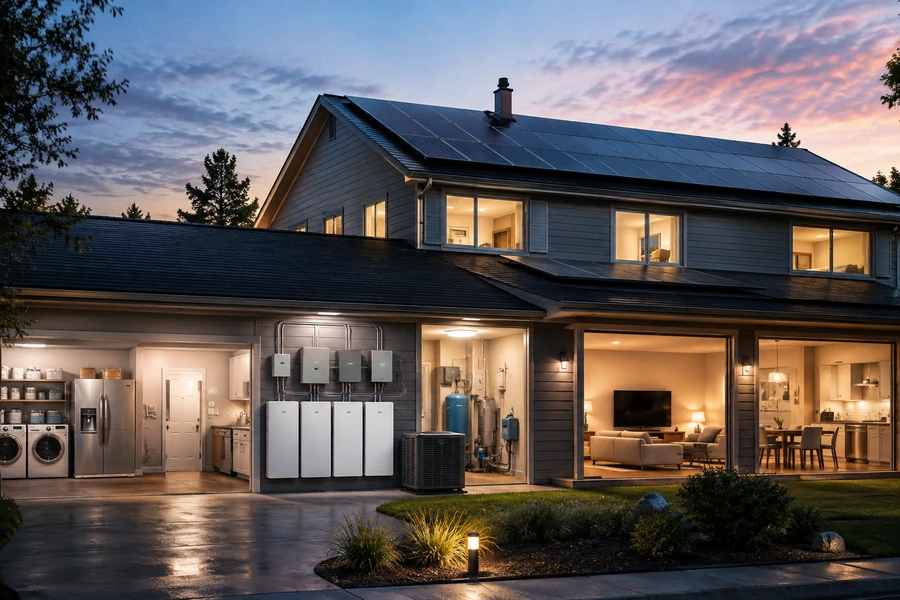
](https://voltcrave-battery.com/wp-content/uploads/2026/08/What-Is-the-Best-Type-of-Solar-Battery-for-Home-Use.webp)
Choosing the wrong solar battery can mean shorter life, limited backup power, higher replacement costs, or a system that does not integrate well with the home's solar equipment.
For most homes, lithium iron phosphate (LFP) is the best type of solar battery. It combines long cycle life, competitive cost, good thermal stability, frequent cycling capability, and low maintenance. LFP now accounts for over 90% of global stationary battery installations, making it the leading chemistry for modern home and grid energy storage.
I would normally choose an LFP home battery before considering NMC lithium-ion, lead-acid, or emerging sodium-ion alternatives. However, chemistry is only part of the decision. Battery capacity, inverter output, backup capability, AC versus DC coupling, warranty, certification, installation quality, and compatibility with the solar system can matter just as much.
Which Solar Battery Chemistry Is Best for a Home?
A home solar battery normally charges during periods of excess solar production and discharges during the evening, during expensive electricity periods, or when the grid fails.
LFP is my preferred battery chemistry for most residential solar systems because stationary storage benefits more from low cost, frequent cycling, longevity, and thermal stability than from maximum energy density. NMC can offer higher energy density, while lead-acid has a lower initial cost, but neither usually provides a better overall balance for a modern daily-cycling home battery.
Why LFP Is Usually the Best Choice
Lithium iron phosphate is one member of the broader lithium-ion battery family.
Its cathode uses lithium, iron, and phosphate rather than the nickel, manganese, and cobalt combination used in NMC batteries.
For home energy storage, I value LFP because it offers:
- Long cycle life
- Frequent charge and discharge capability
- Relatively stable thermal behavior
- No nickel or cobalt in the cathode
- Low routine maintenance
- Strong commercial availability
- Competitive battery cost
- Broad stationary-storage experience
The IEA reports that LFP represented around 90% of global battery-storage deployments in 2025. It also notes that LFP batteries are generally cheaper and better suited to frequent cycling than competing chemistries commonly used in EVs.
LFP's lower energy density is normally less important at a house than it is in an electric vehicle. A car must carry its battery everywhere, so weight and volume have a direct effect on vehicle performance. A home battery remains mounted on a wall, floor, or exterior pad.
The IEA specifically identifies this difference as an important reason for the shift toward LFP in stationary energy storage.
LFP Is Already Used in Major Residential Batteries
LFP is not simply an emerging chemistry.
For example, Enphase states that its IQ Battery 5P uses lithium iron phosphate chemistry. The company describes the chemistry as supporting safety and longevity, while the system uses a modular residential-storage architecture.
This does not mean every LFP battery performs equally well. Two products using the same chemistry may have different:
- Inverter power
- Usable capacity
- Cooling design
- Battery management
- Backup capability
- Warranty conditions
- Installation requirements
- Software
- Service support
I therefore use chemistry as a starting point rather than the only purchasing criterion.
How Does LFP Compare With Other Solar Battery Types?
Several battery chemistries can store solar energy. Each has different advantages.
LFP provides the strongest overall balance for most homeowners. NMC is more energy-dense but generally costs more and places greater emphasis on thermal management. Lead-acid is mature and inexpensive initially but is less attractive for frequent deep cycling. Sodium-ion is promising, but in 2026 its manufacturing and commercial ecosystem remains less mature than LFP.
LFP vs. NMC
NMC stands for lithium nickel manganese cobalt oxide.
It is also a lithium-ion chemistry and became popular where high energy density was important.
The main comparison looks like this:
| Feature | LFP | NMC |
|---|---|---|
| Energy density | Moderate | Higher |
| Frequent cycling | Excellent fit | Good |
| Thermal stability | Generally stronger | Requires more careful thermal management |
| Nickel required | No | Yes |
| Cobalt required | No | Yes |
| Stationary-storage market share | Very high | Much smaller |
| Typical home-storage suitability | Excellent | Good |
| My preference for most homes | Yes | Only when specific product advantages justify it |
The IEA reported in 2026 that LFP battery prices had fallen more than 15% during 2025 and were, on average, more than 40% cheaper than NMC alternatives on a per-kWh basis in the markets it assessed.
I would not reject an excellent residential battery simply because it uses NMC. Product-level engineering matters. However, if two similarly capable home-storage products were otherwise equal, I would generally favor LFP.
LFP vs. Lead-Acid
Lead-acid batteries have been used in off-grid solar systems for decades.
They remain familiar and widely recyclable, and they can have a relatively low purchase price.
However, traditional lead-acid systems have important disadvantages for modern home solar use.
They generally tolerate less usable depth of discharge and require more installed capacity to provide the same usable energy. Older flooded lead-acid designs may also require maintenance and ventilation.
For a home that cycles its battery regularly to increase solar self-consumption or reduce time-of-use electricity costs, I normally prefer LFP.
Lead-acid may still make sense when:
- Initial purchase cost is the dominant constraint.
- The battery is used only occasionally.
- An existing off-grid system is already designed around lead-acid.
- Local replacement and recycling infrastructure strongly favors lead-acid.
For most new grid-connected solar-plus-storage installations, however, lithium-ion has become the more practical architecture. DOE describes lithium-ion batteries as a major technology for solar-plus-storage applications because they can store significant energy and be repeatedly recharged.
LFP vs. Sodium-Ion
Sodium-ion is one of the most interesting emerging alternatives.
Instead of relying on lithium as the primary charge-carrying element, sodium-ion batteries use sodium.
This could eventually provide advantages related to material availability and supply-chain diversification.
However, I would not currently make sodium-ion my default recommendation for a homeowner.
The IEA reported in February 2026 that sodium-ion was making meaningful progress toward commercial scale, but optimized LFP technology still held advantages in cost, energy density, and supply-chain maturity.
For homeowners, maturity matters because a solar battery may remain installed for a decade or longer. I want proven installers, spare parts, software support, warranty infrastructure, and a large operating history.
Sodium-ion may become a stronger residential option as more certified products reach the market.
Is an LFP Solar Battery Safer for Home Use?
Safety is one reason LFP attracts residential buyers, but battery chemistry alone cannot make a home storage system safe.
LFP generally offers favorable thermal stability for stationary storage, but an LFP battery can still fail after electrical abuse, internal defects, overheating, physical damage, or external fire exposure. I therefore prioritize a certified complete energy storage system, good battery management, appropriate installation location, electrical protection, and professional commissioning rather than relying on chemistry alone.
The Complete System Matters More Than the Cell Label
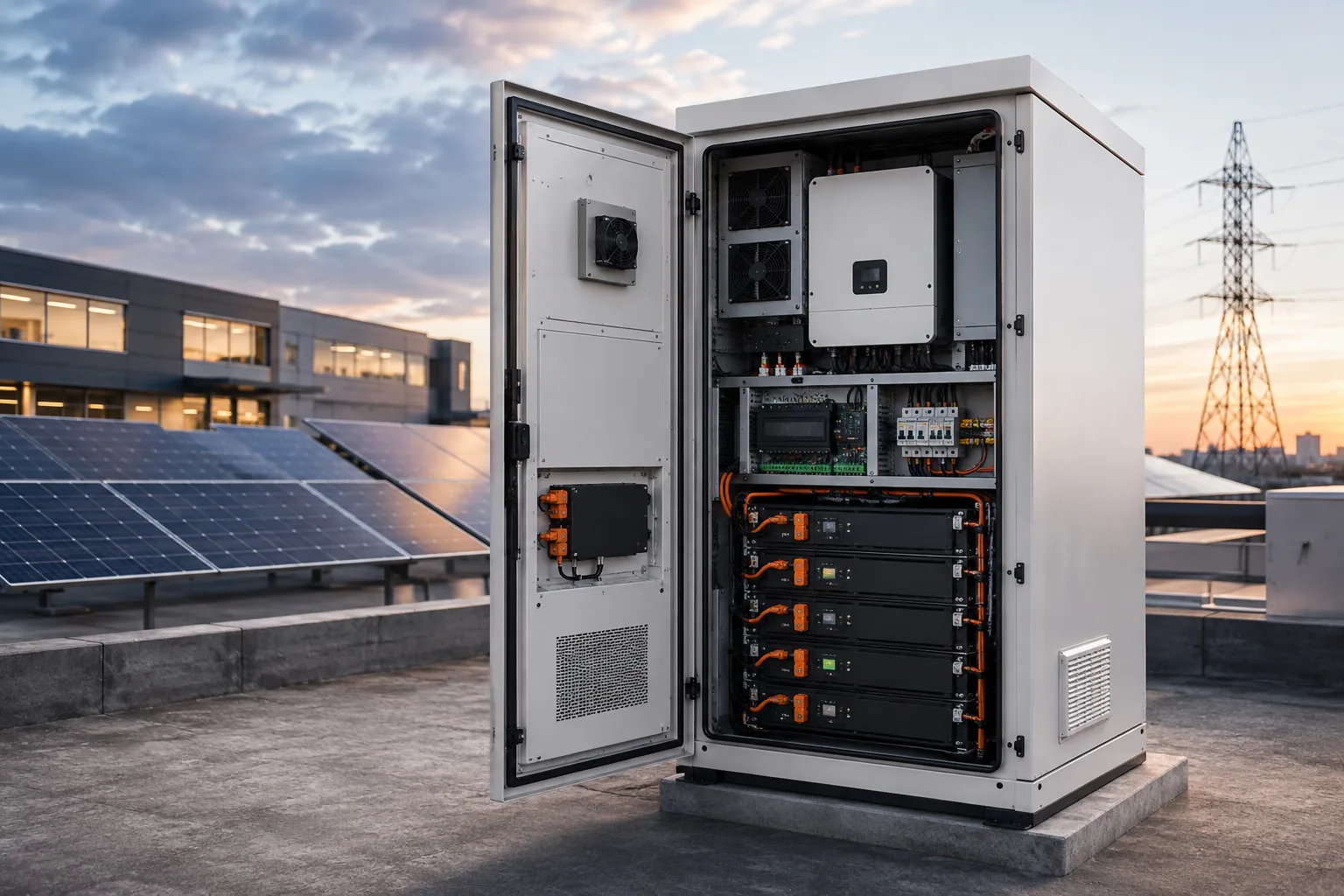
A home battery usually contains:
- Battery cells
- Battery modules
- Battery management system
- Inverter or power conversion equipment
- Contactors and electrical protection
- Temperature sensors
- Communications
- Enclosure
- Backup controls
The battery management system monitors conditions such as voltage, current, state of charge, and temperature.
The inverter controls the electrical power entering and leaving the battery.
The enclosure, electrical design, installation spacing, and emergency controls also influence overall safety.
This means an unknown battery marketed as “LFP” is not automatically a safer choice than a well-engineered and certified system from an established manufacturer.
Certification Matters in the United States
For U.S. homeowners, I would specifically verify that the complete residential energy storage system has the appropriate listing for its intended installation.
UL states that UL 9540 addresses complete energy storage systems and references standards covering stationary batteries and power-conversion equipment.
UL 9540A is a test method used to evaluate thermal-runaway fire propagation behavior in energy storage systems.
I would therefore ask the installer:
- Is this exact battery system listed to UL 9540?
- What UL 9540A testing supports the installation?
- Is the proposed location permitted?
- What spacing is required?
- Can it be installed indoors or outdoors?
- Does the local authority require additional protection?
A battery's chemistry should never replace this system-level due diligence.
What Size LFP Solar Battery Is Best for a Home?
After choosing the chemistry, battery capacity becomes the next major decision.
The best home battery size depends on daily electricity consumption, solar production, desired backup duration, high-power appliances, electricity tariffs, and whether the goal is essential-load or whole-home backup. Many homes can begin around the 10–20 kWh range, but actual sizing should come from measured household energy use rather than a universal capacity recommendation.
I Calculate Energy Requirements First
A battery's energy capacity is measured in kilowatt-hours.
Suppose a house needs these loads during an outage:
| Essential load | Average consumption over outage period |
|---|---|
| Refrigerator | 1.5 kWh |
| Internet and communications | 0.5 kWh |
| Lighting | 1.0 kWh |
| Electronics | 1.0 kWh |
| Heating controls or pumps | 2.0 kWh |
| Other essential loads | 2.0 kWh |
| Total | 8.0 kWh |
An 8 kWh energy requirement does not automatically mean I would install exactly an 8 kWh battery.
I also account for conversion losses, minimum battery reserve, degradation, and uncertainty in actual consumption.
Power Rating Is Just as Important
Capacity tells me how long the battery can operate.
Power tells me what it can run at once.
A homeowner may install a 15 kWh battery and still be unable to start a large air conditioner if the inverter cannot provide enough continuous or surge power.
I therefore check:
- Continuous AC output
- Short-duration surge output
- 120V versus 120/240V support
- Air-conditioner starting requirements
- Well pumps
- Electric ovens
- Water heaters
- EV chargers
A whole-home battery normally requires much stronger output capability than a battery serving only lights, refrigeration, internet equipment, and selected outlets.
Should I Choose an AC-Coupled or DC-Coupled Solar Battery?
Battery chemistry and electrical architecture are separate decisions.
For an existing solar system, an AC-coupled home battery is often easier to retrofit because it can work alongside the existing solar inverter. For a new solar-plus-storage installation, a DC-coupled or integrated hybrid system can reduce conversion stages and consolidate equipment. Neither architecture is universally better.
AC-Coupled Batteries
In an AC-coupled system, the solar array and battery have their own power-conversion equipment and meet on the AC side.
DOE explains that an AC-coupled solar-plus-storage configuration uses both a PV inverter and a bidirectional battery inverter.
I often consider AC coupling when:
- Solar already exists.
- The existing PV inverter is still useful.
- The homeowner wants a straightforward retrofit.
- Modular expansion is important.
- The selected battery platform uses an AC architecture.
The main disadvantage is that solar energy stored in the battery may pass through additional conversion stages.
DC-Coupled Batteries
In a DC-coupled design, the solar array can connect to the battery side before electricity is converted to AC.
DOE describes DC coupling as connecting the battery directly with the PV system through a bidirectional inverter architecture.
This approach can be attractive for a new installation because solar and battery equipment can share more of the power-conversion architecture.
I consider DC coupling when:
- Solar and battery are being installed together.
- The homeowner wants an integrated hybrid inverter.
- Maximizing direct solar-to-battery charging is important.
- The selected system supports the required solar-array size.
The best architecture depends on the actual solar equipment, electrical panel, backup design, and expansion plans.
What Should I Look for Besides Battery Chemistry?
I would not buy a home solar battery by asking only whether it uses LFP.
A good home battery should combine suitable chemistry with enough usable capacity, adequate continuous and surge output, strong solar integration, backup capability, high system efficiency, appropriate certification, a useful warranty, reliable software, and qualified local installation support.
My Home Solar Battery Checklist
| Feature | What I check |
|---|---|
| Chemistry | LFP is my normal starting point |
| Usable capacity | Enough kWh for the intended daily or backup use |
| Continuous output | Enough power for simultaneous loads |
| Surge capability | Can it start motors and air conditioners? |
| Backup operation | Can it form a local grid during an outage? |
| Solar charging | Will solar continue operating during grid outages? |
| Coupling | AC, DC, or hybrid architecture |
| Efficiency | How much stored energy returns to the home? |
| Warranty | Years, energy throughput, and retained capacity |
| Expansion | Can more capacity be added later? |
| Certification | Appropriate system-level safety listing |
| Installation | Qualified installer and approved location |
| Service | Local support and replacement equipment |
| Software | Monitoring, reserve settings, and energy optimization |
Warranty Terms Need Careful Reading
A “10-year warranty” does not tell me everything.
I also want to know:
- Is there an energy-throughput limit?
- What capacity is guaranteed at the end?
- Does daily cycling affect warranty coverage?
- Are labor costs covered?
- Is the inverter included?
- Who handles replacement?
- Is internet connectivity required?
- Can the warranty transfer to a new homeowner?
Battery longevity is only valuable if the warranty and service structure remain useful throughout the system's life.
When Might LFP Not Be the Best Solar Battery?
LFP is my default recommendation, not an absolute rule.
Another battery type may be preferable when installation space is extremely limited, the home has an existing battery architecture, local climate creates unusual requirements, an alternative chemistry has stronger local service, or the application requires characteristics that a conventional LFP system cannot provide economically.
Space Can Change the Decision
NMC's higher energy density can reduce the physical space needed for a given amount of battery energy.
Most homes can accommodate an LFP wall or floor unit, so this advantage is usually not decisive.
However, a property with a very restricted equipment area may need to evaluate physical dimensions carefully.
Existing Equipment Can Change the Decision
If a home already has solar, an inverter, smart electrical equipment, or an earlier battery system, compatibility may become more important than chemistry.
Replacing several functioning components merely to obtain LFP may not make financial sense.
I evaluate the full retrofit cost.
Off-Grid Homes Have Different Priorities
A fully off-grid home places unusually high demands on battery storage.
It may cycle every day and rely on the battery for critical electricity through poor weather.
In this situation, I pay additional attention to:
- Large usable capacity
- Generator integration
- Cold-temperature charging
- Solar-array size
- Serviceability
- Spare parts
- Black-start capability
LFP can still be an excellent choice, but the system should be designed as an off-grid power plant rather than a simple grid-connected home battery.
My Insights: What Is the Best Type of Solar Battery for Home Use
I believe the strongest answer for most homeowners is LFP, but buying the right chemistry is only the first step.
LFP is the best type of solar battery for most home applications because it combines frequent cycling, competitive cost, long expected service life, mature manufacturing, and favorable thermal characteristics. Its current dominance in stationary storage reinforces that advantage. However, I would choose a certified, correctly sized, well-supported complete system over an unknown LFP battery based only on chemistry or price.
LFP Matches the Way Homes Actually Use Solar Batteries
A home battery usually charges and discharges repeatedly.
It may charge from solar during the day and discharge every evening.
That makes cycle performance more important than extreme energy density.
The IEA identifies frequent cycling and lower cost as major reasons LFP has become dominant in stationary storage.
This is why I see LFP as especially well matched to residential solar self-consumption.
Safety Should Be Evaluated at the System Level
I would not purchase a battery simply because a salesperson describes LFP as safe.
I want evidence that the complete battery, inverter, controls, enclosure, and protection systems have been evaluated together.
For U.S. installations, UL 9540 certification is a key system-level consideration, while UL 9540A addresses thermal-runaway propagation testing.
Installation location and workmanship remain important even with a strong chemistry.
I Would Prioritize Power Before Adding Excess Capacity
Many homeowners immediately ask whether they need 10, 20, or 30 kWh.
I first check whether the inverter can support the home's important appliances.
A battery with enough energy for twenty hours may still disappoint during an outage if it cannot start the home's air conditioner or well pump.
I therefore size home storage in this order:
- Define essential or whole-home loads.
- Calculate their maximum simultaneous power.
- Calculate daily energy consumption.
- Determine desired backup duration.
- Estimate available solar recharging.
- Choose battery capacity and inverter output together.
Solar Recharging Can Matter More Than Installing Another Battery
For multi-day backup, the battery's ability to recharge from solar is critical.
DOE explains that solar combined with storage can provide electricity during disruptions when the system has the necessary controls to operate independently from the grid.
A larger battery gives me more stored energy at the beginning of an outage.
A well-sized solar array gives me a way to produce new energy each day.
For long outages, I therefore treat solar capacity, battery capacity, and household load management as one resilience system.
My Default Residential Choice
If I were specifying a new home solar-plus-storage system today, my starting requirements would be:
- LFP battery chemistry
- Enough usable kWh for the home's objective
- Adequate continuous and surge power
- Backup-capable system controls
- Solar charging during outages
- Appropriate safety certification
- Good warranty and local service
- Expandable capacity when practical
- Professional installation
I would then decide between AC coupling and DC coupling according to whether the solar system already exists and how the homeowner expects the system to expand.
Conclusion
For most homes, LFP is the best solar battery type. Its combination of cost, cycling, longevity, maturity, and thermal stability makes it the strongest default choice in 2026.
](https://voltcrave-battery.com/wp-content/uploads/2026/09/Everything-You-Need-to-Know-About-BESS-Containers-in-2026-768x512.webp)
](https://voltcrave-battery.com/wp-content/uploads/2026/08/How-Much-Battery-Storage-Do-You-Need-to-Run-a-House-768x512.webp)
](https://voltcrave-battery.com/wp-content/uploads/2026/08/What-Is-an-All-in-One-Energy-Storage-System-768x512.webp)