
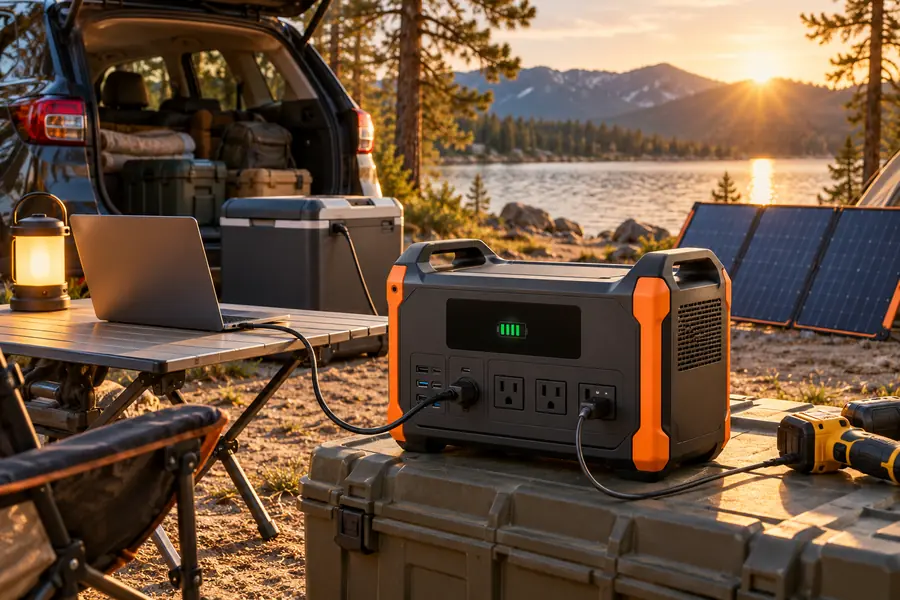
](https://voltcrave-battery.com/wp-content/uploads/2026/10/What-Is-the-Best-Portable-Power-Station-in-2026.webp)
Choosing a portable power station is becoming difficult. Many models offer large batteries, fast charging, and powerful inverters, but not every product delivers the same reliability or value.
The Anker SOLIX C1000 Gen 2 is one of the best portable power stations in 2026 for most users, offering 1,024Wh capacity, 2,000W rated output, and fast charging. The Jackery Explorer 2000 v2 is excellent for extended camping, while the BLUETTI Elite 300 provides greater capacity for off-grid power and emergency backup.
I believe the best portable power station depends on how and where it will be used. A small battery works well for charging laptops and phones, while refrigerators, power tools, and camping appliances need higher output. Battery capacity, LiFePO4 chemistry, charging speed, portability, and real-world efficiency matter more than brand reputation alone.
Which Portable Power Station Is the Best in 2026?
Portable power stations have improved significantly in battery technology, charging speed, and inverter performance. However, the best model for weekend camping may not be the right choice for home emergency power.
The Anker SOLIX C1000 Gen 2 is a strong overall choice for everyday portable power in 2026. Other leading options include the EcoFlow DELTA 3, Jackery Explorer 2000 v2, and BLUETTI Elite 300. Each offers different advantages in battery capacity, output power, portability, and backup duration.
Best Portable Power Stations Compared
I compare portable power stations according to their intended applications rather than selecting one winner for every situation.
| Portable Power Station | Battery Capacity | Rated AC Output | Best Application |
|---|---|---|---|
| Anker SOLIX C1000 Gen 2 | 1,024Wh | 2,000W | Best value for most users |
| EcoFlow DELTA 3 | 1,024Wh | 1,800W | Everyday use and short-term backup |
| Jackery Explorer 2000 v2 | 2,042Wh | 2,200W | Extended camping and off-grid use |
| BLUETTI Elite 300 | 3,014Wh | 2,400W | High-capacity portable backup |
| EcoFlow DELTA Pro 3 | 4,096Wh | 4,000W | Expandable home emergency backup |
The specifications represent manufacturer-rated values for the referenced configurations. Actual usable output varies with operating conditions.
Anker SOLIX C1000 Gen 2: Best Value for Most Users
I consider the Anker SOLIX C1000 Gen 2 a practical choice for homeowners, campers, and mobile workers.
Its 1,024Wh LiFePO4 battery provides enough stored energy for charging electronic devices and operating selected household appliances.
Anker specifies a 2,000W AC output and up to 3,000W peak power.
The manufacturer also advertises a full recharge in as little as 49 minutes under its supported high-speed AC charging mode.
I appreciate the balance between capacity, performance, and portability.
OutdoorGearLab selected this model as its best-value power station for most users in its July 2026 comparison.
However, its approximately 1kWh capacity may be insufficient for extended outages without recharging.
Jackery Explorer 2000 v2: Best for Extended Camping
For longer outdoor trips, I would consider the Jackery Explorer 2000 v2.
Its 2,042Wh LiFePO4 battery provides nearly twice the rated energy capacity of a typical 1kWh power station.
It delivers 2,200W of continuous AC output and supports optional solar recharging.
At approximately 17.9 kg, it is relatively manageable for a power station in the 2kWh category.
OutdoorGearLab measured approximately 1,710Wh of usable AC energy from this unit in testing.
I consider that result more useful than battery capacity alone because it reflects energy actually delivered to connected equipment.
One limitation is that this model does not offer the battery expansion options available in some modular systems.
BLUETTI Elite 300: Best for High-Capacity Portable Power
The BLUETTI Elite 300 is another strong candidate for 2026.
It combines approximately 3,014Wh of LiFePO4 battery capacity with a rated 2,400W AC output.
I would consider this model for RV travel, mobile workshops, emergency backup, and extended off-grid applications.
WIRED selected it as its best overall portable power station in July 2026.
Its higher capacity provides more operating time than smaller models, but the increased weight makes it less suitable for users who need to carry equipment over long distances.
What Features Should the Best Portable Power Station Have?
A portable power station should provide more than a large battery. The quality of its inverter, charging system, protection functions, and output connections determines how useful it will be in daily operation.
The best portable power station should feature a reliable LiFePO4 battery, suitable AC output, high usable capacity, multiple charging methods, and effective battery protection. Fast charging, pure sine wave output, solar compatibility, reasonable weight, and a clear warranty are also important when comparing models in 2026.
Why Is LiFePO4 Battery Technology Important?
Lithium iron phosphate, also called LiFePO4 or LFP, has become a common battery chemistry in modern portable power stations.
I generally prefer LiFePO4 technology for products that will experience frequent charging and discharging.
LFP batteries offer several practical advantages.
Long Cycle Life
Many LiFePO4 batteries are designed to support thousands of charging cycles before reaching a specified capacity-retention threshold.
However, I would always check the manufacturer's test conditions instead of relying only on an advertised cycle count.
Thermal Stability
LiFePO4 cells generally provide stronger thermal stability than many nickel-rich lithium-ion chemistries.
This is valuable for equipment used in homes, vehicles, and outdoor environments.
However, proper temperature monitoring, electrical protection, and ventilation remain essential.
Lower Maintenance
Modern battery management systems monitor voltage, current, and temperature.
These functions help protect the battery during normal operation.
How Much AC Output Power Is Enough?
Battery capacity and inverter output describe different capabilities.
Battery capacity determines how much energy can be stored.
AC output determines how much electrical power the station can deliver at one time.
| Application | Illustrative AC Output Requirement |
|---|---|
| Smartphones and laptops | 100–300W |
| Camping electronics and small appliances | 300–1,000W |
| Refrigerator and multiple devices | 1,000–2,000W |
| Portable cooking and higher-power tools | 2,000–3,000W |
| Larger household backup loads | 3,000W or more |
Actual appliance ratings and startup requirements must be verified.
I would also distinguish between continuous power and surge power.
A power station advertised with a 3,000W peak rating may not be capable of delivering 3,000W continuously.
Some models offer power-boost modes that reduce output voltage for compatible appliances. I would not treat those modes as equivalent to full-rated inverter output for sensitive electronics.
Why Do Charging Speed and Solar Input Matter?
I prefer power stations that offer several charging options.
Common methods include AC wall charging, solar panel charging, and vehicle charging.
Fast AC charging is useful when preparing for a storm or recharging between trips.
Solar input becomes more important when utility electricity is unavailable.
For example, a power station with a 500W solar input limit can potentially collect more solar energy during favorable conditions than a similar system limited to 100W.
However, actual solar charging depends on sunlight, panel orientation, temperature, controller efficiency, and charging restrictions.
I would check the allowed solar voltage and current ranges before connecting third-party solar panels.
How Long Can a Portable Power Station Run Appliances?
Portable power station runtime depends on stored energy and the electricity consumed by connected equipment. Large batteries usually provide longer backup duration, but high-power appliances can drain them quickly.
A 1,000Wh portable power station may operate a 100W continuous load for roughly 8–9 hours under favorable conditions. A 2,000Wh station may provide approximately twice that runtime. Actual operating time depends on usable battery energy, inverter losses, idle consumption, appliance startup demand, and environmental conditions.
How Do I Calculate Portable Power Station Runtime?
I use a simple formula to estimate battery runtime.
Runtime (hours) = Battery Capacity (Wh) × Usable Energy Factor ÷ Appliance Power (W)
For planning purposes, I sometimes use 85% as an illustrative AC usable-energy factor.
This accounts approximately for conversion losses and operating reserves, but it is not a guaranteed efficiency rating for every power station.
For example, a 1,000Wh battery supporting a continuous 100W load would provide:
1,000Wh × 0.85 ÷ 100W = 8.5 hours.
The actual result may be shorter or longer.
OutdoorGearLab's testing illustrates this difference. Its measured usable AC output was approximately 890Wh from the 1,024Wh Anker SOLIX C1000 Gen 2 and approximately 1,710Wh from the 2,042Wh Jackery Explorer 2000 v2.
Estimated Runtime by Battery Capacity
The following calculations use an illustrative 85% usable-energy factor.
| Battery Capacity | 50W Load | 150W Load | 500W Load |
|---|---|---|---|
| 500Wh | 8.5 hours | 2.8 hours | 0.9 hours |
| 1,000Wh | 17 hours | 5.7 hours | 1.7 hours |
| 2,000Wh | 34 hours | 11.3 hours | 3.4 hours |
| 3,000Wh | 51 hours | 17 hours | 5.1 hours |
These calculations assume that the station's inverter supports the specified load. Very small units may not support a 500W appliance.
Which Appliances Use the Most Electricity?
I recommend checking appliance wattage before selecting a portable power station.
Laptop computers, LED lights, routers, and phone chargers usually consume much less energy than heating or cooking equipment.
Refrigerators present a different challenge because their compressors cycle on and off.
A refrigerator may use a relatively low average amount of electricity while requiring a much higher starting current.
Electric kettles, portable heaters, induction cookers, and hair dryers can consume 1,000W or more during operation.
A 2,000Wh power station may support a small electric heater for only a short period.
This is why I would prioritize energy-efficient appliances during an extended power outage.
For camping and RV applications, I would calculate both daily energy consumption and the maximum simultaneous load.
I would also consider whether solar recharging can replace the energy used each day.
Is a Portable Power Station Better Than a Gas Generator in 2026?
Portable power stations and gas generators provide electricity in different ways. Battery-powered systems offer convenience and quiet operation, while combustion generators can provide extended runtime when sufficient fuel is available.
A portable power station is often better than a gas generator for indoor backup, camping electronics, and short outages because it operates quietly without on-site exhaust emissions. Gas generators may be more suitable for extended high-power use, but they require fuel, maintenance, and safe outdoor operation.
Portable Power Station vs. Gas Generator
| Feature | Portable Power Station | Gas Generator |
|---|---|---|
| Energy source | Rechargeable battery | Gasoline or another compatible fuel |
| Noise | Generally quiet | Usually louder |
| Indoor operation | Possible under manufacturer instructions | Never operate indoors |
| On-site exhaust | None during battery operation | Produces exhaust and carbon monoxide |
| Maintenance | Generally lower | Requires engine maintenance |
| Refueling | Requires compatible charging source | Requires fuel |
| High-load runtime | Limited by battery capacity | Limited by fuel supply |
| Solar charging | Available on compatible models | Not a normal charging feature |
| Portability | Depends on capacity and weight | Depends on generator size |
Why Are Portable Power Stations Popular for Camping?
I believe convenience is one of the biggest advantages.
A portable power station can provide AC and DC electricity without the noise or exhaust of a running combustion engine.
It can operate camping lights, charge cameras, run a laptop, and power compatible portable refrigerators.
Many units also provide USB-C ports for modern electronic equipment.
For RV applications, I would check whether the unit includes a suitable RV outlet, adequate continuous output, and compatibility with the vehicle's electrical system.
I would also examine operating temperature limits and weather protection.
Not every portable power station is waterproof, and many require protection from rain and direct exposure to harsh conditions.
Can Portable Power Stations Provide Emergency Home Backup?
Yes. A portable power station can support selected household appliances during outages.
However, I would distinguish portable backup from a complete whole-house energy storage system.
A 1kWh or 2kWh station is useful for phones, routers, lights, and some refrigeration needs.
It generally cannot provide extended backup for high-consumption household loads.
Larger expandable power stations can support more appliances, especially when connected to approved transfer equipment.
Some models include UPS or EPS functions with fast switching times.
I would not assume every UPS-labeled portable power station is suitable for all sensitive medical or computer equipment.
The exact transfer time, output waveform, electrical protection, and certification must match the intended application.
Connecting a portable station to home wiring requires approved equipment and appropriate installation.
I would never connect a power station directly to a household outlet to backfeed the electrical system.
When Is a Gas Generator More Practical?
A combustion generator may be useful when an outage lasts several days and high electricity demand continues.
With an adequate fuel supply, it can keep producing electricity without depending on stored battery capacity.
However, combustion generators produce carbon monoxide.
They must be operated outdoors, away from doors, windows, vents, and occupied spaces, following the manufacturer's required clearances.
I would choose battery power for quiet, convenient, relatively short-duration backup.
For larger emergency power requirements, I would evaluate whether a properly designed combination of battery storage, solar charging, or a compatible generator offers better coverage.
My Insights: What Is the Best Portable Power Station in 2026?
I believe the best portable power station in 2026 is not necessarily the model with the largest battery or highest advertised inverter rating.
The right choice depends on usable energy, reliability, charging flexibility, portability, and the equipment the buyer actually needs to operate.
My Overall Choice for Most Users
I would place the Anker SOLIX C1000 Gen 2 near the top of my list for everyday portable power.
Its combination of 1,024Wh capacity, high-rated inverter output, and fast recharging makes it suitable for many common applications.
Independent testing also supports its position as a strong value choice.
However, I would not recommend a 1kWh model to someone who needs to operate several large appliances throughout a long power outage.
For that application, I would move to a 2kWh or 3kWh system.
Why Usable Capacity Matters More Than Advertised Capacity
I consider real-world AC energy output one of the most useful comparison metrics.
A power station's rated battery capacity represents stored electrical energy under defined conditions.
The amount available through its AC outlets will usually be lower because the inverter consumes electricity while converting DC power into AC power.
Some devices also consume electricity while idle.
I would therefore compare measured energy delivery and standby consumption when that information is available.
A power station with a slightly smaller advertised battery can sometimes provide similar practical runtime to a less efficient competitor.
The Best Portable Power Station Depends on the Application
I would organize my recommendations as follows:
For everyday portable power: Anker SOLIX C1000 Gen 2 provides a useful balance of capacity, output, and portability.
For short-term home backup: EcoFlow DELTA 3 is a strong alternative, especially for buyers who value its charging features and software controls.
For extended camping: Jackery Explorer 2000 v2 offers greater energy storage without moving into the largest home-backup category.
For high-capacity portable applications: BLUETTI Elite 300 provides approximately 3kWh of battery storage.
For expandable home backup: EcoFlow DELTA Pro 3 is worth evaluating, although its size and weight make it less convenient for routine transport.
What Should Buyers Prioritize for Long-Term Value?
I would compare the complete cost of ownership rather than the initial purchase price alone.
Important considerations include battery cycle life, usable AC capacity, warranty coverage, charging performance, and local service support.
For frequent use, I generally prefer a reliable LiFePO4 system with a well-designed battery management system.
I would also check whether replacement parts, compatible expansion batteries, and technical documentation remain available.
For buyers purchasing portable power stations in bulk, I would place additional importance on product consistency, certification documents, supply continuity, and warranty procedures.
These factors can matter as much as the advertised electrical specifications.
Conclusion
The Anker SOLIX C1000 Gen 2 is my preferred all-around value choice for most users in 2026. However, the Jackery Explorer 2000 v2, BLUETTI Elite 300, and EcoFlow DELTA series may be better choices when extended runtime, larger capacity, or expandable backup power is the priority.
](https://voltcrave-battery.com/wp-content/uploads/2026/09/How-to-Choose-the-Best-Lithium-Battery-for-Off-Grid-Solar-Power-768x512.webp)
](https://voltcrave-battery.com/wp-content/uploads/2026/10/Portable-Power-Station-vs-Mobile-Energy-Storage-System-The-Real-Boundary-768x512.jpg)
](https://voltcrave-battery.com/wp-content/uploads/2026/09/What-Are-the-Different-Types-of-LiFePO4-Battery-Cells-768x512.webp)







































