

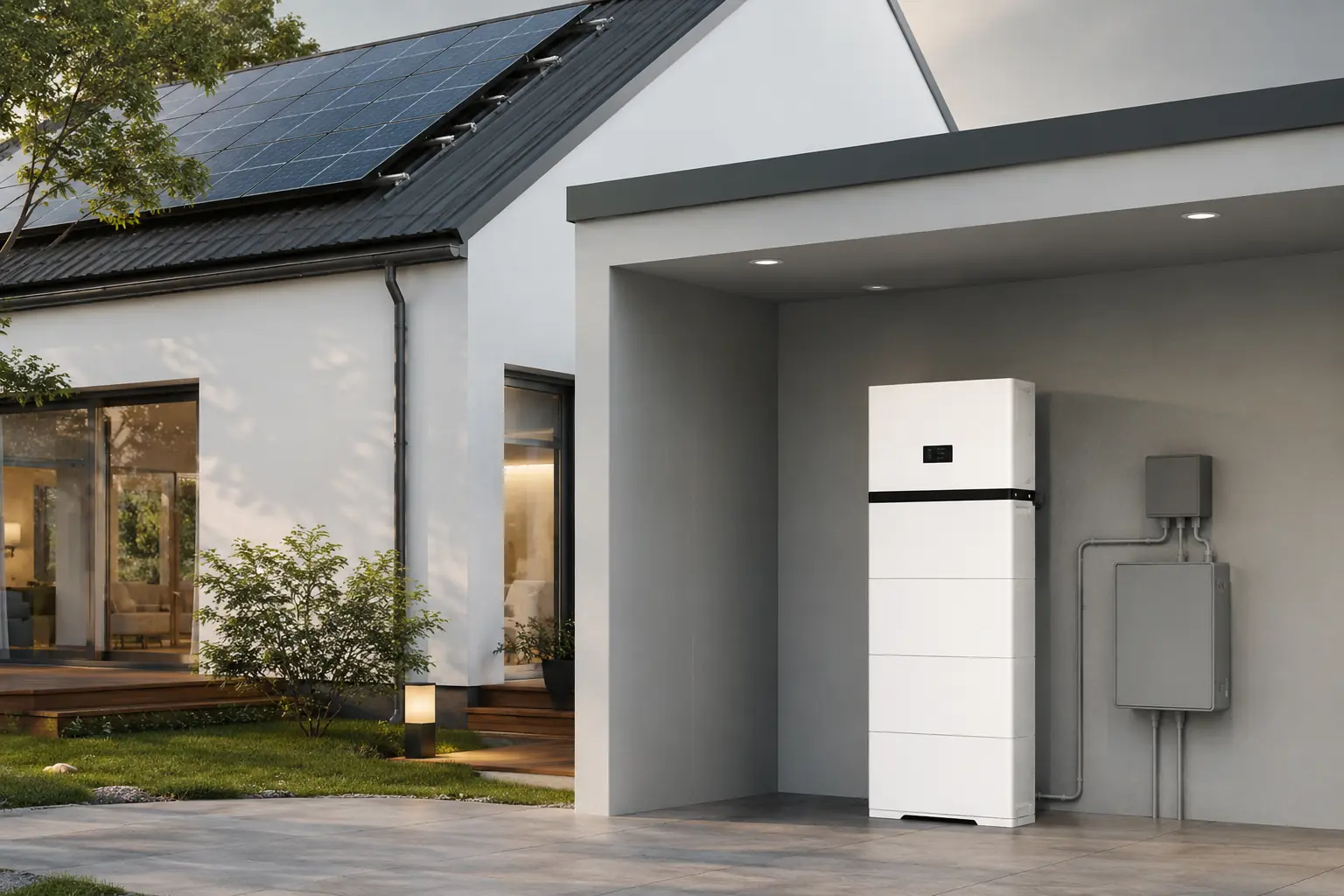
](https://voltcrave-battery.com/wp-content/uploads/2026/08/The-SunESS-Power-Energy-Storage-System-Modular-Intelligent-and-Efficient.webp)
Solar-plus-storage can become complicated when batteries, inverters, controls, backup equipment, and expansion requirements must all be engineered separately.
SunESS Power is Sunwoda Energy's all-in-one residential energy storage system, combining a hybrid inverter with modular battery storage and intelligent energy management. Its current platform supports 5–40 kWh of battery capacity, 5–15 kW normal output power, rapid on-grid/off-grid switching, expandable storage, and integrated solar power management.
In this article, SunESS Power refers specifically to Sunwoda Energy's product, not similarly named energy-storage companies. I see its main value in the way modular batteries, integrated power electronics, battery management, solar input, backup functionality, and monitoring are designed as one coordinated system.
What Is the SunESS Power Energy Storage System?
An energy storage system is more useful when its battery, inverter, controls, and protection equipment understand one another instead of operating as unrelated components.
SunESS Power is an all-in-one residential ESS developed by Sunwoda Energy. The current product integrates energy storage with hybrid-inverter functionality in a modular platform. Sunwoda lists normal output power from 5–15 kW, one to eight battery modules, and nominal battery energy from 5–40 kWh, allowing capacity to be adapted to different household requirements.
It Combines Several ESS Functions
A conventional solar-plus-storage project may require:
Solar panels
↓
PV inverter
↓
Battery inverter
↓
Battery modules
↓
BMS
↓
Energy-management controls
An integrated ESS reduces some of those equipment boundaries.
For SunESS Power, the architecture combines a hybrid inverter with modular battery storage. Sunwoda's earlier technical overview describes each 5 kWh battery module as having its own DC/DC energy optimizer that raises the module's lower DC voltage into a higher-voltage range for system operation.
The complete system can therefore coordinate:
- Solar PV generation
- Battery charging
- Battery discharge
- Household consumption
- Grid interaction
- Backup operation
- Battery monitoring
- Energy-management decisions
DOE describes solar-plus-storage broadly as a system that stores solar-generated electricity so it can be used when generation and consumption do not occur at the same time.
That is exactly the problem an integrated ESS is designed to solve.
Current SunESS Power Specifications
Sunwoda's current product page lists:
| Feature | Current Published Specification |
|---|---|
| Normal output power | 5–15 kW |
| Battery modules | 1–8 |
| Battery nominal energy | 5–40 kWh |
| Ambient temperature | -20°C to 50°C |
| Cooling | Air cooling |
| Enclosure | IP65 |
| Installation | Stacked / leaning against wall |
| On-grid to off-grid switching | 10 ms |
| PV oversizing support | Up to 150% |
| Warranty | Up to 12 years |
| Battery standards listed | IEC 62619, CE, UN38.3, VDE 2510-50, FCC, UL 1973 |
I treat these as product-specific specifications rather than universal ESS requirements.
How Is SunESS Power Modular?
Modularity matters because the electricity needs of a home can change dramatically after an EV, heat pump, larger solar array, or additional backup loads are added.
SunESS Power uses modular battery capacity instead of forcing every installation into one fixed battery size. The current system supports one to eight battery modules and 5–40 kWh of nominal storage. This lets me start with a smaller configuration and select additional capacity within the manufacturer's approved architecture as my energy requirements increase.
The Battery Capacity Can Grow in 5 kWh Steps
Sunwoda's technical explanation describes SunESS Power battery modules as 5 kWh units.
A simplified capacity progression can therefore look like:
| Battery Modules | Nominal Energy |
|---|---|
| 1 | 5 kWh |
| 2 | 10 kWh |
| 3 | 15 kWh |
| 4 | 20 kWh |
| 6 | 30 kWh |
| 8 | 40 kWh |
Sunwoda's current page confirms a total supported range of 5–40 kWh.
That flexibility is useful because I do not always know my final energy requirement on installation day.
Imagine my home currently consumes approximately 8 kWh overnight.
A 10 kWh configuration may be sufficient.
Three years later I add an EV and increase nighttime demand to 14 kWh.
A modular architecture gives me a clearer expansion path than replacing an entire fixed-capacity storage product.
Module-Level Power Electronics Change the Expansion Model
One unusual part of the SunESS Power architecture described by Sunwoda is its battery-level DC/DC energy optimizer.
Sunwoda states that individual battery modules operate around 42–58 V and use a DC/DC booster to provide approximately 350–450 V at the system side. The manufacturer says this independent module architecture supports mixing newer and older battery modules without the calibration process normally associated with some battery-stack designs.
This is different from a conventional high-voltage stack in which:
more series modules = higher total stack voltage.
The SunESS Power concept instead gives individual modules a degree of power-electronic independence.
That can make modular expansion technically more flexible.
However, I would still follow current Sunwoda expansion, firmware, commissioning, and warranty rules rather than assuming that any module can be added at any time.
Modularity Also Helps Installation
Smaller battery modules can be easier to:
- Transport
- Carry into a home
- Position
- Replace
- Expand later
Sunwoda currently describes the system as stacked or wall-leaning and states a maximum installation time of approximately 30 minutes under its product claims.
Actual project installation time can still depend on:
- Electrical panel work
- Solar wiring
- Backup equipment
- Permitting
- Grid requirements
- Site conditions
So I interpret the 30-minute figure as the manufacturer's equipment-installation claim, not a guarantee that an entire permitted solar-plus-storage project can be completed in 30 minutes.
What Makes SunESS Power an Intelligent Energy Storage System?
A battery becomes significantly more useful when its controls can determine when energy should be stored, protected, or released.
SunESS Power uses an integrated BMS and energy-management architecture to monitor battery operating conditions and coordinate charging and discharging. Sunwoda describes BMS functions including data acquisition, battery-status monitoring, fault protection, state-of-charge monitoring, cell-voltage balancing, and charge/discharge control. These functions help the battery operate as a managed energy asset rather than passive storage.
The BMS Protects the Battery
Battery cells cannot simply be charged and discharged without limits.
The system needs to monitor conditions such as:
- Cell voltage
- Battery temperature
- State of charge
- Charge current
- Discharge current
- Fault status
Sunwoda describes the BMS as monitoring battery status and controlling charging and discharging to support safe, reliable operation.
That is especially important in a modular battery.
One module should not be allowed to operate far outside safe limits simply because the rest of the battery system is healthy.
Intelligent Control Connects Solar, Battery, Grid, and Loads
A smart solar-storage system has several possible energy sources and destinations.
During strong solar production:
PV → household loads
and:
PV → battery
When solar production falls:
Battery → household loads
If the battery reaches its configured reserve:
Grid → household loads
During an outage, if the system is configured for backup:
Battery + available solar → backup loads
DOE explains that advanced inverters in solar-plus-storage systems can provide monitoring and communications in addition to converting DC electricity into AC. Properly designed storage systems can also operate without grid support during outages.
This is why I consider intelligent controls one of the most important features of an all-in-one ESS.
The battery capacity tells me how much energy I have.
The control system determines when that energy creates value.
How Does SunESS Power Work With Solar Panels?
A good solar battery should do more than charge whenever electricity is available. It should coordinate PV production with consumption, battery capacity, backup reserve, and system power limits.
SunESS Power integrates hybrid-inverter functionality with battery storage, allowing solar electricity to supply loads and charge the battery within one coordinated platform. Sunwoda states that the current system can support PV arrays oversized up to 150% of the relevant inverter rating, providing additional design flexibility where higher PV generation is desirable.
Solar Energy Can Be Used Later
Suppose my PV system produces:
9 kW
while my house uses:
3 kW
There is:
9 kW − 3 kW = 6 kW
of surplus solar power.
Subject to battery SOC and charge limits, part of that surplus can charge the ESS.
Later in the evening:
Solar output = 0 kW
House load = 3 kW
The battery can discharge to support that load.
DOE identifies this timing flexibility as a central benefit of solar-plus-storage: energy generated during daylight can be stored and used after solar output falls.
Higher Solar Self-Consumption Can Improve the Value of PV
Without storage:
Solar → home → excess exported
With storage:
Solar → home → excess stored → later home use
Whether this produces financial savings depends on the local tariff.
For example, storage becomes particularly interesting where:
retail electricity price > compensation for exported solar.
NREL research has found that solar-plus technologies, including batteries, can improve solar self-consumption and customer economics under certain time-of-use tariffs or export arrangements.
I therefore do not say a battery automatically saves money everywhere.
Its value depends on:
- Electricity prices
- Solar production
- Export compensation
- Household consumption
- Battery cycling
- System efficiency
- Installed cost
How Can SunESS Power Improve Backup and Energy Resilience?
Solar panels alone normally cannot keep a grid-connected home operating during a utility outage. Storage and suitable power electronics are required.
SunESS Power is designed to switch from on-grid to off-grid operation in approximately 10 milliseconds according to Sunwoda's current specifications. It also supports short-duration high inrush demand and can integrate additional sources such as generators, making it suitable for solar-plus-storage installations where backup continuity is an important design objective.
Fast Switching Matters for Backup
Sunwoda currently publishes a:
10 ms on-grid → off-grid switching time.
The practical goal is to reduce the interruption experienced by supported loads when the utility grid fails.
DOE explains that solar panels by themselves normally switch off during outages. For solar to support a home independently, the system needs both appropriately configured inverter functionality and storage.
This makes the ESS fundamentally different from ordinary grid-tied solar.
Starting Loads Can Require Much More Than Running Power
Some household equipment has a high startup current.
Examples can include:
- Pumps
- Compressors
- Air-conditioning equipment
- Refrigerators
- Motors
Sunwoda states that SunESS Power can withstand 150% inrush current for 10 seconds.
That is relevant because a battery may have enough kWh to run a device for hours but still fail to start it if the inverter cannot handle the temporary power surge.
I therefore evaluate both:
kWh = backup duration
and:
kW / surge capability = which loads can start and run.
A 40 kWh Battery Does Not Mean 40 Hours of Backup
Suppose I configure 40 kWh of battery energy.
If my average backup load is:
2 kW
the simplified theoretical duration is:
40 kWh ÷ 2 kW = 20 hours
At:
5 kW
it becomes:
40 kWh ÷ 5 kW = 8 hours
Real backup duration will be lower or different because of:
- Usable SOC
- Conversion losses
- reserve settings
- temperature
- load variation
- battery aging
This is why battery capacity should always be interpreted together with the actual backup load.
What Makes SunESS Power Efficient?
Efficiency is one of the words in the title, but I prefer to separate verified product architecture from unsupported numerical claims.
SunESS Power is designed around integrated hybrid conversion, modular DC/DC energy optimizers, compact high-voltage power management, and coordinated solar-storage control. These design choices can reduce integration complexity and help the system manage energy efficiently. However, the current Sunwoda product page reviewed here does not provide one universal round-trip or conversion-efficiency percentage for every SunESS Power configuration.
High Voltage Can Reduce Current at the Same Power
Electrical power follows:
P = V × I
Therefore:
I = P ÷ V
At 10 kW:
At 50 V:
10,000 ÷ 50 = 200 A
At 400 V:
10,000 ÷ 400 = 25 A
Higher voltage therefore requires much lower current for the same power.
Resistive loss is related to:
P loss = I²R
So lower current can reduce heating in:
- Conductors
- Connectors
- Busbars
- Switching components
Sunwoda's module-level optimizer raises individual module output into approximately the 350–450 V range according to its technical description.
This helps explain the electrical logic behind the architecture.
Integration Can Also Reduce Design Complexity
Efficiency is not only electrical conversion efficiency.
A product can also be efficient in terms of:
- Installation
- Space
- Expansion
- System configuration
- Monitoring
- Troubleshooting
Sunwoda's 2024 technical overview gives product-level energy-density and power-density figures of 105 Wh/dm³ and 192.3 W/dm³, respectively, as part of its compact-design claims.
I would treat those as manufacturer specifications rather than independent performance benchmarks.
For an actual purchasing comparison, I would still request the current model-specific datasheet and compare:
- PV-to-AC efficiency
- Battery-to-AC efficiency
- Round-trip efficiency
- Standby consumption
- Auxiliary consumption
under comparable test conditions.
Is SunESS Power Suitable for Future Expansion?
A battery installed today may need to support a very different household five years from now.
SunESS Power is specifically designed around expandable battery capacity. Its current product range supports 5–40 kWh with one to eight battery modules. This makes it relevant for households that expect electricity demand to grow, although future expansion should always be checked against current inverter, firmware, battery, warranty, and manufacturer compatibility rules.
Why Household Demand May Increase
A home may begin with:
solar + ordinary electrical loads
and later add:
- EV charging
- Heat pump
- Electric water heating
- Additional air conditioning
- Home office equipment
- Larger backup requirements
Suppose my original nighttime consumption is:
8 kWh
and I install:
10 kWh
of battery capacity.
Later, an EV adds another:
6 kWh
of overnight energy demand.
A modular battery architecture gives me a potential path toward:
15 kWh
or:
20 kWh
instead of replacing the entire original battery.
I Still Plan Expansion Before Installation
Even modular batteries have limits.
I check:
- Maximum battery-module count
- Maximum total kWh
- Inverter power
- Solar-array size
- Backup-panel capacity
- Battery-generation compatibility
- Firmware
- Warranty requirements
Sunwoda currently lists up to eight battery modules and 40 kWh for SunESS Power.
That makes 40 kWh a current published system boundary for this product family, not an invitation to add unlimited modules.
My Insights: What Makes the SunESS Power Energy Storage System Modular, Intelligent, and Efficient
After comparing Sunwoda's current product information with the broader role of residential solar-plus-storage, I think the strongest part of the SunESS Power concept is the way modularity, integrated controls, and power electronics reinforce one another.
The SunESS Power Energy Storage System is modular because capacity can scale from 5–40 kWh, intelligent because its BMS and hybrid-inverter controls coordinate battery and solar operation, and efficient in architecture because module-level DC/DC optimization, high-voltage power management, and all-in-one integration are designed to reduce complexity while supporting solar self-consumption and backup.
My First Insight: Modularity Is More Valuable When the Modules Have Electrical Independence
Many battery systems are called modular simply because several batteries can be stacked.
SunESS Power goes further in its published architecture.
Sunwoda says each 5 kWh battery module has a DC/DC energy optimizer.
That means the modular concept affects both:
physical expansion
and:
electrical management.
This is important because battery modules installed years apart may not have identical aging characteristics.
Sunwoda specifically presents module-level independence as the reason newer and older modules can be combined within supported configurations.
My Second Insight: The 5–40 kWh Range Fits More Than One Residential Energy Strategy
A 5 kWh battery and a 40 kWh battery do not solve the same problem.
A smaller configuration might focus on:
- Evening solar use
- Short backup
- Time-of-use shifting
A larger system can support:
- Longer backup duration
- Higher overnight consumption
- Greater solar self-consumption
- Electrified household loads
The same platform covering those configurations reduces the need for completely different battery families.
My Third Insight: Intelligence Matters More Than Battery Capacity Alone
A 40 kWh battery that charges and discharges at the wrong times can create less value than a smaller battery with a good control strategy.
DOE and NREL research both reinforce the importance of coordinating solar, battery storage, tariffs, and household loads rather than viewing a battery as passive energy capacity.
For me, useful intelligence means answering questions such as:
Is excess solar available?
Should the battery charge now?
Should capacity be reserved for backup?
Is grid electricity expensive now?
How much battery power can safely be discharged?
That is where the EMS/BMS architecture creates practical value.
My Fourth Insight: Backup Is a System Function, Not Just a Battery Feature
I would not buy SunESS Power—or any residential battery—based only on kWh if outage protection matters.
I also check:
- Switching architecture
- Inverter output power
- Surge capability
- Critical loads
- Solar operation during an outage
Sunwoda's published 10 ms transfer time and 150% short-duration inrush capability are therefore meaningful because they address the power-delivery side of backup, not only energy storage.
DOE similarly emphasizes that solar requires suitable inverter and storage architecture to support loads when the utility grid is unavailable.
My Fifth Insight: “Efficient” Should Be Judged Across the Complete SunESS Power System
This is the central idea behind The SunESS Power Energy Storage System: Modular, Intelligent, and Efficient.
I would evaluate efficiency in five dimensions:
| Efficiency Dimension | What I Examine |
|---|---|
| Energy efficiency | Conversion and round-trip losses |
| Power efficiency | High-voltage current reduction and inverter performance |
| Space efficiency | kWh and kW delivered from available installation space |
| Installation efficiency | Integrated components and simplified commissioning |
| Expansion efficiency | Ability to add capacity without replacing the original system |
Sunwoda provides strong evidence for several of these architectural advantages: modular 5–40 kWh capacity, high-voltage DC/DC optimization, all-in-one integration, compact construction, IP65 installation flexibility, and fast grid-to-backup switching.
At the same time, I would not invent a numerical efficiency claim that the current product page does not provide.
For a purchasing decision, I would request the current technical documentation for the exact inverter and battery configuration and compare measured efficiency under the same test conditions as competing systems.
My Practical SunESS Power Evaluation Framework
Before selecting the system, I would ask:
- How many usable kWh do I need today?
- Will 5–40 kWh cover my future expansion plan?
- Which 5–15 kW inverter configuration matches my peak household load?
- How much PV capacity will I connect?
- Which loads need backup?
- Will high-inrush equipment such as pumps or HVAC need to start during an outage?
- How does my electricity tariff reward solar self-consumption or load shifting?
- What current warranty terms apply in my country?
- Which certifications and grid requirements apply locally?
- What model-specific efficiency figures apply to my configuration?
- How will future battery modules be commissioned?
- What local service and replacement support is available?
The answers determine whether SunESS Power's architecture produces real value for a particular home.
My overall interpretation is straightforward:
Modular means the system can adapt its battery capacity.
Intelligent means the battery, inverter, and controls actively coordinate energy.
Efficient means the architecture aims to manage energy, power conversion, space, installation, and expansion with fewer unnecessary system boundaries.
That combination is what makes SunESS Power more than a standalone solar battery.
It is designed as a complete residential power-management platform.
Conclusion
SunESS Power combines modular 5–40 kWh storage, hybrid power conversion, intelligent battery management, solar integration, and rapid backup switching in one expandable residential ESS platform.
](https://voltcrave-battery.com/wp-content/uploads/2026/08/Cost-of-Solar-Power-Battery-Storage-A-2026-Engineering-and-Economic-Deep-Dive-768x512.webp)
](https://voltcrave-battery.com/wp-content/uploads/2026/09/What-Does-an-Inverter-Do-for-a-Car-768x512.webp)