

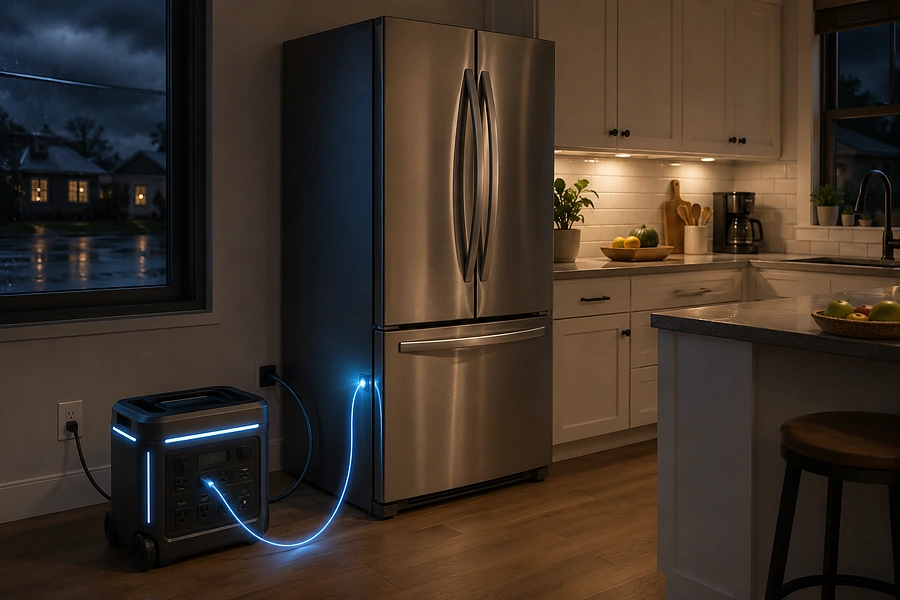
](https://voltcrave-battery.com/wp-content/uploads/2026/09/How-Long-Will-a-Power-Station-Power-a-Fridge.webp)
A refrigerator may use modest power while running, but compressor cycling and startup surges make backup runtime harder to estimate from its watt rating alone.
A portable power station can typically power a refrigerator for several hours to more than a day, depending on battery capacity, fridge energy consumption, inverter efficiency, and compressor duty cycle. A 1,000Wh power station may provide roughly 8–15 hours for many full-size refrigerators, while a 2,000Wh station can often extend practical backup toward 16–30 hours under similar conditions.
I never estimate refrigerator runtime from battery capacity alone. I first check how many watt-hours the fridge actually consumes over time, then account for power-station losses and compressor startup requirements.
How Do You Calculate How Long a Power Station Will Run a Fridge?
The basic calculation is simple, but refrigerator cycling makes real-world results different from a constant-load calculation.
To estimate refrigerator runtime, I multiply the power station's battery capacity by its expected usable efficiency and divide that number by the refrigerator's average power consumption. Because a refrigerator compressor switches on and off, I prefer measured average energy consumption over the appliance's maximum or instantaneous watt rating whenever that information is available.
A simplified formula is:
Runtime = Usable Battery Capacity (Wh) ÷ Average Fridge Load (W)
If I assume approximately 85% usable AC energy from a 1,000Wh portable power station:
1,000Wh × 0.85 = 850Wh usable
If the refrigerator averages 75W over time:
850Wh ÷ 75W ≈ 11.3 hours
This is a much more useful estimate than assuming the refrigerator continuously consumes its nameplate wattage.
Example Runtime Estimates
| Power Station | Average Fridge Load | Approx. Usable Energy | Estimated Runtime |
|---|---|---|---|
| 500Wh | 50W | 425Wh | 8.5 hours |
| 500Wh | 100W | 425Wh | 4.25 hours |
| 1,000Wh | 50W | 850Wh | 17 hours |
| 1,000Wh | 100W | 850Wh | 8.5 hours |
| 2,000Wh | 50W | 1,700Wh | 34 hours |
| 2,000Wh | 100W | 1,700Wh | 17 hours |
These are planning estimates, not guaranteed runtimes.
Real performance changes with refrigerator size, room temperature, food load, door opening, thermostat settings, battery temperature, inverter efficiency, and battery condition.
The best calculation therefore uses measured Wh consumption over several hours rather than a guessed running-watt figure.
How Long Will a 1000Wh Power Station Run a Refrigerator?
A 1,000Wh portable power station is one of the most practical sizes for refrigerator backup because it balances capacity with portability.
A 1,000Wh power station can often keep a typical refrigerator operating for roughly 8–15 hours, although efficient refrigerators may run longer and power-hungry models may run for less time. The result depends mainly on the fridge's average consumption rather than its instantaneous running wattage. I also allow for roughly 10–20% system losses when making a planning estimate.
Suppose the station contains:
1,000Wh
and approximately 85% becomes usable AC energy:
1,000 × 0.85 = 850Wh
Now compare three refrigerators.
| Average Consumption | Estimated Runtime |
|---|---|
| 50W | 17 hours |
| 75W | 11.3 hours |
| 100W | 8.5 hours |
| 150W | 5.7 hours |
The important word here is average.
A refrigerator may consume 120W when its compressor is operating but spend a significant amount of time with the compressor off. Its average load across six or twelve hours could therefore be much lower than 120W.
This is why the calculation:
1,000Wh ÷ 120W = 8.3 hours
can underestimate runtime if 120W is only the compressor's active running power.
The opposite problem can also occur. A refrigerator in a hot garage may cycle much more frequently. Frequent door opening also adds heat that the compressor must remove.
For emergency planning, I prefer conservative numbers. If keeping food cold is critical, I would rather size the battery with extra capacity than depend on an optimistic laboratory-style runtime estimate.
How Long Will a 2000Wh Power Station Run a Fridge?
Moving from 1,000Wh to 2,000Wh approximately doubles stored energy, assuming the two systems have similar usable capacity and conversion efficiency.
A 2,000Wh power station may run many household refrigerators for approximately 16–30 hours, while highly efficient models with low average consumption can potentially operate longer. A larger battery is especially useful for overnight outages because it provides more energy reserve for compressor cycling and can also support small essential loads such as routers and lights.
Using the same 85% planning assumption:
2,000Wh × 0.85 = 1,700Wh usable
At an average refrigerator load of:
75W
runtime becomes:
1,700Wh ÷ 75W ≈ 22.7 hours
At:
100W
it becomes:
17 hours.
At:
50W
it becomes:
34 hours.
Why I Prefer 2kWh for Longer Emergency Backup
A refrigerator is rarely the only device I want during an outage.
I may also need a:
Wi-Fi router
phone charger
laptop
or:
LED light.
Suppose my refrigerator averages 75W and the other essential loads average another 40W.
Total average demand becomes:
115W.
Then:
1,700Wh ÷ 115W ≈ 14.8 hours.
The additional loads have reduced the refrigerator backup period significantly.
This illustrates an important sizing principle.
I do not ask:
“How long can this battery run my fridge?”
I ask:
“How long can this battery run my complete emergency load?”
That produces a much more realistic backup plan.
Why Does a Refrigerator Use Less Power Than Its Running-Watt Rating Suggests?
A refrigerator does not normally run its compressor continuously.
Refrigerators cycle their compressors according to internal temperature. When the target temperature is reached, the compressor switches off and electricity consumption falls substantially. This duty cycle means a refrigerator rated at 100–200W while actively cooling can have a much lower average power draw when consumption is measured across an entire day.
Imagine a refrigerator uses:
120W
while its compressor is running.
If it operated continuously, daily energy consumption would be:
120W × 24h = 2,880Wh.
But suppose the compressor runs only 30% of the time.
A simplified average becomes:
120W × 0.30 = 36W.
Its theoretical daily compressor energy would then be:
36W × 24h = 864Wh.
Real refrigerators also have control electronics, fans, defrost heaters, ice makers, and other loads, so this simplified calculation should not replace actual measurement.
Duty Cycle Changes With Conditions
The compressor may operate more frequently when:
room temperature rises
the door is opened frequently
warm food is added
or:
airflow around the refrigerator is poor.
This explains why two identical refrigerators connected to identical power stations can have different runtimes.
A refrigerator in a 20°C room may require less energy than the same unit operating inside a very hot garage.
For the best estimate, I use an energy meter to measure actual refrigerator consumption for at least 24 hours.
If the refrigerator consumes:
1.2kWh per day
its average load is:
1,200Wh ÷ 24h = 50W.
That figure is much more useful for battery sizing.
Why Does Refrigerator Startup Surge Matter?
Stored energy determines runtime, but inverter power determines whether the refrigerator can start.
A refrigerator compressor can briefly draw significantly more power during startup than during normal operation. The portable power station therefore needs sufficient continuous output and surge capability. A battery can contain enough Wh to run a refrigerator for many hours yet still fail to start it if the inverter cannot handle the compressor's short startup demand.
This creates two separate requirements:
| Requirement | What It Determines |
|---|---|
| Battery capacity in Wh | How long the fridge can run |
| Continuous output in W | Whether normal running load is supported |
| Surge output in W | Whether the compressor can start |
Suppose a refrigerator consumes:
150W while running
but briefly requires:
900W during startup.
A:
500Wh / 300W
power station may contain enough energy for several hours of theoretical operation.
But its inverter may shut down when the compressor tries to start.
A:
500Wh / 1,000W
station could handle the same refrigerator much more successfully, even though both batteries contain 500Wh.
This is why I check the refrigerator and power station together.
For uncertain compressor loads, I prefer meaningful inverter headroom rather than choosing a station whose maximum output is almost identical to the refrigerator's expected startup demand.
How Long Will a 500Wh Power Station Run a Fridge?
A 500Wh station can provide useful short-term refrigerator backup, but it offers much less margin for overnight outages.
A 500Wh power station may operate a refrigerator for approximately 4–8 hours under many practical conditions, although an efficient refrigerator with a low duty cycle can run longer. Because only part of the nominal battery capacity reaches the appliance after inverter and system losses, I would not calculate runtime using the full 500Wh rating.
Using an 85% planning factor:
500Wh × 0.85 = 425Wh usable
For a refrigerator averaging:
50W
runtime is:
425Wh ÷ 50W = 8.5 hours.
At:
75W
runtime falls to:
5.7 hours.
At:
100W
it falls to:
4.25 hours.
This capacity can work well for short outages.
It may also make sense for a highly efficient mini fridge.
But I would be more cautious if I needed to keep a large refrigerator operating overnight while also charging phones and powering other equipment.
The smaller battery also gives me less flexibility if environmental conditions increase refrigerator consumption.
For that reason, I view the 500Wh category mainly as:
short-duration refrigerator backup
rather than:
long-outage refrigerator protection.
Its low weight can still make it attractive for camping, vehicles, and temporary emergency use.
Will a Mini Fridge Run Longer on a Portable Power Station?
Usually, yes, provided the mini fridge is efficient and does not have unusually high energy consumption.
A mini fridge can often run longer than a full-size refrigerator on the same portable power station because its cooling volume and average energy demand may be lower. However, size alone does not determine efficiency. Compressor design, insulation, ambient temperature, thermostat setting, age, and usage patterns can make some small refrigerators surprisingly power-hungry.
Consider a 1,000Wh station with approximately:
850Wh usable AC energy.
If a mini fridge averages:
35W
the theoretical estimate is:
850Wh ÷ 35W ≈ 24.3 hours.
If a full-size fridge averages:
75W
the estimate becomes:
850Wh ÷ 75W ≈ 11.3 hours.
That is a major difference.
However, I would still measure actual consumption.
A compact fridge operating outdoors during summer can cycle heavily.
An older mini fridge with poor insulation may also use more electricity than expected.
A modern efficient full-size refrigerator could sometimes perform better than an inefficient older compact model.
Therefore, I do not size the battery based only on:
mini fridge vs full-size fridge.
I size it using:
actual Wh/day.
That single number incorporates much of the refrigerator's real-world cycling behavior and gives me a stronger foundation for estimating backup runtime.
Can Solar Panels Keep a Power Station Running a Fridge Longer?
Solar panels can dramatically extend refrigerator backup, but only when daily solar production approaches or exceeds daily energy consumption.
Solar charging can extend refrigerator runtime by replacing part or all of the energy used during the day. If the panels generate more usable Wh than the refrigerator consumes over the same period, the system can potentially maintain operation for much longer. However, clouds, shading, panel orientation, season, and the station's solar-input limit affect the result.
Suppose my refrigerator consumes:
1,200Wh per day.
My solar panels produce an average usable:
1,500Wh per day.
In favorable conditions, the solar array can theoretically replace the refrigerator's daily consumption and leave some energy for other loads.
But suppose cloudy weather reduces production to:
500Wh per day.
The daily energy deficit becomes:
1,200Wh − 500Wh = 700Wh.
A 2,000Wh power station will still eventually discharge.
Solar therefore changes the question from:
“How big is my battery?”
to:
“Is my daily energy production at least as large as my daily energy consumption?”
That is the foundation of sustainable off-grid operation.
A larger battery helps bridge cloudy periods, but it does not create energy. The solar array or another charging source must eventually replace what the refrigerator consumes.
What Factors Can Shorten Fridge Runtime?
Portable power-station runtime can change considerably even when battery capacity stays the same.
The biggest factors that shorten refrigerator runtime are high ambient temperature, frequent door opening, warm food being added, poor refrigerator efficiency, defrost cycles, ice makers, additional loads connected to the station, inverter losses, battery aging, and extreme battery temperatures. I therefore treat every runtime calculation as an estimate rather than a guaranteed number.
A Realistic Runtime Model
I think of refrigerator backup as five interacting variables:
| Variable | Effect on Runtime |
|---|---|
| Larger battery Wh | Increases runtime |
| Higher fridge Wh/day | Reduces runtime |
| Better inverter efficiency | Increases usable energy |
| Higher room temperature | Usually increases fridge consumption |
| Additional connected devices | Reduces available fridge runtime |
Battery age matters too.
A 1,000Wh station that eventually retains only:
80% of its original usable capacity
cannot provide the same runtime it provided when new.
Temperature also affects both sides of the system.
Hot weather can increase refrigerator cooling demand while also creating a harsher operating environment for the battery.
That combination can reduce backup duration precisely when refrigeration matters most.
This is why I include extra energy margin when sizing emergency power.
A calculated requirement of:
800Wh
does not automatically mean I would purchase exactly:
800Wh nominal capacity.
I want reserve for uncertainty.
My Insights: How Long Will a Power Station Power a Fridge
The correct answer depends more on energy than on the headline watt rating printed on either device.
A power station can power a fridge from several hours to more than a day. A 500Wh station may provide roughly 4–8 hours, a 1,000Wh station roughly 8–15 hours, and a 2,000Wh station roughly 16–30 hours for many household refrigerators. Actual runtime depends on average fridge consumption, compressor cycling, inverter losses, temperature, and additional loads.
My First Insight: Measure Wh per Day Instead of Guessing From Watts
If I can choose only one refrigerator specification, I want:
Wh/day
or:
kWh/day.
Suppose the refrigerator consumes:
1.0kWh per day.
That equals:
1,000Wh/day.
A portable station with approximately:
850Wh usable
would theoretically supply about:
0.85 day
or:
20.4 hours
under similar conditions.
That is more accurate than assuming the compressor's running wattage remains constant for 24 hours.
My Second Insight: A 1kWh Power Station Is a Useful Starting Point
For short emergency refrigerator backup, I consider the 1kWh class practical.
It offers much more runtime than 300–500Wh systems without becoming as large as multi-kWh home-backup products.
For longer outages, I would move toward:
2kWh or expandable storage
especially when other essential loads share the battery.
My Third Insight: Surge Power and Runtime Are Separate Problems
A power station needs:
enough W to start the fridge
and:
enough Wh to keep it running.
I check both.
This prevents the frustrating situation where a battery has plenty of stored energy but shuts down every time the compressor starts.
My Fourth Insight: Solar Can Matter More Than Buying an Even Bigger Battery
For a short blackout, capacity dominates.
For a multi-day blackout, recharge capability becomes increasingly important.
If my refrigerator consumes:
1,000Wh/day
and my solar setup can reliably replace close to:
1,000Wh/day,
the system becomes far more sustainable.
If solar produces only 200Wh/day, adding a solar panel helps, but the battery still experiences a large daily deficit.
My Fifth Insight: How Long Will a Power Station Power a Fridge in Real Life?
This directly answers the main question.
| Power Station Capacity | Practical Planning Range for Many Fridges* |
|---|---|
| 300Wh | ~2–5 hours |
| 500Wh | ~4–8 hours |
| 1,000Wh | ~8–15 hours |
| 1,500Wh | ~12–22 hours |
| 2,000Wh | ~16–30 hours |
| 3,000Wh | ~24–45+ hours |
*These are broad planning ranges, not guarantees. Efficient refrigerators may run longer, while older, larger, hotter-running, or frequently opened refrigerators may run for less time.
The best way to calculate my own runtime is:
Step 1: Measure refrigerator energy consumption in Wh/day.
Step 2: Determine the power station's usable AC energy.
Step 3: Verify that continuous and surge output can start the compressor.
Step 4: Account for other loads connected to the station.
Step 5: Add reserve for temperature, losses, battery aging, and uncertain cycling.
If my fridge uses:
1,200Wh/day
and my power station provides:
1,700Wh usable,
the simple estimate is:
1,700 ÷ 1,200 × 24 ≈ 34 hours.
If the same station also supplies 500Wh/day to lights, networking, and electronics, total consumption becomes:
1,700Wh/day.
Estimated runtime then falls toward:
24 hours.
So the most accurate answer to “How long will a power station power a fridge?” is not determined by the power station alone.
It is determined by the relationship between:
usable battery Wh ÷ actual refrigerator Wh consumption.
Once I know those two numbers and confirm the inverter can handle compressor startup, refrigerator backup becomes much easier to predict.
Conclusion
A power station can run a fridge for hours or days, but accurate runtime depends on usable Wh, actual fridge consumption, compressor cycling, surge power, losses, and recharging.
](https://voltcrave-battery.com/wp-content/uploads/2026/08/Cost-of-Solar-Power-Battery-Storage-A-2026-Engineering-and-Economic-Deep-Dive-768x512.webp)
](https://voltcrave-battery.com/wp-content/uploads/2026/09/What-Is-Containerized-Battery-Energy-Storage-768x512.webp)
](https://voltcrave-battery.com/wp-content/uploads/2026/09/Do-Portable-Car-Jump-Starters-Actually-Work-768x512.webp)