
](https://voltcrave-battery.com/wp-content/uploads/2026/10/What-Is-an-Electrical-Control-Cabinet.webp)
Modern electrical systems need reliable power distribution and equipment control. Without proper protection and monitoring, electrical faults can damage machinery, interrupt operations, and create serious safety risks.
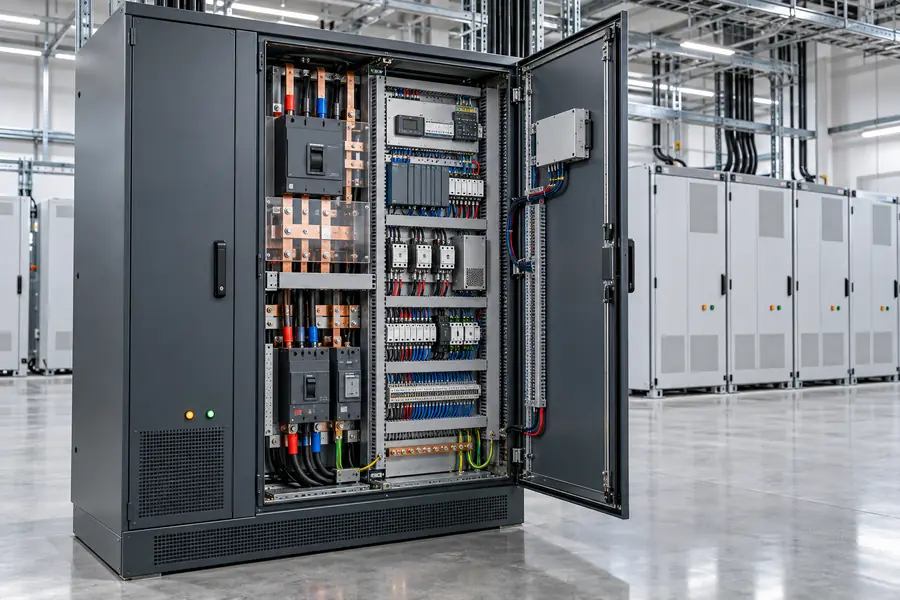
An electrical control cabinet is an enclosed assembly that houses electrical components used to control, protect, and monitor equipment or electrical circuits. It commonly contains circuit breakers, contactors, relays, controllers, terminal blocks, and wiring. These cabinets support industrial automation, power distribution, motor control, and battery energy storage systems.
I consider electrical control cabinets essential to modern industrial electrical infrastructure. They organize electrical equipment in one protected location and help operators manage complex systems. However, different cabinets serve different purposes. Understanding their components, working principles, and safety requirements helps engineers and buyers select suitable equipment for industrial and energy storage applications.
What Does an Electrical Control Cabinet Do?
Electrical control cabinets are widely used in factories, commercial buildings, and energy facilities. Their main purpose is to organize electrical control functions while protecting equipment and personnel from electrical hazards.
An electrical control cabinet manages electrical power and control signals through devices such as breakers, relays, contactors, and programmable controllers. Depending on its design, it can start and stop equipment, distribute electricity, monitor operating conditions, isolate faults, and coordinate electrical systems.
How Does an Electrical Control Cabinet Work?
I usually explain the working principle through four main functions.
1. Power Distribution
The cabinet receives electricity from an external power source and distributes it to connected equipment.
Circuit breakers, switches, and other protective devices help manage electrical circuits.
However, not every control cabinet is designed as a main power distribution assembly.
2. Equipment Control
Control devices operate machinery according to electrical signals or programmed instructions.
For example, a programmable logic controller (PLC) can receive signals from temperature or pressure sensors and command motors, valves, or other equipment.
Contactors and motor controllers then operate the connected electrical loads.
3. Electrical Protection
Protection devices respond to conditions such as overcurrent, short circuits, and certain electrical faults.
I consider proper protective-device coordination essential because different circuits may require different protection methods.
A cabinet must be designed to handle the electrical characteristics of the installation.
4. Monitoring and Communication
Modern control cabinets can collect information from sensors, energy meters, and industrial controllers.
This information may be displayed through a human-machine interface (HMI) or transmitted to a supervisory control system.
I find monitoring particularly valuable in installations where operators need to observe electrical loads, equipment status, temperatures, and alarms.
Why Are Electrical Control Cabinets Important?
The main benefits of a properly designed control cabinet include:
- Safety: Enclosures reduce accidental contact with hazardous electrical components.
- Reliability: Organized circuits and suitable protection help reduce equipment failures.
- Automation: Controllers allow equipment to respond to operating conditions.
- Maintenance: Clearly identified components simplify inspections and troubleshooting.
- Scalability: Some cabinet designs allow additional circuits or control functions.
- System integration: Communication interfaces can connect equipment with larger monitoring systems.
I would never assume that an enclosure alone guarantees electrical safety.
The internal wiring, component selection, protective devices, grounding, and installation conditions determine how safely the complete cabinet operates.
What Components Are Inside an Electrical Control Cabinet?
The internal structure of an electrical control cabinet depends on its application. A motor control cabinet may contain several drives, while an energy storage control cabinet may focus on protection, communication, and system coordination.
Common electrical control cabinet components include circuit breakers, fuses, contactors, relays, PLCs, power supplies, terminal blocks, and communication devices. Some cabinets also contain variable frequency drives, energy meters, HMIs, and cooling equipment. Each component performs a specific function within the electrical system.
Main Electrical Control Cabinet Components
I classify the components into protection, switching, control, communication, and environmental management.
| Component | Main Function |
|---|---|
| Circuit Breaker | Interrupts current under specified overload or fault conditions |
| Fuse | Provides overcurrent protection |
| Contactor | Switches electrical loads using a control signal |
| Control Relay | Performs switching or control logic functions |
| PLC | Executes programmed automation instructions |
| Variable Frequency Drive (VFD) | Controls compatible AC motor speed and operation |
| Power Supply | Provides suitable power for control devices |
| Terminal Block | Connects and organizes electrical conductors |
| HMI | Displays information and allows operator interaction |
| Energy Meter | Measures electrical parameters and energy consumption |
| Communication Module | Exchanges data with connected equipment |
| Cooling Fan or Heat Exchanger | Helps maintain acceptable cabinet temperature |
Not every cabinet contains all these components.
I would select the internal configuration based on the electrical load, control requirements, and operating environment.
What Is the Difference Between a PLC and a Circuit Breaker?
A circuit breaker and a PLC perform different functions.
A circuit breaker is primarily a protective switching device. It interrupts current when specified electrical conditions occur.
A PLC is a programmable controller that processes signals and executes control logic.
For example, a PLC may decide when a pump should operate based on water level measurements.
The motor circuit must still include suitable electrical protection.
I would not treat ordinary PLC software as a replacement for dedicated electrical protective devices or required safety-rated controls.
The control system and the protection system must work together.
How Are Electrical Components Arranged Inside a Cabinet?
A professional cabinet normally uses an organized internal layout.
Power circuits and sensitive control wiring may need separation to reduce electrical interference and satisfy applicable design requirements.
Components are mounted on suitable rails, panels, or supports.
Wiring ducts, cable identification, and terminal labels improve installation and maintenance.
I also consider heat management important.
Variable frequency drives, power supplies, and other electrical devices generate heat during operation.
Poor ventilation can raise internal temperatures and shorten component life.
Cooling fans, filtered ventilation, heat exchangers, or air-conditioning systems may be needed depending on the equipment and environmental conditions.
I would calculate thermal requirements rather than install cooling equipment based only on cabinet dimensions.
What Types of Electrical Control Cabinets Are Used in Industry?
Electrical control cabinets are available in different configurations. Industrial manufacturers, energy companies, and commercial facilities use specific designs to manage their equipment and electrical systems.
The main types of electrical control cabinets include PLC control cabinets, motor control cabinets, power distribution cabinets, VFD cabinets, and energy storage control cabinets. Each type is designed for particular electrical loads, automation functions, protection requirements, and installation environments.
1. PLC Control Cabinet
A PLC control cabinet provides automated control for industrial processes.
It usually contains programmable controllers, power supplies, interface relays, terminal blocks, and communication equipment.
I often associate these cabinets with manufacturing lines, water treatment systems, packaging equipment, and industrial process automation.
PLCs can monitor input signals and operate connected equipment according to programmed logic.
2. Motor Control Cabinet
A motor control cabinet manages the operation of electric motors.
It may contain contactors, overload protection, motor starters, and other switching devices.
Some installations use motor control centers (MCCs) to organize multiple motor control units.
I consider these cabinets important in factories, pumping stations, ventilation systems, and industrial cooling facilities.
They allow operators to manage motor operation while providing appropriately engineered electrical protection.
3. VFD Control Cabinet
A variable frequency drive cabinet contains one or more motor drives.
A VFD adjusts the electrical frequency and voltage delivered to compatible motors.
This allows motor speed to respond to the equipment's operating requirements.
I consider VFD cabinets useful for pumps, fans, compressors, and industrial process systems where variable-speed operation is beneficial.
The cabinet design must account for heat dissipation, electromagnetic compatibility, and electrical protection.
4. Power Distribution Cabinet
A power distribution cabinet is designed to distribute electrical energy to connected circuits.
Depending on its design, it may contain circuit breakers, busbars, metering devices, and protective equipment.
Its primary function differs from that of a PLC cabinet.
A distribution cabinet emphasizes electrical power routing and protection, while a PLC cabinet emphasizes automation and control.
Some electrical assemblies combine both functions.
5. Energy Storage Electrical Control Cabinet
Electrical control cabinets also play an important role in battery energy storage systems.
A commercial or industrial battery energy storage system may use control and distribution cabinets to coordinate auxiliary power, protective switching, monitoring, and communication between system components.
A typical BESS includes several important subsystems:
| BESS Subsystem | Main Role |
|---|---|
| Battery Management System (BMS) | Monitors and protects battery cells and modules |
| Power Conversion System (PCS) | Converts energy between DC battery circuits and AC electrical systems |
| Energy Management System (EMS) | Determines charging and discharging operating targets |
| Electrical Control Cabinet | Houses designated control, switching, distribution, and communication components |
| SCADA System | Provides system supervision, monitoring, and data collection |
| Thermal Management System | Maintains equipment and battery operating temperatures |
I consider integration between these subsystems especially important.
For example, the EMS may request battery discharge during a period of high electricity demand.
However, the BMS can restrict discharge based on battery temperature, state of charge, or other operating conditions.
The PCS must operate within the applicable electrical and battery limits.
The electrical control cabinet may provide the physical control interfaces, protection devices, and communication connections needed for this coordination.
Its exact role depends on the BESS architecture.
An electrical control cabinet is not automatically a battery management system, power conversion system, or complete energy storage system.
How Do You Choose a Safe and Reliable Electrical Control Cabinet?
Selecting an electrical control cabinet requires careful evaluation of electrical specifications, operating conditions, protection requirements, and installation standards. Choosing an unsuitable cabinet can cause overheating, equipment failures, and safety problems.
A reliable electrical control cabinet should match the system voltage, current, fault level, control requirements, and installation environment. Buyers should evaluate component quality, enclosure protection ratings, applicable standards, thermal management, wiring documentation, and manufacturer testing before approving a cabinet for industrial or energy storage use.
Check Electrical Specifications
I start with the actual system requirements.
Important specifications include:
- Rated operating voltage and frequency
- Continuous current and connected load
- Number of phases and circuit configuration
- Available short-circuit current
- Required short-circuit current rating (SCCR), where applicable
- Control voltage and automation requirements
- Communication interfaces
- Indoor or outdoor installation conditions
- Ambient temperature and thermal design
I would verify these details before determining cabinet dimensions or choosing electrical components.
For example, a cabinet used with a three-phase industrial motor requires different equipment from a cabinet designed for DC auxiliary distribution within a battery storage system.
Understand IP and NEMA Enclosure Ratings
The electrical enclosure must provide suitable protection for its operating environment.
IP ratings follow IEC 60529, while NEMA enclosure types describe protection characteristics under a different classification system.
| Enclosure Rating | Typical Protection or Application |
|---|---|
| IP54 | Dust-protected enclosure with protection against splashing water |
| IP55 | Dust-protected enclosure with protection against water jets |
| IP65 | Dust-tight enclosure with protection against water jets |
| NEMA 1 | Basic indoor enclosure protection |
| NEMA 3R | Outdoor enclosure protection against specified rain and sleet conditions |
| NEMA 4 | Indoor or outdoor protection against specified dust and water exposure |
| NEMA 4X | Similar environmental protection to Type 4 with additional corrosion resistance |
| NEMA 12 | Indoor protection against specified dust, dirt, and dripping or splashing liquids |
IP and NEMA ratings are not directly interchangeable.
I would evaluate rain exposure, humidity, dust, corrosion, temperature, and required ventilation before selecting the enclosure.
A high ingress-protection rating does not eliminate the need for proper heat dissipation.
What Safety Standards Apply to Electrical Control Cabinets?
Applicable standards depend on the cabinet's function and installation market.
| Standard | Application |
|---|---|
| UL 508A | Industrial control panels within its scope |
| IEC 61439 Series | Low-voltage switchgear and controlgear assemblies |
| IEC 60204-1 | Electrical equipment of machinery |
| IEC 60529 | Enclosure ingress protection classification |
| NFPA 70 (NEC) | Electrical installations in applicable US jurisdictions |
I would distinguish between a general industrial control panel and a low-voltage power distribution assembly.
UL 508A does not automatically cover every kind of electrical cabinet.
Likewise, IEC 61439-1 provides general requirements and must be applied together with the relevant product-specific part of the series when determining assembly conformity.
For energy storage installations, additional requirements may apply to the complete BESS.
I would also verify short-circuit protection, electrical isolation, grounding and bonding, component ratings, and required inspection procedures.
What Should Buyers Request From a Cabinet Manufacturer?
I recommend reviewing technical documentation before placing a large order.
Useful documents include:
- Electrical schematic and wiring diagrams
- Component list and technical specifications
- Cabinet general arrangement drawing
- Nameplate and electrical rating information
- Applicable conformity or certification records
- Factory acceptance test documentation
- Installation and maintenance instructions
- Communication interface documentation
- Environmental and thermal design specifications
- Warranty and technical support conditions
For custom industrial projects, I would also discuss factory acceptance testing and the specific operating scenarios that need verification.
Only qualified electrical personnel should install, inspect, or service energized electrical equipment.
My Insights: What Is an Electrical Control Cabinet
I believe an electrical control cabinet should be understood as more than a metal box containing electrical components.
It is a functional part of the electrical system that brings together protection, switching, automation, monitoring, and communication according to the installation's specific requirements.
A Good Cabinet Begins With System Engineering
I would not select a control cabinet based only on its appearance, enclosure size, or number of components.
A well-designed cabinet starts with the electrical system architecture.
Engineers need to understand where electricity enters the equipment, which devices consume power, how operating commands are generated, and what happens when a fault occurs.
I consider these questions important because poor coordination between components can create problems even when every individual component is high quality.
Energy Storage Cabinets Need Reliable System Integration
For commercial and industrial energy storage, I place particular importance on communication and protection coordination.
The BMS, PCS, EMS, and site-level controls must exchange the correct information and respect their defined operating limits.
An electrical control cabinet can provide a suitable location for the control devices, communication hardware, auxiliary distribution, and protective components used in this process.
However, simply placing these components inside one cabinet does not guarantee reliable operation.
I would verify communication behavior, electrical protection, shutdown functions, alarm signals, and the system response to equipment or communication failures.
Maintenance and Future Expansion Matter
I also consider long-term maintenance during cabinet selection.
A clearly organized cabinet with labeled wiring, accessible components, and accurate schematics can make servicing easier.
Some projects may require future expansion.
For example, an industrial facility may add pumps, motors, monitoring devices, or additional energy storage equipment.
A cabinet with an appropriately engineered expansion plan can reduce future modification difficulties.
However, spare physical space alone does not guarantee electrical expansion capacity. The power ratings, thermal limits, wiring, protection, and certification implications must also be reviewed.
The Best Electrical Control Cabinet Is Application-Specific
I would choose different cabinet configurations for different projects.
A motor control application may need contactors, starters, and variable frequency drives.
An automated production line may require PLCs, industrial networking, and control interfaces.
A battery energy storage installation may require specific power distribution, control, communication, and protective functions.
I believe the best result comes from selecting components and enclosure designs that match the system's real requirements.
Conclusion
An electrical control cabinet is an integrated enclosure for managing, protecting, and controlling electrical equipment. Its value depends on correct engineering, suitable components, reliable protection, and proper integration with the application rather than enclosure design alone.
](https://voltcrave-battery.com/wp-content/uploads/2026/10/What-Is-the-Highest-Rated-Portable-Power-Station-768x512.webp)
](https://voltcrave-battery.com/wp-content/uploads/2026/08/Which-Is-Better-a-Solar-Inverter-or-a-Regular-Inverter-768x512.webp)
](https://voltcrave-battery.com/wp-content/uploads/2026/08/What-Is-a-Commercial-Battery-Storage-System-768x512.webp)