
](https://voltcrave-battery.com/wp-content/uploads/2026/09/How-Much-Does-an-Off-Grid-Solar-System-Cost-A-Complete-Price-Breakdown.webp)
Off-grid solar promises energy independence, but panels are only part of the investment. Batteries, inverters, backup power, installation, and sufficient capacity can significantly increase the final price.
A complete off-grid solar system can cost from roughly $20,000 for a small, low-consumption setup to $100,000+ for a fully independent U.S. home. In 2026, a typical full-size off-grid home can exceed $115,000 because it may require a large solar array, substantial battery storage, power electronics, and backup generation.
The biggest mistake is assuming an off-grid system costs about the same as normal rooftop solar. It does not. A grid-connected home can rely on the utility at night and during poor weather. A truly off-grid property must provide that flexibility itself.
What Is Included in the Cost of an Off-Grid Solar System?
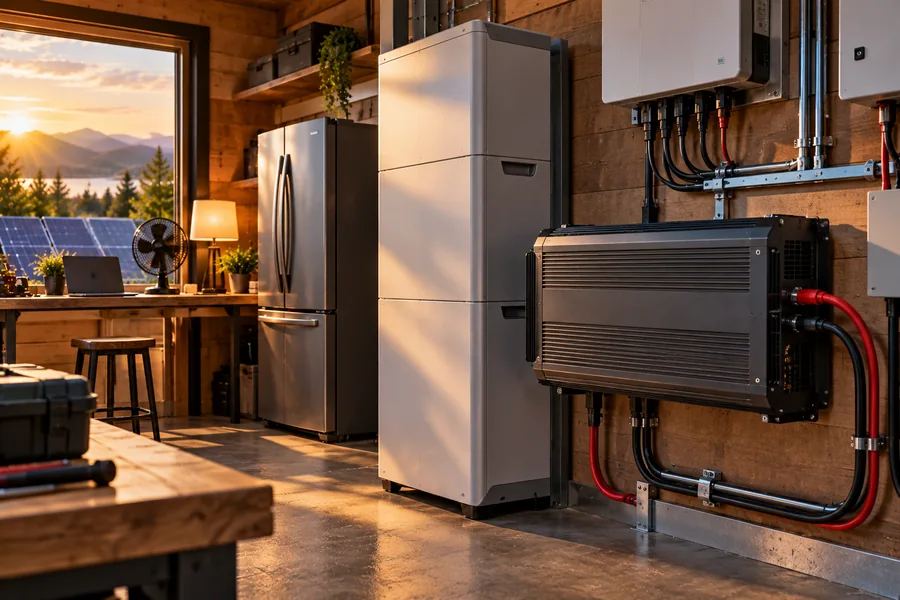
A complete off-grid system needs to generate, store, convert, distribute, and manage electricity without depending on a utility connection.
The cost of an off-grid solar system normally includes solar panels, battery storage, an off-grid or hybrid inverter, MPPT charge control, mounting hardware, electrical protection, wiring, monitoring, installation, and engineering. Depending on the required reliability, the system may also include a backup generator and additional solar or battery capacity for poor-weather periods.
A simplified architecture looks like this:
Solar Panels → Charge Control → Battery Storage → Inverter → Home Loads
A more resilient system might become:
Solar + Generator → Battery → Inverter → Home
The major cost categories are:
| Component | What You Are Paying For |
|---|---|
| Solar array | Electricity generation |
| Battery bank | Nighttime and low-solar energy |
| Inverter | DC-to-AC power conversion |
| MPPT/charge controller | Solar charging control |
| BMS | Battery monitoring and protection |
| Mounting | Roof or ground support |
| Electrical BOS | Cables, breakers, disconnects and protection |
| Monitoring/EMS | System control and energy monitoring |
| Labor | Mechanical and electrical installation |
| Engineering | System sizing and design |
| Generator | Optional extended backup |
This explains why:
Solar Panel Cost ≠ Off-Grid System Cost
The solar modules can represent only one part of the total investment.
How Much Does a Small Off-Grid Solar System Cost?
Small cabins, tiny homes, workshops, and low-consumption properties can require far less equipment than a conventional American home.
A small off-grid solar system can roughly cost $5,000–$20,000 depending on PV capacity, battery storage, inverter power, installation, and whether the system is professionally installed or partly DIY. These smaller systems work best when energy consumption is deliberately limited and large electrical heating, cooling, cooking, and EV loads are avoided.
Consider a small cabin using:
lights,
laptop,
router,
small refrigerator,
water pump,
and:
phone charging.
If consumption is only:
3–5kWh/day
the required battery and solar system can remain relatively modest.
For example, a conceptual design might include:
3kW solar
*
5–10kWh battery
*
3–5kW inverter
This is very different from a full-size home consuming:
25–40kWh/day.
The important principle is:
Lower Consumption → Smaller Solar Array → Smaller Battery → Lower Cost
Reducing energy demand before sizing an off-grid system can therefore produce substantial savings.
How Much Does an Off-Grid Solar System Cost for a House?
A conventional home requires much more energy than a cabin, particularly when it uses electric heating, cooling, cooking, water heating, or EV charging.
A professionally designed off-grid system for a full-size U.S. home can cost well above $50,000, and a system intended to maintain normal household consumption through poor solar conditions can exceed $100,000. Current 2026 analysis estimates that an average-sized fully off-grid home may require $115,000 or more in solar-plus-storage equipment.
Why is the number so high?
The answer is:
battery storage.
A grid-connected solar home can operate like this at night:
Grid → Home
A fully off-grid home cannot.
Instead:
Battery → Home
Now imagine several cloudy days.
The system needs:
Battery Reserve
or:
Generator Backup
or:
a combination of both.
Current 2026 analysis of full off-grid homes illustrates how quickly the cost can grow. EnergySage estimates example full off-grid configurations at approximately $115,945 in Arizona and $157,949 in Massachusetts, reflecting the substantial storage needed to maintain independence from the grid.
These figures should not be treated as universal quotes, but they demonstrate an important point:
True grid independence can cost much more than ordinary solar-plus-storage.
How Much Do Solar Panels Cost for an Off-Grid System?
Solar-array cost depends on system capacity, equipment, mounting, labor, and location.
As a current U.S. reference point, a professionally installed 10kW grid-connected solar system costs about $25,800 before incentives in 2026. Off-grid solar-array costs can differ because the PV system may need to be oversized for winter conditions and battery recovery rather than designed primarily around annual electricity consumption.
That 10kW benchmark works out to approximately:
$25,800 ÷ 10,000W = $2.58/W
But I would not simply apply:
$2.58/W × Off-Grid Array Size
and call that the project price.
Off-grid design may involve:
ground mounting,
long cable runs,
remote-site access,
additional protection,
specialized inverter equipment,
and:
different labor requirements.
Most importantly, an off-grid array often needs additional capacity.
Why?
Because solar must do two jobs:
Power Current Loads
and:
Recharge the Battery
after nighttime or poor-weather discharge.
How Much Do Batteries Cost for an Off-Grid Solar System?
Battery storage is frequently one of the largest expenses in a true off-grid installation.
Residential battery costs vary by capacity, equipment, and installation. Current September 2026 California marketplace data average about $1,074/kWh installed, with approximately $10,737 for 10kWh, $13,958 for 13kWh, $21,474 for 20kWh, and $27,916 for 26kWh before applicable incentives.
These figures illustrate how storage capacity changes the project budget:
| Battery Capacity | Current California Installed-Cost Reference |
|---|---|
| 10kWh | ~$10,737 |
| 13kWh | ~$13,958 |
| 20kWh | ~$21,474 |
| 26kWh | ~$27,916 |
These are marketplace storage costs, not universal off-grid quotations.
A fully off-grid property may need considerably more than:
10–20kWh.
Current 2026 analysis of complete off-grid homes estimates much larger storage requirements in example scenarios, which is why battery costs can drive complete systems into six figures.
NREL's residential storage cost modeling also demonstrates an important principle: the battery pack itself is only one part of installed storage cost. Inverters, balance-of-system equipment, supply chain, labor, engineering, permitting, sales, overhead, and other expenses contribute to the complete installed system.
So:
Battery Cell Cost ≠ Installed Battery Cost
How Much Battery Storage Do You Need to Go Off-Grid?
Battery size should be determined from energy consumption and required autonomy, not simply solar-array wattage.
An off-grid battery bank should be sized according to daily electricity consumption, desired days of autonomy, usable battery capacity, conversion losses, seasonal solar conditions, and generator availability. A low-consumption home may use 10–20kWh, while a conventional fully off-grid house may require 40–100kWh or substantially more to maintain multi-day resilience.
Suppose the home consumes:
20kWh/day.
For one day:
20 × 1 = 20kWh
For two days:
20 × 2 = 40kWh
For three days:
20 × 3 = 60kWh
Now suppose the home consumes:
30kWh/day.
Three days require:
30 × 3 = 90kWh
of usable energy before considering design margins and other system constraints.
This explains why off-grid costs can increase rapidly.
Moving from:
13kWh backup battery
to:
60–100kWh off-grid battery bank
is not a small upgrade.
It changes the entire economics of the system.
What Is the Difference Between Backup Storage and Off-Grid Storage?
A backup battery does not necessarily have enough capacity to operate a home independently for several days.
Backup storage is normally designed to maintain selected loads during temporary grid outages, while off-grid storage must repeatedly balance household consumption with variable solar generation without relying on utility electricity. A fully off-grid battery bank therefore often requires substantially more energy capacity, solar recharge capability, and reserve than a typical home backup battery.
Consider:
13.5kWh battery
and:
30kWh/day home consumption.
Ignoring losses:
13.5 ÷ 30 = 0.45 day
of average household energy.
That is only about:
10.8 hours
at the average daily consumption rate.
Of course, during an outage the homeowner could reduce consumption.
But this illustrates why:
one home battery ≠ full energy independence.
A grid-independent system needs to survive the mismatch between:
Solar Generation
and:
Household Consumption
over time.
How Much Does an Off-Grid Inverter Cost?
The inverter is critical because it determines how much AC power can be delivered at one time.
Off-grid inverter costs can range from several thousand dollars upward depending on power rating, voltage, integrated MPPT charging, split-phase output, generator support, parallel operation, monitoring, and system architecture. Large homes may require multiple inverter units or higher-power equipment to support simultaneous household loads.
Suppose the home operates:
Air conditioning = 4kW
Cooking = 3kW
Water pump = 1kW
Other loads = 2kW
Simultaneous demand:
4 + 3 + 1 + 2 = 10kW
A:
5kW inverter
cannot simply deliver 10kW continuously because the battery contains enough energy.
This demonstrates the difference between:
kW = Power
and:
kWh = Energy
The battery may contain:
40kWh
but the inverter still determines how quickly that energy can be delivered.
Off-grid systems need sufficient:
kW + kWh
not one or the other.
How Much Does a 5kW Off-Grid Solar System Cost?
A 5kW system can work for efficient homes, cabins, and smaller properties, but its price depends strongly on storage.
A professionally installed 5kW off-grid solar system might broadly fall around $20,000–$45,000 or more when paired with residential battery storage. The lower end assumes modest storage and simpler requirements, while larger battery banks, difficult site work, generators, or greater autonomy can push the system beyond this range.
A conceptual budget might look like:
| Configuration | Broad Planning Range |
|---|---|
| 5kW + small battery | $20,000–$25,000+ |
| 5kW + ~10kWh storage | $22,000–$30,000+ |
| 5kW + ~20kWh storage | $30,000–$40,000+ |
| 5kW + ~30kWh storage | $35,000–$45,000+ |
These are planning ranges rather than installer quotations.
The same:
5kW solar array
can therefore belong to systems with dramatically different prices.
The deciding factor is often:
Battery kWh
rather than:
Solar kW.
How Much Does a 10kW Off-Grid Solar System Cost?
A 10kW array can produce substantial electricity, but full off-grid capability still depends on battery storage and local solar resources.
A 10kW off-grid system can cost roughly $40,000–$80,000+ when paired with meaningful battery storage, while systems engineered for high household consumption and multi-day autonomy can exceed $100,000. For comparison, the solar-only portion of a standard professionally installed 10kW U.S. system averages about $25,800 before incentives in 2026.
Imagine:
10kW solar = $25,800 reference solar cost
plus:
26kWh storage = approximately $27,916 using current California marketplace storage data.
That already produces:
$25,800 + $27,916 = $53,716
before considering whether the two independently quoted averages overlap in equipment/labor, or whether the off-grid project requires:
additional battery storage,
specialized inverter architecture,
generator,
site work,
or:
other equipment.
So $53,716 is not a universal 10kW off-grid quote.
It simply demonstrates how quickly solar plus substantial battery storage can become a major investment.
Does an Off-Grid Solar System Need a Generator?
Not every system requires one, but a generator can reduce the need to oversize batteries for rare periods of poor solar production.
A backup generator can improve off-grid resilience by supplying electricity during extended cloudy weather, unusually high demand, or low battery SOC. Including a generator can sometimes be more economical than installing enough batteries and solar panels to handle every rare worst-case weather event, although it introduces fuel, maintenance, noise, and emissions.
Consider a home consuming:
20kWh/day.
Five days of stored energy would require:
20 × 5 = 100kWh usable storage
before additional design margins.
That is a large battery bank.
An alternative architecture is:
Solar + Battery + Generator
The solar system handles normal conditions.
The battery handles:
nighttime
and:
short low-production periods.
The generator handles:
exceptional conditions.
This can reduce the amount of expensive battery capacity installed purely for rare events.
However, someone seeking complete fossil-fuel independence may prefer:
larger solar + larger storage.
The correct answer depends on project priorities.
How Does Daily Electricity Consumption Affect Off-Grid Cost?
Energy consumption may be the single most important variable in the entire project.
Higher electricity consumption increases the required solar generation, battery storage, inverter capacity, and potentially backup generation, so reducing loads can dramatically reduce off-grid system cost. Energy efficiency is therefore often one of the most economical first steps before designing a fully independent solar system.
Compare two homes.
Home A
Daily consumption:
10kWh
Three-day energy requirement:
10 × 3 = 30kWh
Home B
Daily consumption:
30kWh
Three-day energy requirement:
30 × 3 = 90kWh
Home B requires:
three times the energy
for the same autonomy period.
It may also need:
more solar,
more battery capacity,
larger inverter power,
and:
larger electrical infrastructure.
This creates a powerful relationship:
Reduce Load → Reduce Battery → Reduce Solar → Reduce Cost
Before buying more batteries, it can sometimes be more economical to improve:
insulation,
lighting,
appliance efficiency,
HVAC efficiency,
and:
load scheduling.
How Do You Size an Off-Grid Solar System?
Correct sizing starts with consumption rather than choosing a solar-system size from a product catalog.
To size an off-grid solar system, calculate daily electricity consumption, peak simultaneous load, required autonomy, local solar resource, seasonal variation, system losses, battery operating limits, and backup-generation strategy. These inputs determine the required solar-array kW, battery kWh, and inverter kW.
Start with:
Daily Energy = Sum of Appliance Watts × Hours Used
Suppose:
Daily consumption = 15kWh
Desired autonomy = 2 days
Required usable battery energy:
15 × 2 = 30kWh
Now assume:
Peak sun = 5 hours/day
Planning efficiency factor = 80%
The theoretical array required to replace average daily consumption is:
15 ÷ (5 × 0.8)
= 3.75kW
But installing exactly:
3.75kW
would usually leave little room for:
battery recovery,
seasonal variation,
poor weather,
or:
unexpected consumption.
An off-grid designer may therefore select a larger array.
That additional PV capacity can help recharge the battery more quickly when good sunlight returns.
Is LiFePO4 Worth the Cost for Off-Grid Solar?
Off-grid batteries may cycle frequently, making lifetime characteristics particularly important.
LiFePO4, or LFP, is widely used in modern stationary storage because it combines useful cycle characteristics, cost, and thermal behavior. For frequently cycled off-grid systems, these characteristics can be attractive, although battery quality, BMS design, temperature management, warranty, inverter compatibility, and complete system engineering remain important.
LFP is a type of:
lithium-ion battery.
It should not be described as the opposite of lithium-ion.
NREL's residential battery-storage modeling includes lithium-ion systems and notes LFP as the primary stationary storage chemistry in its modeling from 2021 onward.
Off-grid use can involve:
charging during the day,
discharging at night,
and:
repeating this process frequently.
That makes cycling behavior important.
However, I would never choose a battery based on chemistry alone.
I would compare:
Usable kWh
Continuous kW
Cycle/Warranty Terms
Operating Temperature
BMS
Inverter Compatibility
Expansion
and:
Installed Cost
as one complete system.
Why Does Location Change Off-Grid Solar Cost?
The same house can require different solar and battery capacities in different climates.
Location affects off-grid solar cost through solar irradiation, seasonal variation, temperature, snow, shading, local labor, permitting, equipment prices, and installation conditions. Areas with strong and consistent solar resources may require less generation and storage capacity than locations with large seasonal swings or prolonged cloudy periods.
Current 2026 modeling illustrates the effect clearly.
EnergySage's example off-grid analysis estimates an average off-grid home at roughly:
10.8kW solar and 32kWh/day consumption in Massachusetts
versus:
13.6kW solar and 57kWh/day consumption in Arizona
under its assumptions.
The corresponding modeled total off-grid solar-plus-storage costs exceed:
$157,000 in Massachusetts
and:
$115,000 in Arizona.
These figures are scenario estimates, not universal state prices.
But they show why the question:
“How much does off-grid solar cost?”
cannot be separated from:
“Where is the property?”
Is Off-Grid Solar More Expensive Than Grid-Tied Solar?
For a typical full-size home, complete grid independence generally requires substantially more equipment.
Off-grid solar is usually more expensive than grid-tied solar because the property must replace services normally provided by the electricity grid. That means installing enough solar generation, battery storage, power electronics, and potentially backup generation to maintain electricity during nights, poor weather, and seasonal changes.
A grid-tied home can use:
Solar → Home
and then:
Grid → Home
when solar is insufficient.
An off-grid home needs:
Solar → Battery → Home
and potentially:
Generator → Home/Battery
during extended shortages.
Current 2026 analysis estimates that full off-grid solar-plus-storage can cost more than double or triple typical grid-connected solar-plus-storage configurations in some modeled scenarios.
This explains why grid independence is often economically attractive primarily where:
grid connection is unavailable,
utility extension is extremely expensive,
reliability is poor,
or:
energy independence has unusually high value to the owner.
What Is the Complete Off-Grid Solar Cost Breakdown?
There is no universal price, but a planning framework can show where the money goes.
Off-grid solar costs can range from several thousand dollars for a small cabin to well above $100,000 for a conventional home designed for full energy independence. Solar panels, batteries, inverters, electrical balance-of-system equipment, installation, site work, and backup generation all contribute, with battery storage usually creating one of the largest cost differences.
| Off-Grid System | Broad Planning Cost |
|---|---|
| Small cabin/basic system | $5,000–$15,000+ |
| Small home system | $15,000–$30,000+ |
| 5kW with moderate storage | $20,000–$45,000+ |
| 10kW with substantial storage | $40,000–$80,000+ |
| Large home/high autonomy | $70,000–$120,000+ |
| Full-size home/very high independence | $100,000–$150,000+ |
| Complex high-consumption system | $150,000+ |
These are broad planning ranges, not price quotes.
Current 2026 market evidence provides useful reference points: a standard 10kW solar installation averages about $25,800 before incentives, while California residential battery installations average approximately $1,074/kWh in current marketplace data.
For complete grid independence, however, current analysis shows that a typical full-size off-grid home can exceed $115,000, primarily because large storage capacity and backup capability are required.
My Insights: How Much Does an Off-Grid Solar System Cost
Off-grid pricing is best understood as the cost of replacing the grid, not simply the cost of buying solar panels.
An off-grid solar system can cost roughly $5,000–$20,000 for a small low-energy property, $20,000–$80,000+ for more substantial solar-and-storage installations, and $100,000+ for a conventional home designed for true grid independence. The final cost depends primarily on consumption, battery autonomy, solar resource, equipment, installation, and backup strategy.
My First Insight: Energy Consumption Determines Cost Before Equipment Does
The cheapest way to reduce an off-grid system price can sometimes be:
use less electricity.
If daily demand falls from:
30kWh
to:
15kWh,
the property may require substantially less:
solar,
battery storage,
and:
inverter capacity.
Efficiency therefore becomes part of system economics.
My Second Insight: Battery Capacity Is the Biggest Pricing Trap
Someone may see:
10kW solar = around $25,800
and assume an off-grid system will cost somewhere near that amount.
But the home may also require:
40–100+kWh of storage.
That can completely change the project budget.
Solar kW alone does not define off-grid cost.
My Third Insight: Grid Independence and Backup Power Are Different Products
A battery designed to keep:
refrigerator,
router,
lights,
and:
selected outlets
running through an outage is not necessarily designed to operate an entire home indefinitely.
Backup asks:
“How long can I survive an outage?”
Off-grid asks:
“Can generation and storage continuously balance my consumption without a utility?”
The second problem is much harder.
My Fourth Insight: A Generator Can Reduce Battery Oversizing
Designing enough batteries for:
every possible cloudy day
can become extremely expensive.
A hybrid design:
Solar + Battery + Generator
can use the generator only during unusual conditions.
That can reduce the amount of battery capacity required solely for rare weather events.
My Fifth Insight: How Much Does an Off-Grid Solar System Cost?
This directly answers the H1.
| Scenario | Approximate Cost | Main Cost Driver |
|---|---|---|
| Small cabin | $5,000–$15,000+ | Small PV and battery |
| Small efficient home | $15,000–$30,000+ | Moderate storage |
| 5kW off-grid system | $20,000–$45,000+ | Battery capacity |
| 10kW off-grid system | $40,000–$80,000+ | Larger PV + storage |
| Large home | $70,000–$120,000+ | High daily consumption |
| Full grid independence | $100,000–$150,000+ | Multi-day battery reserve |
| High-consumption/custom system | $150,000+ | Large storage and power requirements |
The most useful cost equation is therefore:
Total Off-Grid Cost = Solar + Battery + Inverter + BOS + Installation + Site Work + Backup
But the system itself should be sized using:
Daily Consumption + Peak Power + Autonomy + Solar Resource + System Losses
That difference is important.
A buyer should not start with:
“I want a 10kW system.”
I would start with:
“I consume 20kWh per day.”
Then determine:
How many days of autonomy are required?
Then:
How much solar is available in the worst important season?
Then:
What peak loads must operate simultaneously?
Those answers determine:
Solar kW
Battery kWh
Inverter kW
and ultimately:
Total Cost
Current 2026 data make the scale of the difference clear. A normal 10kW U.S. solar installation averages around $25,800 before incentives, while a true full-size off-grid home can exceed $115,000 once the storage and equipment required to replace the grid are included.
That is why the most accurate answer to “How much does an off-grid solar system cost?” is not one fixed number.
It is a range determined primarily by:
how much electricity the property consumes
and:
how long it needs to operate without sunshine or grid support.
Conclusion
An off-grid solar system can cost from several thousand dollars to over $100,000, with energy consumption, battery storage, autonomy, and installation driving the final price.
](https://voltcrave-battery.com/wp-content/uploads/2026/10/Do-I-Really-Need-a-Pure-Sine-Wave-Inverter-768x512.webp)
](https://voltcrave-battery.com/wp-content/uploads/2026/08/What-Makes-a-High-Voltage-LiFePO4-Battery-Structurally-Superior-768x512.webp)
](https://voltcrave-battery.com/wp-content/uploads/2026/09/What-Types-of-Electrical-Control-Cabinets-Are-Available-768x512.webp)







































