

](https://voltcrave-battery.com/wp-content/uploads/2026/09/Why-Are-LiFePO4-Batteries-Becoming-the-Standard-for-Energy-Storage.webp)
Energy storage needs batteries that can cycle frequently, control costs, and manage safety risks. Many older battery choices struggle to balance all three requirements.
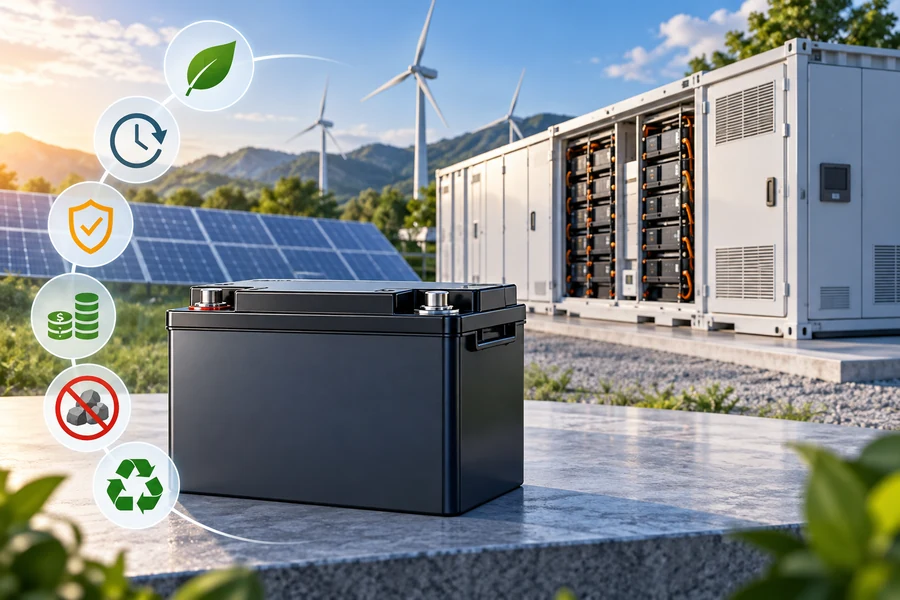
LiFePO4 batteries are becoming the standard for energy storage because they combine lower cost, long cycle life, strong thermal stability, frequent-cycling capability, and freedom from nickel and cobalt. Their lower energy density matters less in stationary systems, where safety, lifetime, cost per kWh, and dependable daily cycling usually matter more than minimum weight or size.
This shift is already visible at global scale. The IEA reports that lithium iron phosphate, or LFP, represented around 90% of battery-storage deployments in 2025, compared with well below half only five years earlier. I see this as more than a chemistry trend. It reflects a change in what the energy-storage market actually values.
Why Is LiFePO4 So Popular for Energy Storage?
Stationary storage has different priorities from electric vehicles, smartphones, and other applications where every kilogram matters.
LiFePO4 is popular for energy storage because stationary batteries need affordable capacity, frequent cycling, long service life, and strong safety characteristics more than maximum energy density. LFP fits those priorities well. The IEA reports that LFP now represents around 90% of battery-storage deployment worldwide and is typically cheaper and better suited to frequent cycling than competing lithium-ion chemistries.
Stationary Storage Changes the Battery Design Priority
An EV designer cares greatly about how much energy can fit into a limited vehicle weight and volume.
A stationary ESS has more freedom.
A battery cabinet standing beside a commercial building does not need to travel 500 kilometers while carrying its own weight. A utility-scale container does not need to fit underneath passenger seats.
That makes lower energy density much less damaging.
Instead, stationary storage buyers usually care more about several practical measures:
| Storage Requirement | Why It Matters for ESS | LFP Position |
|---|---|---|
| Cost per kWh | Affects total project investment | Strong |
| Frequent cycling | Important for daily energy shifting | Strong |
| Thermal stability | Important for system safety | Strong |
| Long operating life | Reduces replacement pressure | Strong |
| Energy density | Determines size and weight | Lower than NMC |
| Material profile | Influences cost and supply chain | No nickel or cobalt in cathode |
| Power capability | Supports charge/discharge operation | Suitable for many ESS applications |
The IEA explains that LFP is a lower-cost lithium-ion chemistry with lower energy density than nickel-rich alternatives, but this disadvantage is less important for stationary storage. It also notes that LFP does not use nickel or cobalt and offers lower flammability and longer lifetime characteristics than some competing lithium-ion chemistries.
This is why I would not judge a stationary battery using the same priorities I would use for an EV.
For stationary storage, a physically larger battery can still be the better engineering and economic choice if it provides safer operation, lower material cost, and better repeated cycling.
That change in priorities is one of the biggest reasons LFP has moved from an alternative chemistry toward the mainstream choice for residential, commercial, industrial, and utility-scale energy storage.
Are LiFePO4 Batteries Safer for Energy Storage?
Battery safety is one reason LFP has become attractive, but saying “LFP cannot catch fire” would be inaccurate.
LiFePO4 has stronger thermal stability than many nickel-rich lithium-ion chemistries, which is valuable in stationary energy storage. However, LFP is still a lithium-ion battery and can experience thermal runaway, fire, gas generation, or other failures. Safe ESS design still requires a BMS, thermal management, electrical protection, enclosure engineering, monitoring, and system-level fire testing.
Thermal Stability Is an Advantage, Not Immunity
The U.S. Department of Energy identifies lower cost, better cycle life, and increased thermal stability as major reasons recent grid-scale projects have adopted LFP. At the same time, DOE explicitly warns that LFP is not a “silver bullet”: thermal runaway can still occur, and gas generation can create serious hazards.
That distinction matters.
A chemistry can have a safer failure profile without being inherently safe under every possible condition.
A complete LFP energy storage system still needs protection against problems such as excessive voltage, excessive current, abnormal temperature, internal faults, external short circuits, poor installation, and failures that spread from one cell or module to another.
This is where system engineering becomes critical.
A typical safety architecture includes the battery cells, module-level monitoring, BMS, contactors, fuses or breakers, thermal management, gas detection where appropriate, fire controls, enclosure design, emergency shutdown functions, and an installation layout based on applicable codes.
Current U.S. safety requirements also demonstrate why chemistry alone is not enough. UL describes UL 9540 as the foundational product safety standard for energy storage systems, while UL 9540A evaluates thermal-runaway and fire-propagation behavior. The 2026 edition of NFPA 855 places stronger emphasis on large-scale fire testing, and UL reports that the sixth edition of UL 9540A was published on March 13, 2026.
So when I compare LFP with another chemistry, I treat thermal stability as one layer of safety.
I do not use it as a substitute for:
cell quality + BMS + thermal control + system testing + correct installation.
That is a much more realistic way to understand why LFP has gained a strong safety reputation in energy storage.
Why Does LiFePO4 Cycle Life Matter for Solar and BESS?
Energy-storage batteries may charge and discharge every day, so battery life is strongly connected to how well the chemistry tolerates repeated cycling.
LiFePO4 is well suited to solar and BESS applications because it can support frequent charge-discharge cycling while offering strong cycle-life potential. This matters for solar self-consumption, peak shaving, time-of-use shifting, and grid services, where a battery may cycle hundreds of times per year. Longer useful cycling can lower replacement pressure and improve lifetime economics.
ESS Batteries Work for a Living
Consider a residential solar battery.
During the day:
Solar → Battery
During the evening:
Battery → Home
If this happens almost every day, the battery can experience roughly 365 operating cycles per year, although real cycles may be partial rather than full.
Commercial batteries can work even harder.
A C&I system may charge when electricity is inexpensive and discharge when demand or electricity prices rise.
A utility battery may perform energy shifting while also responding to grid signals.
The IEA says LFP is particularly well suited to more frequent cycling, which is one of the reasons it has become dominant in battery storage.
However, I would not quote one universal number such as:
“Every LFP battery lasts 6,000 cycles.”
That statement would be too broad.
Actual cycle life depends on the individual cell and system design. It also depends on depth of discharge, average state of charge, temperature, C-rate, charging strategy, cell balance, and end-of-life definition.
A manufacturer might define end of life at 80% remaining capacity, while another warranty could use a different measurement.
That means I prefer to evaluate:
| Lifetime Factor | What I Check |
|---|---|
| Cycle warranty | Number of supported cycles under stated conditions |
| Energy throughput | Total warranted MWh or kWh |
| Remaining capacity | Capacity expected at warranty endpoint |
| DoD limits | Permitted usable SOC window |
| Temperature limits | Conditions under which warranty applies |
| Power limits | Continuous and peak charge/discharge rates |
| Calendar warranty | Years of coverage regardless of cycling |
DOE's storage cost assessment also recognizes cycle life and calendar life as important variables in evaluating lithium-ion storage economics. The agency uses levelized cost of storage to capture not just upfront cost, but charging cost, augmentation, replacement, power equipment, operation, and other lifecycle factors.
This is why LFP's cycling ability matters so much.
The cheapest battery on purchase day is not necessarily the lowest-cost battery over years of daily service.
Why Are LiFePO4 Batteries Becoming More Cost-Competitive?
Battery projects are highly sensitive to the cost of stored energy, especially when hundreds of kWh or multiple MWh are required.
LiFePO4 has become increasingly cost-competitive because its cathode avoids nickel and cobalt and relies on relatively lower-cost materials such as iron and phosphate. Large-scale manufacturing has also reduced battery prices. In 2025, the IEA found that average LFP battery packs were more than 40% cheaper per kWh than NMC alternatives.
Cost Advantage Multiplies at ESS Scale
A small difference in $/kWh may look unimportant in a small portable battery.
It becomes enormous at grid scale.
Suppose two hypothetical battery systems differ by:
$30/kWh.
For a:
10kWh residential battery,
the difference in battery-level cost would be:
$300.
For a:
1MWh commercial battery,
it becomes:
$30,000.
For a:
100MWh utility project,
the difference becomes:
$3 million.
These examples are simplified and do not represent installed project prices, but they show why battery chemistry cost matters so much as system size increases.
The IEA reports that record-low LFP prices were a major contributor to battery cost declines in 2025. Average LFP packs were more than 40% cheaper than NMC alternatives, although the agency also cautions that current price levels may not all be sustainable because some cathode manufacturers have been operating at losses.
That qualification is important.
I would not assume LFP prices will continue falling at the same rate forever.
Commodity prices, manufacturing utilization, trade policy, supply-chain concentration, and regional production costs can all change.
Still, LFP has a structural material advantage because its cathode does not depend on nickel or cobalt. The IEA highlights this difference directly.
For energy storage, this improves more than initial purchase economics.
If the battery also offers strong cycling performance, the system can spread its investment across a large amount of lifetime energy throughput.
That is why I prefer to compare:
installed cost + lifetime throughput + efficiency + degradation
instead of focusing only on the initial battery price.
LFP has become powerful in the market because it performs reasonably well across all of these categories rather than winning on only one specification.
What Are the Disadvantages of LiFePO4 for Energy Storage?
LFP has become dominant, but it still involves technical and commercial compromises.
The main disadvantages of LiFePO4 are lower gravimetric and volumetric energy density than nickel-rich lithium-ion batteries, weaker performance in some cold conditions, and continued lithium-ion fire and thermal-runaway risks. LFP also remains dependent on lithium supply, manufacturing capacity, BMS quality, thermal management, and system integration. It is dominant in short-duration storage, not automatically every storage duration.
Lower Energy Density Is Real
The IEA reports that LFP has lower energy density than NMC-type batteries. In current EV technology, the latest LFP cells can reach lower Wh/kg levels than leading nickel-based alternatives.
For a stationary battery, that often means:
a larger enclosure,
more racks,
or more physical space
for the same stored energy.
At a home with limited wall space, that can matter.
At a dense urban BESS site where land is expensive, it can matter even more.
For an EV, the penalty is larger because additional battery mass must move with the vehicle.
This is why LFP's lower energy density is much easier to accept in stationary storage than in long-range transportation.
Cold Conditions Need Proper Management
Cold weather can reduce available performance and charging capability in lithium-ion batteries.
LFP systems therefore need proper BMS logic and, in some climates, active battery heating or thermal management.
A battery that performs very well at 25°C should not automatically be assumed to perform identically below freezing.
LFP Does Not Eliminate Fire Engineering
This is another important limitation.
LFP's thermal stability does not remove the need for fire and gas evaluation.
DOE notes that LFP systems can still experience thermal runaway and can generate significant gases during failure.
UL's current ESS framework likewise evaluates thermal runaway, gas release, fire propagation, deflagration potential, separation, and fire-protection behavior at the system level.
LFP Is Not Automatically Best for Long-Duration Storage
Most lithium-ion ESS projects are still designed for short- to medium-duration applications.
Applications requiring ten, twenty-four, or one hundred hours of storage may benefit from completely different technologies.
DOE continues to evaluate flow batteries, sodium-based storage, thermal storage, pumped hydro, compressed air, and other alternatives because chemistry choice depends on duration, efficiency, cost, land, cycling, and application requirements.
So I describe LFP as the present standard for many lithium-ion stationary storage applications, not the universal answer to every energy-storage problem.
Where Are LiFePO4 Batteries Used in Energy Storage?
The same chemistry now appears from small household batteries to utility-scale installations.
LiFePO4 batteries are used in residential solar storage, commercial and industrial ESS, utility-scale BESS, telecom backup, microgrids, off-grid solar, EV charging support, and portable energy systems. Their combination of frequent-cycling capability, cost, safety characteristics, and modular scalability allows the chemistry to serve applications ranging from a few kWh to large multi-MWh projects.
Residential Solar Storage
A residential battery may store excess daytime PV production for evening use.
For example:
12 p.m. → solar surplus → LFP battery
7 p.m. → battery → household loads
The system can increase solar self-consumption and, when designed correctly, support backup power.
Commercial and Industrial ESS
A factory or commercial building may use LFP for peak shaving.
Suppose grid demand reaches:
600kW
but the business wants to cap it at:
500kW
for two hours.
The simplified battery requirement is:
100kW × 2h = 200kWh.
The actual design would need additional allowance for losses, reserve, degradation, power limits, and other services.
Utility-Scale BESS
At grid scale, the same operating principle becomes much larger.
Batteries can shift renewable electricity from periods of high generation to periods of high demand.
The IEA describes battery storage as one of the most versatile forms of short-term grid flexibility, supporting wind and solar integration, balancing, capacity provision, grid services, and rapidly growing loads such as EV charging and data centers.
The market scale demonstrates how important these applications have become.
The IEA reports that 108GW of new battery-storage capacity was deployed globally in 2025, 40% more than in 2024, and approximately 80% of new capacity was utility-scale. LFP accounted for around 90% of battery-storage deployments.
That combination of chemistry and application growth explains why LFP increasingly feels like a default specification rather than an alternative.
My Insights: Why Are LiFePO4 Batteries Becoming the Standard for Energy Storage
The rise of LFP is not based on one breakthrough specification. It comes from matching the economic and engineering priorities of stationary storage unusually well.
LiFePO4 batteries are becoming the standard for energy storage because stationary systems prioritize affordable kWh, repeated cycling, thermal stability, long service life, scalable production, and dependable daily operation more than maximum energy density. LFP performs strongly across those priorities, which helps explain why it now represents around 90% of global battery-storage deployments.
My First Insight: Stationary Storage Rewards Balance, Not Maximum Energy Density
This is the fundamental market advantage of LFP.
NMC may provide higher energy density.
But stationary ESS rarely wins or loses because a battery rack weighs a little more.
It wins or loses because of:
cost,
lifetime,
safety,
availability,
and usable energy.
The chemistry that offers the best overall balance can therefore outperform one that wins only on Wh/kg.
The market has increasingly reached that conclusion.
My Second Insight: Frequent Cycling Changes the Economics
An ESS is not designed to sit unused.
A solar battery may cycle daily.
A commercial battery may respond to peak demand.
A utility BESS may shift renewable electricity and provide grid services.
That means lifetime energy throughput matters.
A chemistry that can economically repeat the charge-discharge process over many years has a structural advantage.
This is why I see cycle life not simply as a technical specification but as an economic one.
My Third Insight: LFP Makes Safety Easier, but Not Easy
LFP's thermal stability is a meaningful advantage.
But the industry should avoid turning that advantage into overconfidence.
A large battery installation still contains substantial stored energy.
The correct safety question is not:
“Is the chemistry safe?”
It is:
“How does the complete system manage a cell failure if one occurs?”
That is why BMS design, thermal control, electrical protection, gas behavior, fire testing, spacing, and emergency planning remain important even as LFP becomes dominant. Current UL 9540A and NFPA 855 requirements reinforce this system-level approach.
My Fourth Insight: Falling Cost Has Turned a Technical Advantage Into a Market Standard
LFP has had useful technical properties for years.
What changed is scale.
Large manufacturing volumes and falling battery prices made those properties economically accessible to far more projects.
The IEA reports that LFP battery prices declined by more than 15% in 2025 and were more than 40% below NMC alternatives on average.
Once an established chemistry becomes:
cheaper,
widely manufactured,
frequently cycled,
and suitable for large-scale stationary projects,
standardization can happen quickly.
That is what the storage market is experiencing.
My Fifth Insight: Why Are LiFePO4 Batteries Becoming the Standard for Energy Storage?
This directly answers the H1.
| Why LFP Is Becoming Standard | Importance for Energy Storage |
|---|---|
| Lower battery cost | Makes large kWh and MWh projects more economical |
| Strong cycle-life potential | Supports frequent daily charging and discharging |
| Thermal stability | Improves the starting point for ESS safety engineering |
| No nickel or cobalt in cathode | Reduces dependence on those higher-cost materials |
| Frequent-cycling suitability | Fits solar shifting, peak shaving, and grid services |
| Scalable manufacturing | Supports residential through utility-scale projects |
| Mature lithium-ion ecosystem | Benefits from established BMS, PCS, and ESS integration |
| Acceptable energy density for stationary use | Lower Wh/kg matters less when the battery does not move |
| Broad application range | Fits residential, C&I, microgrid, and utility BESS |
| Strong market momentum | Around 90% of 2025 battery-storage deployments used LFP |
The core reason is therefore not simply:
“LFP lasts longer.”
It is also not:
“LFP is completely safe.”
And it is not:
“LFP has the highest energy density.”
The better answer is:
LiFePO4 has reached a combination of cost, cycle capability, thermal stability, material availability, manufacturing scale, and adequate energy density that closely matches what stationary energy storage needs.
That combination matters more than winning every individual specification.
A stationary battery does not have to be the lightest battery.
It needs to store energy economically.
It needs to charge and discharge repeatedly.
It needs to operate within a controlled thermal window.
It needs to integrate with a BMS and PCS.
It needs to meet project safety requirements.
And it needs to remain useful long enough to justify the investment.
LFP performs well across this entire group of requirements.
The market numbers now reflect that fit. LFP's share of battery-storage deployment rose from well below 50% five years ago to around 90% in 2025. At the same time, global battery-storage additions reached 108GW, making battery storage the fastest-growing power technology in the IEA's 2026 assessment.
That does not mean LFP will own every future storage application.
Long-duration systems may use flow batteries, sodium-ion, compressed air, thermal storage, pumped hydro, or technologies that have not yet reached commercial scale.
Very space-constrained applications may prioritize higher energy density.
Extreme climates may change the chemistry decision.
New sodium-ion and LMFP technologies may also take part of the market as they mature.
But for today's mainstream lithium-ion stationary storage, LFP has become difficult to displace because it matches the application so well.
I therefore see the emergence of LFP as a standard not as the result of one superior number, but as the result of system-level balance.
That is usually what creates a durable industry standard.
Conclusion
LiFePO4 is becoming the energy-storage standard because its cost, cycling, thermal stability, mature supply chain, and practical energy density closely match stationary ESS requirements.
](https://voltcrave-battery.com/wp-content/uploads/2026/09/How-Long-Will-a-Power-Station-Power-a-Fridge-768x512.webp)
](https://voltcrave-battery.com/wp-content/uploads/2026/09/How-to-Choose-a-Complete-Solar-Energy-System-for-Home-and-Business-768x512.webp)