
](https://voltcrave-battery.com/wp-content/uploads/2026/10/Can-a-Portable-Power-Station-Run-a-House.webp)
Power outages can interrupt refrigeration, lighting, internet access, and essential household appliances. Choosing an undersized portable power station can leave a home without enough electricity during emergencies.
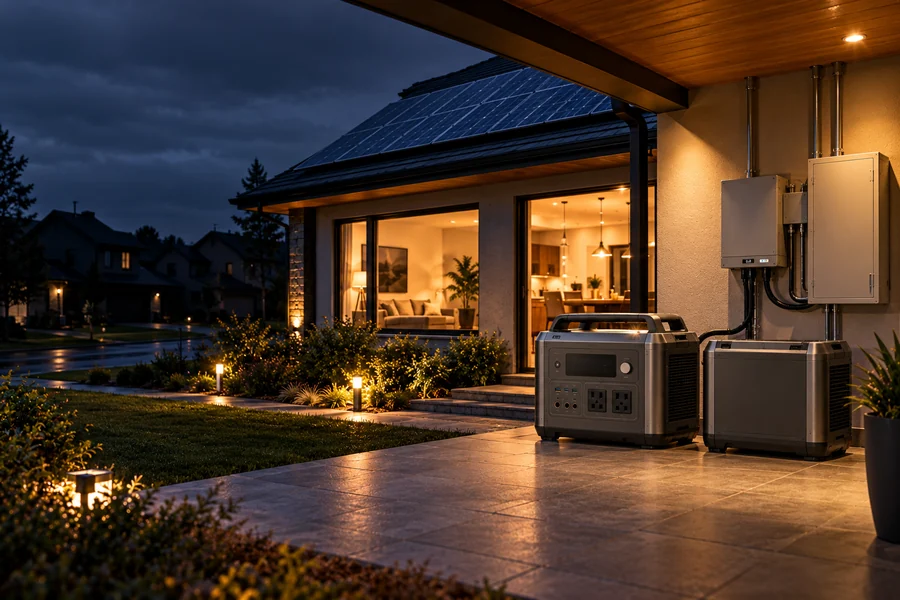
Yes, a portable power station can power essential household appliances, but most smaller models cannot operate an entire house. A 1–2 kWh station can support selected devices, while larger expandable systems may supply multiple household circuits. Whole-home backup requires sufficient battery capacity, inverter output, and approved electrical connection equipment.
I believe portable power stations can provide practical emergency electricity, but their actual capabilities depend on how much power a household consumes and how long the outage lasts.
Can a Portable Power Station Power an Entire House or Only Essential Appliances?
Portable power stations are increasingly used for emergency electricity. However, many homeowners confuse powering a few essential appliances with maintaining normal electricity throughout the entire house.
A portable power station can power selected household appliances when its inverter supports their electrical requirements. Larger expandable systems can supply multiple home circuits through approved transfer equipment. However, unrestricted whole-house operation requires enough stored energy and continuous output to support simultaneous loads, including any high-power appliances.
What Household Appliances Can a Portable Power Station Run?
I consider portable power stations most practical for essential household loads.
These may include:
- Refrigerators and freezers
- Wi-Fi routers and communication equipment
- LED lighting
- Laptops and desktop computers
- Televisions
- Fans and ventilation equipment
- Selected kitchen appliances
- Compatible medical and monitoring equipment
However, I would not assume that all these appliances can operate simultaneously.
The power station must have sufficient continuous AC output and battery capacity.
For example, a 2,000W inverter can support many small appliances, but it cannot continuously supply a combined electrical load exceeding its rated output.
Can a Power Station Run a Refrigerator?
Many portable power stations can operate compatible household refrigerators.
However, refrigerator electricity consumption varies by size, efficiency, room temperature, and compressor operation.
A refrigerator may draw 100–200W while running, but its average electricity use over 24 hours can be considerably lower because the compressor cycles.
I recommend checking the refrigerator's actual daily energy consumption.
For example, suppose a refrigerator consumes 1.2 kWh per day.
A power station delivering 2.4 kWh of usable AC energy could theoretically support approximately two days of refrigerator operation if no other appliances consume electricity.
However, I would also verify the refrigerator's starting surge requirement.
Can a Power Station Run Air Conditioning?
Some larger portable power stations can operate selected air conditioners.
However, air conditioning often consumes substantially more electricity than basic household electronics.
For example, a unit drawing an average of 1,500W consumes:
1,500W × 3 hours = 4,500Wh
This equals 4.5 kWh of electrical energy.
A single 4 kWh portable power station would normally not supply this load for three hours without recharging.
Large air conditioning systems may also require 240V electricity and substantial startup power.
I recommend checking both voltage compatibility and inverter surge capability.
What Is the Difference Between Essential-Load and Whole-House Backup?
Essential-load backup supplies selected appliances and circuits during an outage.
Whole-house backup connects to a broader household electrical system and may support many or all household circuits.
However, whole-house connectivity does not automatically mean every appliance can operate simultaneously.
| Home Backup Type | Typical Equipment | Main Limitation |
|---|---|---|
| Essential electronics | Phones, routers, laptops | Limited stored energy |
| Critical-load backup | Refrigerator, lighting, selected outlets | Battery capacity |
| Multi-circuit backup | Several household circuits | Inverter and storage requirements |
| Whole-house backup | Larger household electrical system | Peak demand and outage duration |
I believe essential-load backup is sufficient for many households experiencing occasional short outages.
A larger whole-home system becomes more useful when maintaining heating, cooling, water pumping, or other major services is necessary.
Are There Portable Power Stations Designed for Whole-Home Backup?
Yes.
Some manufacturers provide large expandable systems designed for home backup integration.
For example, EcoFlow DELTA Pro 3 offers 4,096Wh of battery storage and 4,000W of continuous AC output.
It supports 120V/240V output and compatible expansion configurations.
Anker SOLIX F3800 Plus provides 3,840Wh of capacity and 6,000W of continuous AC output.
Both manufacturers offer approved home connection options.
I consider these products useful examples of how portable battery technology can support more extensive residential backup.
However, a single battery unit still has limited stored energy.
Whole-house backup for longer outages may require several batteries and suitable electrical installation equipment.
How Much Battery Capacity and Inverter Power Does a House Need?
A portable power station may have enough output power to operate appliances but insufficient energy to run them for long. Understanding battery capacity and inverter ratings helps prevent costly purchasing mistakes.
Home backup sizing requires two calculations: electrical power in kilowatts and stored energy in kilowatt-hours. Power determines which appliances can run simultaneously, while energy determines runtime. A 5 kWh system may support selected essential loads, but broader whole-house backup often requires 15–30 kWh or more, depending on actual consumption.
Understand the Difference Between kW and kWh
I always distinguish between electrical power and energy storage.
Kilowatts (kW) measure electrical power.
Kilowatt-hours (kWh) measure stored or consumed electrical energy.
For example, an appliance consuming 1,000W operates at a power demand of 1kW.
If it runs for three hours:
1kW × 3 hours = 3kWh
A battery must contain enough usable energy to support this consumption.
However, the inverter must also provide at least the required continuous output.
A 5 kWh battery with a 500W inverter cannot continuously operate a 1,000W appliance.
How Much Electricity Do Essential Household Appliances Consume?
I begin by identifying the equipment that must remain operational during an outage.
Consider the following illustrative daily energy requirements.
| Appliance | Daily Energy Consumption |
|---|---|
| Refrigerator | 1.20 kWh |
| Wi-Fi router | 0.24 kWh |
| LED lighting | 0.27 kWh |
| Laptop | 0.24 kWh |
| Fan | 0.36 kWh |
| Total | 2.31 kWh |
These are illustrative values rather than universal appliance ratings.
Actual consumption depends on appliance efficiency, operating duration, and environmental conditions.
In this example, the home needs approximately 2.31 kWh per day for selected essential devices.
This is much less than the electricity required for unrestricted household operation.
How to Calculate Required Battery Capacity
I use the following simplified formula:
Required Nominal Capacity (kWh) = Required AC Energy (kWh) ÷ Usable AC Energy Fraction
Suppose the home requires 2.31 kWh of AC electricity.
Assume that 85% of the battery's nominal capacity becomes usable AC energy.
The required capacity is:
2.31 kWh ÷ 0.85 = 2.72 kWh
I would therefore evaluate a power station with approximately 3 kWh or more of nominal storage for this example.
However, I would also allow additional capacity for unexpected electricity demand and operating reserves.
What Size Power Station Is Recommended?
| Nominal Capacity | Recommended Starting Application |
|---|---|
| 500Wh–1kWh | Routers, phones, laptops, and lights |
| 1–2kWh | Small appliances and shorter outages |
| 2–5kWh | Refrigerator and essential household loads |
| 5–10kWh | Longer critical-load backup |
| 10–20kWh | Multiple circuits and extended essential-load operation |
| 20–40kWh+ | Broader whole-home backup |
These ranges are general guidelines.
I would not use them as substitutes for a detailed electrical load calculation.
For homes using electric heating, large air conditioners, or EV charging, capacity requirements may be substantially higher.
How Much Inverter Output Power Do You Need?
I also calculate the maximum simultaneous electrical load.
For example, suppose the home operates:
- Refrigerator: 150W while running
- Wi-Fi router: 10W
- Television: 100W
- Lighting: 60W
- Fan: 80W
The total running load is:
150W + 10W + 100W + 60W + 80W = 400W
However, refrigerator and fan motors may require additional starting power.
I recommend checking the actual appliance specifications and selecting an inverter with sufficient surge capability.
I would not assume that an inverter rated for 500W is automatically adequate for this example.
Does Higher Inverter Power Mean Longer Runtime?
No.
I consider this one of the most common misunderstandings.
A 4 kWh battery with a 6,000W inverter can provide high instantaneous output.
However, it does not automatically operate longer than a 4 kWh battery with a 4,000W inverter.
Runtime mainly depends on usable stored energy and actual load consumption.
I therefore compare battery capacity and inverter output as separate specifications.
How Long Can a Portable Power Station Keep a Home Running?
Battery backup duration is one of the biggest concerns for homeowners. A power station can keep essential equipment operating for hours, but larger household loads may consume stored electricity much faster.
A portable power station's runtime depends on usable battery capacity and average household demand. For example, a 4 kWh power station delivering 85% of nominal capacity could operate a constant 500W load for approximately 6.8 hours. At a 1,500W load, the same battery would last approximately 2.3 hours without recharging.
How to Calculate Portable Power Station Runtime
I use the formula:
Runtime (hours) = Available AC Energy (kWh) ÷ Average Load (kW)
Consider a power station with 4 kWh of nominal battery storage.
Assume 85% is available as AC electricity.
Available energy:
4 kWh × 0.85 = 3.4 kWh
For a constant 500W load:
3.4 kWh ÷ 0.5kW = 6.8 hours
For a constant 1,500W load:
3.4 kWh ÷ 1.5kW = 2.27 hours
These estimates assume no additional charging.
Actual runtime depends on battery condition, inverter efficiency, temperature, idle consumption, and operating reserves.
Estimated Home Backup Runtime
The following table assumes 85% of nominal battery capacity becomes usable AC energy.
| Battery Capacity | 500W Load | 1,500W Load |
|---|---|---|
| 1 kWh | 1.7 hours | 0.6 hours |
| 2 kWh | 3.4 hours | 1.1 hours |
| 4 kWh | 6.8 hours | 2.3 hours |
| 10 kWh | 17 hours | 5.7 hours |
| 20 kWh | 34 hours | 11.3 hours |
| 30 kWh | 51 hours | 17 hours |
These figures are simplified estimates and should not be interpreted as guaranteed performance for a specific product.
Household electricity demand also changes throughout the day.
Can a 4 kWh Power Station Run a House for 24 Hours?
It depends on how much electricity the home consumes.
Suppose a household only needs 3 kWh of usable AC electricity during one day.
A 4 kWh battery delivering 3.4 kWh could theoretically meet that demand.
However, a household consuming 20 kWh per day would require substantially more storage.
I would therefore avoid claiming that a 4 kWh station can power every home for a complete day.
The correct question is how much energy the household needs over the expected outage period.
Can Solar Panels Keep a House Running During a Blackout?
Solar panels can extend backup duration when they are compatible with the power station or installed backup system.
For example, a solar array delivering an average of 600W for four hours generates:
600W × 4 hours = 2.4 kWh
Actual energy stored in the battery will be lower after charging losses.
I consider solar charging valuable for multi-day outages.
However, solar production depends on sunlight, shading, weather, season, and equipment limits.
I would not assume that every portable power station can recharge enough electricity to support unrestricted household use.
Will Ordinary Rooftop Solar Panels Work During an Outage?
Not necessarily.
Many conventional grid-connected solar systems stop operating when the utility grid fails.
This protects utility workers and electrical infrastructure.
To provide power during a blackout, the installation needs suitable backup-capable inverter and electrical isolation equipment.
I recommend checking whether the existing solar installation supports islanded operation.
A portable power station with solar charging ports cannot automatically connect to any rooftop solar system.
What About a Generator for Multi-Day Outages?
I consider a generator worth evaluating when outages frequently last several days.
A battery provides electricity until its stored energy is depleted.
A generator produces electricity while its fuel supply remains available and the equipment operates correctly.
Some expandable portable power stations support compatible generator charging.
However, I would verify the exact manufacturer's approved charging arrangement.
Not every power station allows the same generator connections.
A hybrid battery-and-generator system can provide more flexibility, but it also increases system complexity and cost.
How Do You Safely Connect a Portable Power Station to a House?
Portable power stations are generally simple to use through their built-in outlets. However, connecting them to permanent household wiring introduces additional electrical requirements and potential hazards.
A portable power station can connect to household circuits only through suitable manufacturer-approved equipment and electrical installation methods. Options may include an approved transfer switch, power inlet, or compatible home backup panel. The system must isolate the home from the utility grid during an outage. Improvised electrical backfeeding is unsafe and should never be used.
Can You Plug a Portable Power Station Directly Into a Wall Outlet?
I would never recommend connecting a power station's AC output to an ordinary household wall outlet to energize the house.
This practice can cause dangerous electrical backfeeding.
It may energize utility lines or damage equipment if the power station and grid are not correctly isolated.
The power station's built-in AC outlets should be used according to the manufacturer's instructions.
For permanent household circuit connections, I recommend qualified electrical installation.
What Is a Transfer Switch?
A transfer switch allows electrical loads to receive power from a backup source while disconnecting them from the normal utility supply as required.
It helps prevent simultaneous unsafe connections between the utility grid and a backup power source.
Some portable power station manufacturers offer compatible manual transfer switches or smart home backup panels.
I consider these systems important for households that want to power selected circuits without running individual extension cords.
However, the transfer equipment must match the station's electrical specifications.
Do You Need 120V or 240V Output?
In North America, many ordinary outlets supply 120V electricity.
However, larger household appliances may require 240V.
Examples include certain water pumps, air conditioners, and electric cooking equipment.
A small power station with only 120V outlets may not support these appliances.
I would evaluate a power station with suitable 120V/240V split-phase capability when broader home backup is required.
However, voltage compatibility alone is insufficient.
The inverter must also provide enough continuous power and starting capability.
Is a Portable Power Station the Same as a Home Battery System?
No.
A conventional portable power station is designed primarily to supply electricity through its integrated outputs.
A stationary residential energy storage system is designed for approved installation and integration with building electrical equipment.
Some larger portable products are offered as part of manufacturer-approved home backup systems.
However, the complete installation must meet the applicable electrical and fire safety requirements.
I recommend verifying the certification and intended use of the exact combination of battery, inverter, and home connection equipment.
What Safety Certifications Matter?
In North America, the following standards may apply depending on the equipment.
| Standard | Main Application |
|---|---|
| UL 2743 | Portable power packs within its defined scope |
| UL 9540 | Complete installed energy storage systems |
| UL 1973 | Stationary and certain other battery applications |
| UL 1741 | Inverters and related distributed energy equipment |
| UL 9540A | Thermal runaway fire propagation testing |
| NFPA 855 | Energy storage installation requirements |
I distinguish between portable equipment certification and stationary energy storage certification.
A portable power station certified under UL 2743 is not automatically approved as a complete stationary residential ESS.
UL Solutions states that residential ESS installations require appropriate system-level certification under UL 9540.
I recommend following the applicable local electrical and fire codes.
What Should You Consider Before Buying?
I evaluate home backup power stations through several technical requirements.
| Selection Factor | What I Check |
|---|---|
| Battery capacity | Nominal and usable kWh |
| Inverter output | Continuous watts and starting surge |
| Output voltage | 120V/240V compatibility |
| Battery chemistry | LiFePO4 or other approved chemistry |
| Battery expansion | Compatible additional modules |
| Solar charging | Input voltage, current, and power limits |
| Backup transfer | Approved electrical isolation equipment |
| Certification | Correct product and system listing |
| Operating temperature | Charging and discharge limits |
| Warranty | Coverage, service, and replacement support |
I believe the best purchasing decision should be based on the entire backup system rather than the portable battery alone.
When Is a Dedicated Residential ESS Better?
I would consider a dedicated residential energy storage system when the household requires frequent backup, permanent circuit integration, substantial battery capacity, or daily solar energy management.
Portable power stations remain useful for temporary electricity and smaller backup applications.
A fixed residential ESS may provide greater flexibility for complex household installations.
However, the correct choice depends on local electrical requirements, installed cost, and the intended operating conditions.
My Insights: Can a Portable Power Station Run a House
Portable power stations are increasingly marketed for home backup. However, advertised wattage and battery capacity can create unrealistic expectations about their ability to support an entire household.
I believe a portable power station can provide valuable home backup when its battery capacity, inverter output, and electrical connections match the household's requirements. Smaller models are best for essential appliances. Larger expandable systems can support broader home loads, but long-duration whole-house operation requires careful sizing, safe installation, and reliable recharging.
I Prioritize Essential Appliances Before Whole-House Power
I do not believe every homeowner needs to operate every appliance during an outage.
Refrigeration, communication equipment, and lighting often represent the most important loads.
These appliances generally consume much less energy than electric heating, air conditioning, and large kitchen equipment.
I recommend identifying critical loads before choosing battery capacity.
For many households, a smaller system can provide meaningful emergency protection.
Battery Capacity Matters More Than Maximum Wattage for Runtime
I consider stored energy one of the most important factors in home backup.
A power station with 6,000W of inverter output can support substantial electrical loads.
However, if it contains only 3.84 kWh of stored energy, it cannot operate at 6,000W for several hours without recharging.
I therefore distinguish between how much power the station can deliver and how long it can deliver it.
Both specifications are essential.
Electrical Integration Determines Practical Home Backup Capability
I also believe safe household integration is an important difference between a camping power station and a home backup system.
A portable product may have enough battery capacity to support a refrigerator and lights.
However, supplying household circuits through a distribution panel requires approved connection equipment.
I would not consider improvised backfeeding a practical or safe alternative.
For multi-circuit backup, I recommend a professionally designed installation.
Solar Charging Can Improve Backup Resilience
I consider compatible solar charging especially valuable during extended outages.
Solar panels may replenish stored battery energy during daylight hours.
This can reduce dependence on the utility grid.
However, solar generation changes with weather.
A cloudy day may produce much less energy than expected.
I recommend estimating daily solar production before relying on it for multi-day backup.
Larger Batteries Are Not Always the Most Economical Choice
I believe whole-home backup can become expensive when large battery capacity is required.
A homeowner may need several expansion batteries to maintain normal electricity use over multiple days.
For homes with frequent long outages and high loads, I would also compare standby generators and compatible hybrid systems.
The most suitable option depends on expected outage duration, available energy sources, and total ownership costs.
My Recommended Selection Method
I evaluate a home backup project through five connected factors:
Essential Loads → Peak Power → Usable Battery Capacity → Backup Duration → Recharging Availability
I start with appliance consumption and expected outage duration.
I then calculate required battery capacity and inverter power.
Finally, I verify electrical connections, safety certification, charging options, and manufacturer support.
For small emergency loads, I generally recommend a 1–3 kWh portable station.
For longer essential-load backup, I would evaluate 3–10 kWh or compatible expandable systems.
For broader whole-house operation, I would consider a properly designed installation with greater storage capacity and approved home integration.
Ultimately, I believe a portable power station can run a house within its power and energy limits, but a reliable whole-home backup solution requires much more than simply purchasing a large battery.
Conclusion
Portable power stations can run essential home appliances, while larger expandable systems support broader backup. Select sufficient capacity, inverter power, approved connections, and reliable recharging.
](https://voltcrave-battery.com/wp-content/uploads/2026/08/Cost-of-Solar-Power-Battery-Storage-A-2026-Engineering-and-Economic-Deep-Dive-768x512.webp)
](https://voltcrave-battery.com/wp-content/uploads/2026/06/Top-5-Tesla-Powerwall-Alternatives-in-2026-The-Ultimate-Home-Battery-Guide-768x512.jpg)
](https://voltcrave-battery.com/wp-content/uploads/2026/09/What-Are-the-Downsides-of-Using-a-Car-Inverter-768x512.webp)







































